Cloud native commerce is an ecommerce software approach where companies use a modular and microservices-based architecture hosted entirely in the cloud, rather than a traditional all-in-one software approach. This changes how the company operates and grows, and offers several benefits, but you also need to prepare for certain challenges to get the best results.
This guide takes a closer look at cloud native commerce, and covers what it is, the benefits it provides ecommerce brands, and the potential challenges to prepare for to ensure both implementation and operation go according to plan.
What is Cloud Native Commerce?
Cloud native commerce is a software approach in the world of ecommerce where companies use software that was specifically designed to live in the cloud, as opposed to being migrated or adapted from older and more traditional legacy systems.
These are usually architectures built on modular microservices and/or APIs that operate like a network of independent components and capabilities that you can integrate, scale, change, and update separately from one another. This is the opposite of the traditional approach that often uses a single and rigid software package for all of your needs.
For example, instead of having to use the same piece of software for your checkout, inventory, and search features, a cloud native commerce approach lets you mix and match the best options on the market based on your needs and preferences. This also lets you provide a more unique and custom experience to your customers.
The Benefits of Cloud Native Commerce for Businesses
Taking a cloud native commerce software approach offers several distinct benefits over going with the traditional bundled model.
Provides Much More Flexibility Than Traditional Monolithic Commerce
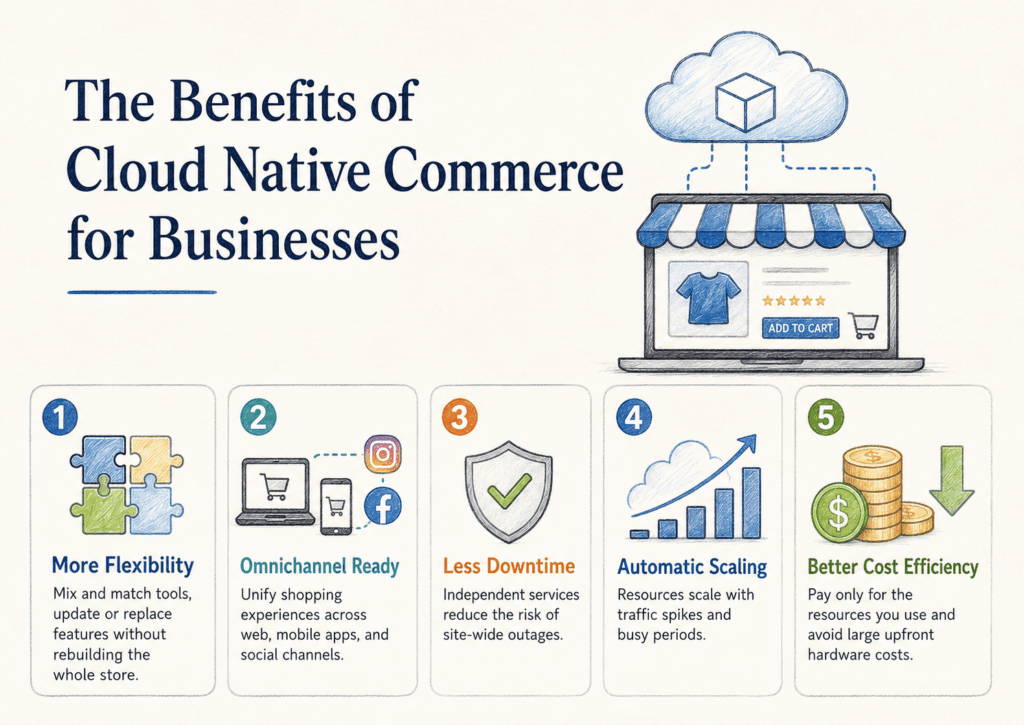
First, brands taking a cloud-native approach enjoy much more flexibility than traditional monolithic commerce. Instead of being forced to use all the components that come bundled in a traditional piece of software, you’re free to combine capabilities from different providers into one system where you’re able to change and update each one independent from the others.
You can also easily swap out individual features as you see fit without having to rebuild the entire store. All of this lets you build a custom tech stack that fits your exact needs, budget, and preferences, and ensures you can deliver a completely custom experience to your shoppers.
Prepares Your Company for Omnichannel Selling
The growth of omnichannel selling in retail is impossible to ignore, and cloud-native commerce can help your brand take advantage of this popular retail strategy. This approach prepares your company for omnichannel selling as it generally provides an adaptable API-driven architecture that unifies your shopping data and experiences across channels.
Being able to offer a seamless and high-quality user experience across devices is one of the biggest ecommerce success factors, so using an approach that lets you easily push unified data across browsers, social media, and mobile apps without rebuilding from scratch each time is a huge win.
Reduces Downtime
Downtime is horrible for ecommerce stores, as it can not only hurt your sales, but also ruin your reputation if it’s long or overly frequent. A cloud-native approach reduces site-wide downtime as each isolated service operates independently of the others.
If you use a centralized monolithic system, all it takes is a single error to potentially crash the entire site. But with a microservices-based approach, each component is separate, so an issue with your search function won’t negatively impact things like the checkout or shopping cart. While certain features being down still isn’t ideal, it’s better than a site-wide outage.
Automates Scaling
Scaling is also generally better when companies take a cloud-native commerce approach. The approach often uses elastic auto-scaling, which automatically adjusts and allocates resources based on real-time needs. This allows for frictionless traffic handling and ensures that even when spikes occur, your store can handle them without going down.
If a specific service or component on your site is under a heavy load, it can scale automatically without slowing down or impacting other parts of your store. This type of software also works with you as your needs change, making it more efficient and straightforward to scale your business.
For example, you’ll use (and pay for) more resources when your site needs them to handle traffic from sales events or viral marketing moments, but as things calm down during off-peak hours, it scales down, and you’ll use and pay for fewer resources.
Improves Cost Efficiency
Lastly, opting for a cloud native commerce approach also boosts your cost efficiency and can save you plenty of money. Because the approach is generally scalable, you’ll only pay for what you need and use, and not be stuck paying every month for resources you may only need periodically.
You also won’t need to pay for on-premises hardware, like servers, and the physical security measures brands often need in place to protect this hardware. This approach also lets companies align their tech spend with actual growth and revenue, rather than paying high upfront costs for servers or being stuck in the rigid guidelines of a traditional platform’s plans.
Potential Challenges to Prepare For
Of course, when implementing and using cloud-native commerce tools and platforms, you may run into some challenges. Here are a few of them, as well as how to ready your business for them.
Technical Complexity
First, the complexity of using this approach may be higher than with a traditional setup. Rather than having a single platform to use for everything, your store will feature a variety of different components from different companies or providers.
This means many more integration points, potential syncing issues, and needing to keep up with things like updates, new versions, vulnerabilities, patches, and more. Not only that, but this high technical complexity may lead to a learning curve for workers, which may be frustrating to some of your staff.
To prepare, make sure to involve your team in the process, train them well on the new software being used, and offer assistance and resources to help them familiarize themselves with your new way of doing things.
Beyond that, consider using some type of API-first middleware or an Integration Platform as a Service (IPaaS) that’s built to handle and manage dynamic microservices, to help lessen the complexity.
Higher Risk of Attacks
Because cloud native commerce often uses a decentralized architecture with multiple providers for different components, this means more potential vulnerabilities. If you use a single provider, you only need to worry about their security efforts and yours.
But if you use eight different providers for the various parts of your store, that’s a lot more potential places for bad actors to attack. This expanded attack surface increases your risk, and there are more places where data leaks could originate.
Also, with components constantly communicating and working with one another, a breach or leak in one service can expose your entire ecosystem if you’re not careful.
To deal with this issue, make sure to use tools that actively scan your environment to identify threats or misconfigurations, and ensure proper permissions are set to ensure only authorized people can view and interact with certain data and/or features.
Difficulties Pinpointing the Causes of an Issue
Lastly, because a cloud-native approach involves using components from different providers, it may be harder to pinpoint the causes of an issue within your store. With only one provider, there’s no question about where the issue stems from. But if you use tools from five, it becomes challenging to find the source of the problem you’re experiencing.
While you may think that a checkout problem is obviously due to an issue with your checkout provider, that’s not always the case. Failures or issues in one component can cause cascading problems in others, so finding where the problem originated may take plenty of time and work.
However, some ways to prepare for this challenge are to create strong observability practices, monitor everything, and add centralized logging. You can also use distributed tracing, which tracks a user’s request as it travels throughout your various services and components, and may help you identify which API or server is causing the problem.
Final Thoughts
Cloud-native commerce is a great approach for ecommerce brands to take, especially if your store struggles with scalability, agility, reliability, and handling sudden and unexpected traffic spikes. Breaking down traditional monolithic systems into agile microservices also lets you respond to trends faster, keep downtime in check, and deliver a more personalized experience.
As customer expectations and preferences continue to evolve, transitioning to a cloud-native commerce model ensures you’re ready for the shift and helps you stay flexible and competitive going forward.
FAQs
Here are some frequently asked questions about cloud native commerce, along with their answers.
What’s the difference between cloud-native and cloud-hosted?
Cloud-native apps and platforms are built from the start for the cloud, while cloud-hosted apps and platforms have been migrated from traditional environments to the cloud, without going through major changes to their architecture.
Which platforms and providers offer cloud native commerce?
There are several platforms and providers that are cloud-native, including commercetools, Adobe Commerce, BigCommerce, and VTEX, just to name a few.
Is cloud native commerce secure?
Yes, cloud native commerce is generally secure, but its security also depends on your organization. While the major cloud-native apps and platforms you use are likely highly secure and invest a ton of time and money to protect their infrastructure, it’s on you and your brand to do your part to secure app data, customer accounts, access control, and more.
How is cloud-native commerce different from traditional ecommerce?
While traditional ecommerce often relies on a monolithic design that bundles both the front and back ends together into a single deployable unit, cloud native commerce breaks your online store into several independently managed microservices and gives you the freedom to create custom tech stacks.