
Brunello Cucinelli, the Italian cashmere label whose founder describes his business philosophy as “humanistic capitalism” and closes the factory at 5:30pm so employees can have dinner with their families, replaced its website with an AI. Of course it did.
There is also a version of this story that is the most radical rethinking of what an ecommerce website is that any brand has attempted at scale, and that version is worth taking seriously.
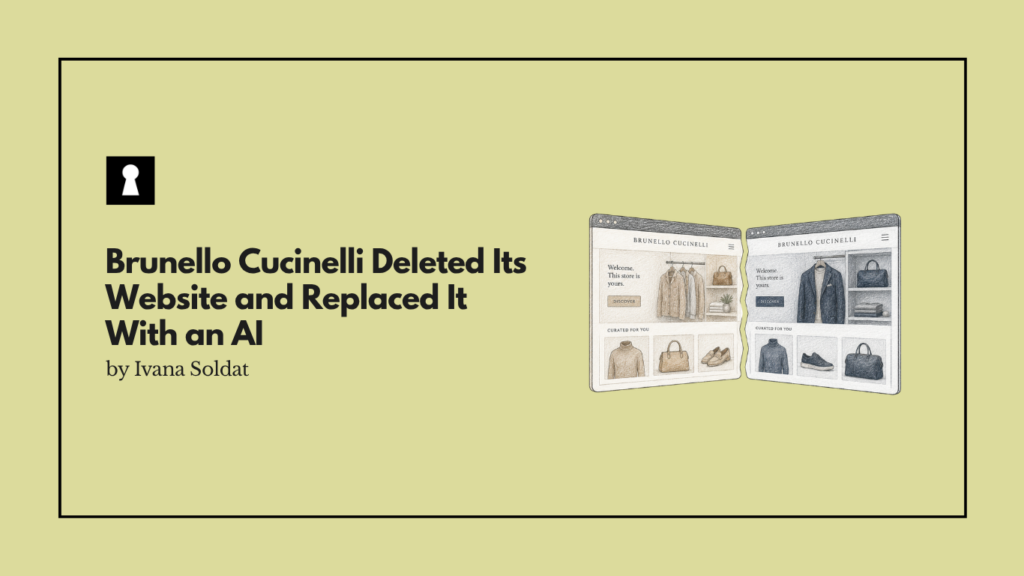
Brunello Cucinelli replaced its traditional ecommerce site on January 21 with a platform that builds a different shopping experience for each visitor rather than routing everyone through the same fixed pages and menus. The system, called Callimacus, was developed by Solomei AI, the Italian luxury brand’s in-house AI research centre. It interprets a shopper’s intent in real time to generate personalised content and pathways instead of relying on static navigation. The platform is now live in Italy, the US, and the UK, with additional markets planned.
What Callimacus Actually Does
Callimacus follows a shopper’s browsing behaviour and recognises intent without collecting personal data. Behind the interface, it works as a headless presentation layer, integrating with a retailer’s existing digital and ecommerce systems instead of replacing them. AI agents handle the real-time work of reading visitor intent and assembling a personalised experience in place of fixed pages and predefined navigation.
The “without collecting personal data” detail is the part that distinguishes Callimacus from standard personalisation systems. Most personalisation in ecommerce works by accumulating a profile on the user over time: purchase history, browsing behaviour, demographic inferences, retargeted advertising signals. The surveillance pricing ban we covered in New Jersey last month, and the broader regulatory environment around using personal data to present individualised prices or experiences, is exactly the kind of framework that makes profile-based personalisation increasingly legally complex.
Callimacus claims to bypass that entirely: it reads intent from behaviour within the current session, without building or accessing a persistent personal profile. Whether that claim holds up to GDPR Article 4 scrutiny in the EU, where “personal data” is defined broadly enough to capture session-level behavioural data under some interpretations, is a question that will eventually need a definitive answer. The approach is commercially attractive and genuinely novel.
The Salesforce Bet and the Italy Wrinkle
Salesforce announced in late July it would invest in Callimacus to support its deployment for new clients across Europe and North America. The investment means Callimacus is no longer just a Brunello Cucinelli project. It is a venture-backed platform seeking to prove that what works for an ultra-luxury cashmere brand can be productised and sold to mainstream retailers.
The Salesforce deal falls under Italy’s “golden power” regulation for technology assets considered strategically important, meaning it cannot close without authorisation from the Presidency of the Council of Ministers.
Italy invoking golden power on an AI ecommerce platform investment is a remarkable data point about where European governments currently place AI in their strategic technology frameworks. The same mechanism is used for foreign investment in defence, telecommunications, and critical infrastructure. Callimacus, the AI system behind a luxury clothing website, is in that company.
The Question the Mainstream Retail World Is Asking
“For a brand like Cucinelli, eCommerce is not just a sales channel,” said Justin Baer, founder and CEO of menswear brand Collars & Co. “Most mainstream brands optimise their sites purely for conversion, prioritising faster checkout and fewer steps, while luxury retailers use eCommerce differently.”
Brunello Cucinelli has approximately 14,000 SKUs. Its average selling price is in the hundreds to thousands of dollars. Its customer is making a considered, emotionally significant purchase and has enough luxury literacy to navigate an unconventional shopping experience. The ecommerce site is not primarily optimised for conversion rate in the Shopify sense. It is optimised for brand experience.
A brand like H&M, running millions of transactions with fast fashion SKUs and a customer who comparison-shops on price, has a different optimisation problem. The question is not whether Callimacus is technically impressive. It clearly is. The question is whether an ecommerce experience that prioritises personalised intent interpretation over conversion-optimised fixed flows generates more revenue for a mainstream retailer, or whether the friction of a non-standard experience outweighs the personalisation benefit.
Etsy has built buyer profiles covering more than 65 million shoppers to feed real-time personalisation into search results and marketing. Callimacus applies that same logic to the storefront itself rather than just the recommendations layered on top of it, which may be the harder problem for a mainstream retailer to solve.
The Surveillance Pricing Tension
The Callimacus story lands in the same month that New Jersey signed the Fair Price Protection Act, which bans using personal data to show different prices to different consumers based on predicted willingness to pay.
A system that generates a “different store for every visitor” raises obvious questions about whether different visitors are being shown different prices, different availability signals, or different framing of the same product based on what the AI has inferred about their intent and likely purchase threshold. Callimacus’s claim of no personal data collection addresses one regulatory concern.
Whether intent-inferred, session-level personalisation that adjusts the commercial presentation of a product constitutes the kind of manipulation that regulators are moving against is a question the industry has not yet had to answer in court.
Our Take
“Artificial Intelligence Must Remain Profoundly Human.” Brunello Cucinelli Said That About His Website.
The Callimacus story is interesting at three levels. At the technical level, it is the most complete implementation of the agentic storefront concept that any brand has shipped: a website that is not a website but a real-time experience generator.
At the commercial level, it is a luxury brand experiment that Salesforce has decided is worth scaling, which means it will either prove that personalised AI storefronts drive measurable commercial outcomes or produce a well-funded failure case that answers the question definitively.
At the regulatory level, it sits in genuinely ambiguous territory: the no-personal-data claim is commercially attractive and possibly technically accurate, but the regulatory frameworks that govern what constitutes personal data processing in the EU are broad enough that the ambiguity will eventually require resolution.