France’s Economy Minister Serge Papin said it plainly on Friday:
“From September 1, ultra-fast fashion will pay the true price for the damage it causes, to the environment, to our businesses, and to our regions. France is the first country in the world to introduce such a scheme.”
The mechanism is not a flat tax. It is a modulated surcharge on top of the existing eco-contribution that every fashion brand selling in France already pays to Refashion, the industry body responsible for managing textile end-of-life.
The new framework specifically covers textile manufacturers and “operators of online interfaces.” Ultra-fast fashion is legally defined by two cumulative criteria: placing on the market a large number of new product lines, coupled with little incentive to repair. Clothing, footwear and household linen are covered. Second-hand sales are explicitly excluded.
The surcharge amount depends on three factors: the breadth of the product range, the frequency of new offers, and the efforts made to encourage repair. A brand that releases hundreds of new SKUs per week with no repair programme is at the top of the penalty range.
The Penalty Range That Matters for Ecommerce Planning
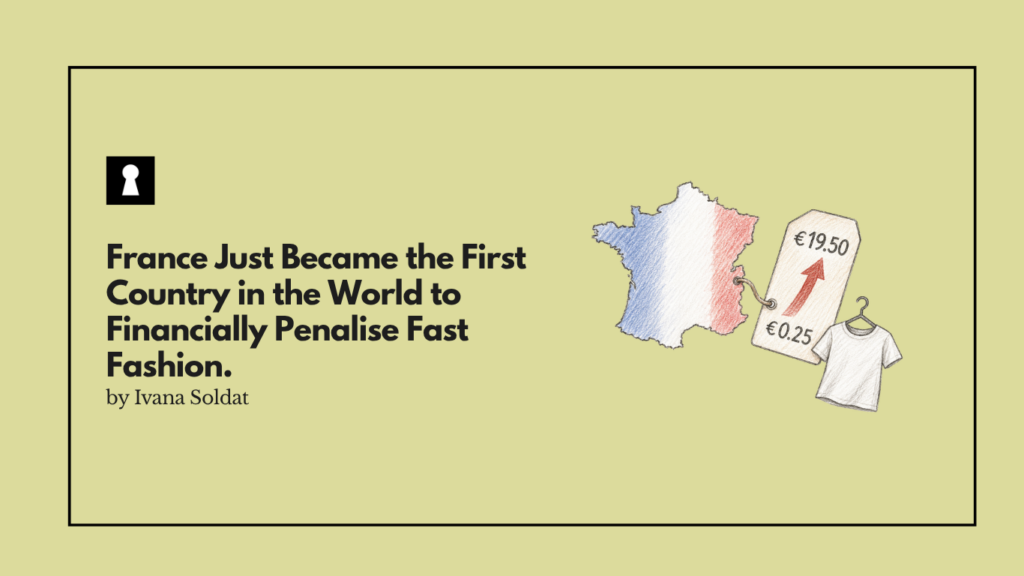
From September 1, the financial penalty ranges from €0.25 to €12 per item, before rising to between €2.20 and €19.50 per item in 2030.
At the low end, €0.25 per item is a rounding error on any garment priced above a few euros. At the high end, €12 per item in 2026 rising to €19.50 by 2030 is potentially catastrophic for a business model built on selling €5 dresses and €8 tops.
Shein’s average selling price across its catalogue is estimated at approximately €10 to €15 for most fashion categories. A €12 per-item penalty at the maximum end represents 80% to 120% of the item’s selling price. Even at the mid-range, a €5 to €6 surcharge on a €10 garment represents a 50% to 60% cost increase that cannot be absorbed and cannot plausibly be passed to a consumer who chose the platform specifically for extreme low prices.
Lawmakers have capped the levy so that it will not ultimately exceed 50% of the pre-tax sale price. For ultra-low-price items, a maximum penalty capped at 50% of the pre-tax price still means a surcharge that fundamentally changes the unit economics.
The Tax Donation Abolition That Is Less Noticed
One provision in the September 1 framework that has received less attention than the penalty: the outright abolition of the tax relief granted to companies donating their unsold stock to charities.
This is the end of a mechanism that many fast fashion brands have used to manage excess inventory: donate unsold items to charities, claim the tax deduction. From September 1, that tax relief is gone in France. Brands that built overproduction into their model on the assumption that the tax deduction would offset the cost of unsold inventory need to revise that model immediately.
The Disclosure Requirements That Apply to Online Platforms
Platforms will be required to detail the social and environmental impact of products, as well as their delivery. Manufacturing locations must be indicated clearly, using a font size that must be the same as that of the displayed price.
The font size requirement is the most operationally specific rule. A platform that displays “€8” in large prominent text and “Made in China” in small grey text is not compliant. The manufacturing origin must be presented with the same visual prominence as the price.
The French Customs Number That Puts This in Context
The September 1 penalty arrives alongside a data point from French customs that EcomWatch has not previously reported. Since the EU parcel duty’s introduction on July 1, imports of small non-European parcels have fallen by between 30% and 40% in the European Union, the French Ministry of the Economy announced on Thursday, citing French customs data.
That is a sharper figure than the 20% decline we reported from the Chinese industry data last week. The discrepancy likely reflects methodology, French customs measuring imports into France specifically, versus Chinese industry data measuring outbound volumes to all EU markets, but the order of magnitude is consistent: the July 1 duty has produced a rapid and significant reduction in Chinese parcel volumes entering the EU.
Combined with the September 1 fast fashion penalty, France has now deployed two distinct regulatory tools against ultra-fast fashion in the space of two months. The parcel duty hits the logistics economics. The fast fashion penalty hits the product economics. A brand like Shein that ships directly from China to French consumers faces both: higher import costs per shipment and higher per-item surcharges on every unit sold.
The 2030 Trajectory That Matters More Than the 2026 Number
The September 1 penalty range of €0.25 to €12 is the starting point, not the destination. The trajectory to 2030, €2.20 to €19.50, is the number that should be driving business model decisions now.
A brand that decides to absorb the 2026 penalty and continue its current operating model is making a bet that the French market revenue justifies the cost at 2026 rates. That bet is harder to sustain as the penalties escalate toward 2030 levels. The brands that adapt now, by slowing product cycles, investing in repair programmes, or restructuring how they present French market offerings, are making decisions against the 2030 trajectory rather than the current one.
Our Take
France Did Something No Other Country Has. Tomorrow It Starts.
The French anti-fast-fashion penalty is genuinely novel in global ecommerce regulation. Every other major regulatory intervention in the fast fashion space has been disclosure-based, process-based, or indirectly financial through import duties.
France has created a direct per-item financial penalty specifically calibrated to the ultra-fast fashion operating model, designed to escalate over time, and structured to ensure that the least sustainable operators pay the most. For Shein and any brand operating at the ultra-fast end of the fashion spectrum, tomorrow is the beginning of a multi-year cost escalation in their largest European market.
The 30% to 40% parcel duty impact on EU imports since July 1 suggests the regulatory tools are working. The September 1 penalty is the next instrument in the same orchestra.