
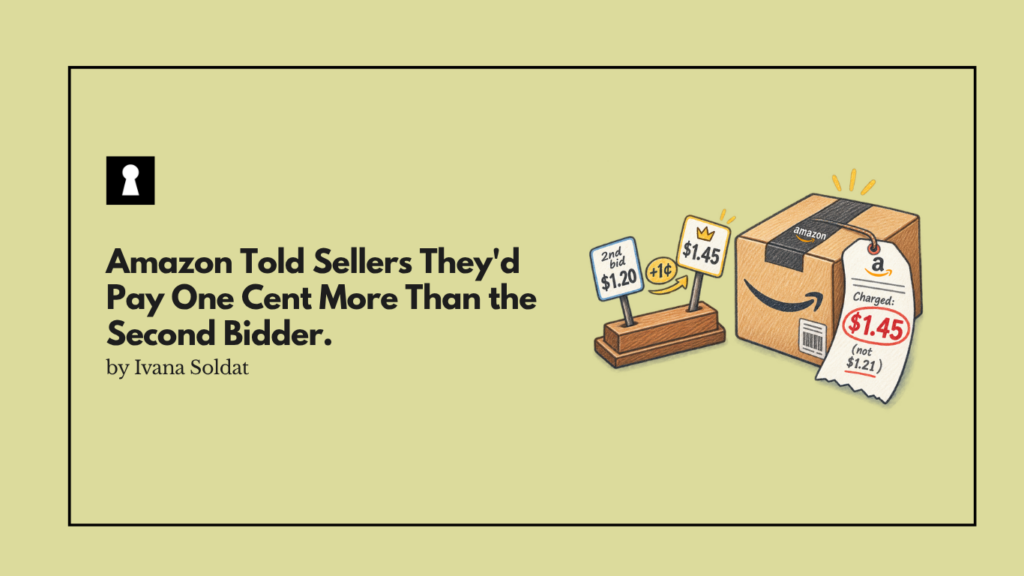
The standard pitch for Amazon’s advertising auction system is a second-price auction: you bid whatever you think the click is worth, and if you win, you pay one cent more than the second-place bidder.
Amazon informed businesses that they would pay only “one cent more” than the second-place bidder for an advertising keyword. But the lawsuit alleges that the retailer charged the winners their own price about 80% of the time.
If that allegation is accurate, Amazon’s auction was not functioning as a second-price auction in any meaningful sense. It was functioning as a first-price auction while being presented to advertisers as a second-price auction. The difference matters commercially: in a genuine second-price auction, the rational strategy is to bid your true value.
In a first-price auction, you shade your bid below your true value to preserve margin. An advertiser who bid their true value believing they were in a second-price auction would systematically overpay if the auction was actually clearing at first-price.
The Mechanism the FTC Is Alleging
The FTC alleges that starting in 2019, Amazon made a “surreptitious” change without telling advertisers. It added a hidden surcharge that Amazon internally called a “soft reserve price,” and used what one internal document called an “invented auction participant”, a fake bidder, to push prices higher than true competition would have produced.
The complaint quotes from an Amazon employee who stated that Amazon’s surcharges enable it to obtain prices “beyond what can be achieved through advertiser competition.” Notes from a 2024 discussion between senior executives, including the head of Amazon Ads and Amazon’s Chief Digital Economist, acknowledged that Amazon’s “clever non-transparent way to charge first price” has been an “incredibly effective way to drive revenue.”
The phrase “clever non-transparent way” in a document authored by Amazon’s senior advertising and economics leadership is the kind of quote that will appear in every subsequent legal filing, every settlement negotiation, and every congressional hearing on this topic.
Internal Amazon documents suggest the retailer was aware that advertisers were bidding based on their belief they were in a true second-price auction, but that employees allegedly discussed raising prices while “hoping that advertisers don’t notice and decrease bids or ad spend.”
The Prime Day and Black Friday Dimension
The complaint alleges that Amazon’s unlawful scheme has generated tens of billions of dollars of revenue by substantially increasing prices on ordinary shopping days and applying far greater increases on high-volume shopping days like Prime Day and Black Friday.
This is the dimension that makes the alleged scheme most damaging to the specific brands and sellers who needed it most. The ecommerce sellers who increase their advertising spend most aggressively on Prime Day and Black Friday are the ones trying to capture holiday season volume at peak demand.
If the complaint’s allegations are accurate, those are precisely the days when the hidden surcharge was applied most aggressively, extracting the maximum amount from advertisers at the moment of their highest commercial need and highest advertising investment.
Amazon’s Defence
Amazon says in its statement: “The case centers on generalized second price auction dynamics, which the complaint itself concedes have been ‘the industry standard for decades.’ In no scenario does an advertiser pay more than their bid.” Amazon further claims: “After reviewing approximately 1.5 million pages spanning six years, the FTC leans on a handful of simplified communications to allege a companywide effort to deceive. That is patently false.”
The “no advertiser pays more than their bid” defence is technically true but legally irrelevant to the complaint’s core allegation. Nobody is claiming Amazon charged more than winning bids. The allegation is that Amazon secretly altered the auction mechanism so that prices were higher than genuine competition would have produced, not higher than bids, but higher than they would have been in a transparent second-price auction without the hidden surcharge and invented participant.
What This Means for Every Amazon Advertiser
The undisclosed surcharges have impacted more than 50,000 small- and medium-sized businesses which took part in auctions for ad placements on Amazon’s site and mobile app. The coalition of states seeks a permanent injunction to prevent further violations, plus civil penalties, restitution, and disgorgement, language that encompasses money going back to the advertisers who overpaid.
Every brand and seller who has run Sponsored Products, Sponsored Brands, or Display advertising on Amazon since 2019 is potentially an affected party in this complaint. Whether restitution actually materialises, and how it would be calculated and distributed, is a question for litigation that is likely to run for years.
Our Take
The Advertising Ecosystem That Every Ecommerce Brand Depends On Just Got a Lawsuit Against It
The FTC’s Amazon advertising lawsuit is the most significant action against Amazon’s ecommerce business since the Section 2 monopolisation complaint, and it is more specific in its alleged harm. The Section 2 case is about structural market power.
This case is about a specific, allegedly deceptive mechanism, a hidden surcharge and an invented auction participant, that may have systematically extracted tens of billions of dollars from more than a million advertisers over seven years.
The internal documents quoted in the complaint are the critical piece: executives discussing their “clever non-transparent way to charge first price” and hoping advertisers “don’t notice” are not descriptions of good-faith auction management.
Every ecommerce brand that has ever run Amazon advertising should be watching this case closely, because the restitution the states are seeking, if it ultimately materialises, would represent a meaningful return of money that the complaint alleges should never have been taken.