
On July 1, 2026, the EU abolished the €150 duty-free threshold on small parcels and introduced a €3 per-category fee targeting Temu, Shein, and AliExpress. Chinese parcel volumes into the EU dropped 20% in the first six weeks.
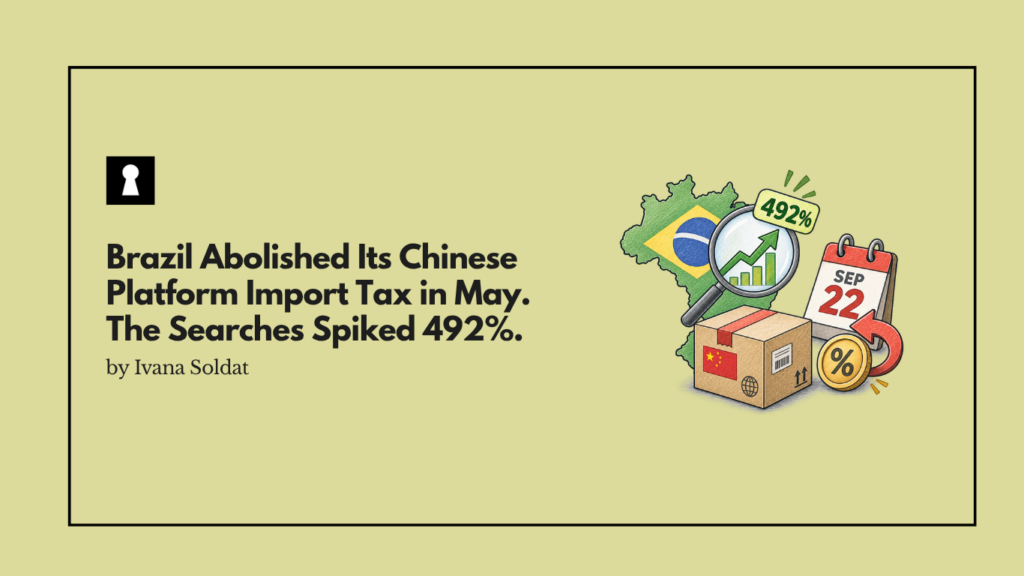
On May 13, 2026, Brazil did the opposite. President Lula signed Medida Provisória 1.357/2026, zeroing the 20% federal import tax on purchases under US$50. Shein, Shopee, and AliExpress immediately removed the tax from their Brazilian checkout flows. Search interest spiked 492%.
What the Taxa das Blusinhas Actually Was
“Blusinhas” means “little blouses” in Portuguese, and the nickname captures exactly who was driving the political debate. Brazilian consumers, particularly women in lower and middle income brackets, had embraced Shein and Shopee as sources of affordable clothing materially cheaper than anything available in Brazilian retail. The 2024 tax was the domestic retail lobby’s response.
The 20% federal import tax had been in force since August 2024 and generated approximately R$5 billion in revenue in 2025. Between January and April 2026 alone, the federal revenue authority collected R$1.78 billion, 25% growth year-on-year, suggesting cross-border purchase volumes were still increasing despite the tax.
The tax was popular with domestic manufacturers and unpopular with consumers. The reversal was popular with consumers and economically problematic for the government: Brazil’s fiscal accounts were already indicating a deficit approaching R$60 billion, and the R$5 billion annual tax revenue was being abandoned at a moment of fiscal stress.
The Remessa Conforme Framework
The May 2026 reversal did not eliminate all taxation on Chinese platform purchases. It zeroed only the federal import duty for purchases within the Remessa Conforme programme, the compliance framework Brazil established in 2023 that allows platforms to register, declare parcel values accurately, and collect taxes transparently at checkout.
With the federal tax zeroed, the only remaining charge on sub-$50 purchases is the ICMS state tax, which varies between 17% and 20% depending on the destination state. A R$200 purchase on Shein now costs approximately R$250 after state ICMS, compared to approximately R$361.50 when both the 20% federal import duty and state ICMS were applied.
That is a 30% reduction in total cost for the consumer. The 492% surge in searches reflects consumers discovering or rediscovering a price point that makes cross-border purchasing significantly more attractive.
The September 22 Cliff
The reversal is not permanent. Under Brazilian constitutional law, a Medida Provisória requires Congressional ratification within a defined period or it automatically lapses. Congress voted to extend the MP in July, setting a final ratification deadline of September 22, 2026.
If Congress does not ratify the MP by September 22, the 20% federal import tax automatically returns. Independently of the Congressional vote, a new federal tax is already scheduled for 2027 under Brazil’s broader tax reform, which will institute a CBS consumption tax on cross-border purchases.
This creates a three-phase scenario for cross-border sellers in Brazil. Phase one (May 13 to September 22, 2026): Federal import duty zeroed, only state ICMS applies on sub-$50 purchases. Best pricing environment for Chinese platforms since pre-2024.
Phase two (post September 22, depending on Congress): Either the reversal is ratified and the zero-duty period extends, or the 20% federal duty returns automatically. Phase three (2027 onward): New CBS consumption tax applies under the broader tax reform regardless of the September 22 outcome.
The Brazil-EU Mirror
The contrast with the EU’s simultaneous policy move in the opposite direction is the most instructive data point in cross-border ecommerce policy this year.
The EU imposed a new duty. Chinese parcel volumes into the EU dropped 20% in six weeks. Platform stocks fell. The platforms began building EU warehouses to route around the duty.
Brazil removed an existing duty. Search interest spiked 492%. Platform traffic surged. The domestic retail lobby complained.
Both interventions produced the expected consumer response within weeks: price is the dominant variable, and consumers respond to price changes rapidly and visibly. The political economy question neither government has fully resolved is what happens in the medium term. The EU’s Chinese platforms are building EU warehouses to restore their price competitiveness without paying the tax.
Brazil’s Chinese platforms are presumably building their market position during the window of favourable pricing, creating customer habits that will persist even if the tax returns in September.
The Distributional Politics That Made This Possible
The domestic industry’s core argument, that zero-tariff Chinese platform competition is structurally unfair to domestically-produced goods that face full Brazilian labour costs, regulatory requirements, and taxation, is not wrong. It is the same argument that European textile manufacturers made to the EU Commission, and that drove the EU’s parcel duty in part.
The counterargument, which the Lula government sided with when it signed the MP, is that the tax is regressive: it falls most heavily on lower-income consumers who shop on Chinese platforms precisely because they cannot afford domestically-produced alternatives. Removing the tax is a transfer from domestic manufacturers to lower-income consumers, an explicitly distributional political choice, not a purely economic one.
Our Take
Brazil Went the Other Way From the EU. The Consumers Noticed in Both Directions.
The taxa das blusinhas reversal and the EU parcel duty are the most instructive natural experiment in cross-border ecommerce policy that has run in 2026. Both interventions produced rapid, measurable consumer responses within weeks.
Both created second-order platform adaptations. And both face the same unresolved policy question: what is the sustainable equilibrium between domestic industry protection and consumer access to lower prices? Brazil has three weeks to decide, at least provisionally.
The EU has months of data showing what happened when it went in the opposite direction. Neither has found an answer that satisfies both domestic producers and consumers simultaneously, because such an answer probably does not exist.