


What does it take to turn an everyday grocery store product into an exciting new brand? For Austin Person, founder of Bussin’ Butters, the answer involved a walk through Wegmans, a background in social media, and a willingness to challenge one of the most established categories in the food industry.
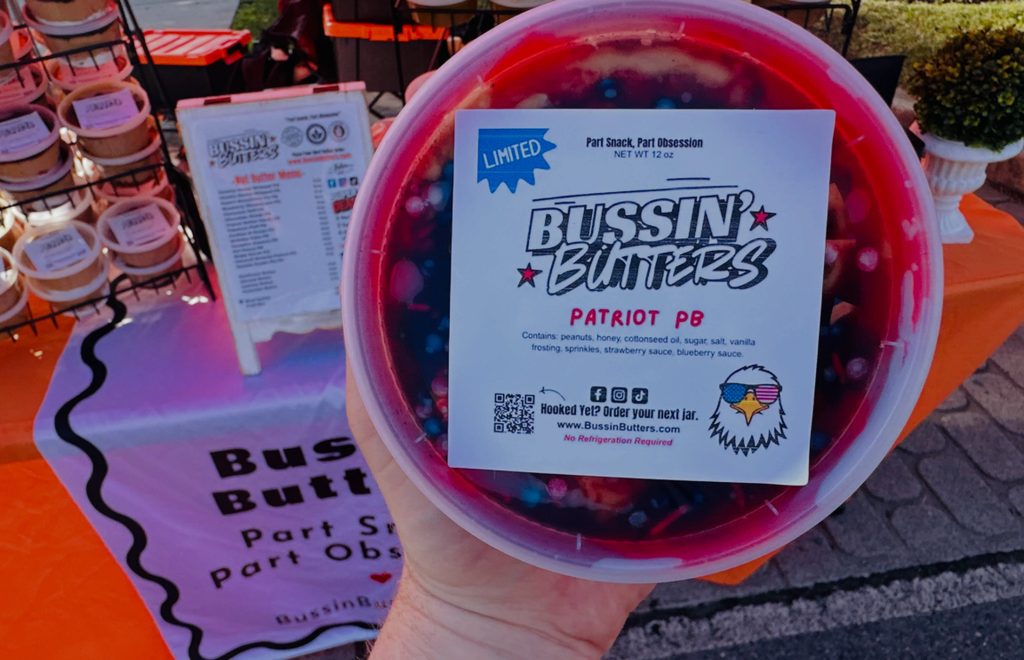
Based in Easton, Pennsylvania, Bussin’ Butters is a gourmet nut butter company bringing creativity and variety to traditional peanut butter. What started as a small business serving local farmers markets has grown into a brand shipping nationwide, with ambitions to expand into major retail stores and potentially launch its own franchise concept.
Austin’s entrepreneurial journey is also deeply personal. Inspired partly by his son’s experience with type 1 diabetes, he wanted to build something that went beyond simply selling another food product.
We spoke with Austin about how Bussin’ Butters got started, the marketing strategies that helped it grow, the importance of in-person customer feedback, and why he believes small brands shouldn’t be intimidated by established competitors.
From Facebook to Peanut Butter: The Story Behind Bussin’ Butters
Tauras Sinkus: Austin, could you start by introducing yourself and telling us a little about Bussin’ Butters?
Austin Person: Absolutely. My name is Austin Person, and I own a gourmet nut butter company called Bussin’ Butters. I like to describe us as the Crumbl Cookie of peanut butter.
We’re based in Easton, Pennsylvania. We originally focused on Pennsylvania, New Jersey, and New York City, but we now ship nationwide.
It’s been quite a journey, and we’re continuing to grow.
Tauras: Your business started in a rather unusual way. You were walking around Wegmans looking for a product category you could reinvent. How did that happen, and why peanut butter?
Austin: It’s actually a funny story. I used to work for Facebook, where I was recruited in 2020 as a persuasive technology expert. I helped community leaders monetize their audiences and learned a lot about sponsorships, brand collaborations, and consumer behavior.
When my team was laid off in 2023, I started looking for my next opportunity.
My family has been involved in food manufacturing for over 65 years, primarily in meat products, so I already had some familiarity with the industry. But I didn’t want to go into meat manufacturing because of the costs and regulations involved.
Instead, I decided to walk through a grocery store and look for something that hadn’t really changed in a long time.
I literally went into Wegmans with a clipboard and walked up and down the aisles, looking at different products and thinking about what could be done differently.
I kept coming back to peanut butter.
At the same time, I wanted to create something meaningful because my son has type 1 diabetes. Raising awareness and supporting that community was very important to me.
Peanut butter felt like a good fit because it was a familiar product that also had a personal connection for our family.
That’s really how it started. We launched the brand, and things began taking off from there.
Tauras: Having grown up around a family business in food manufacturing, did that give you an advantage when starting your own company?
Austin: Definitely. I think I had a bit of an advantage compared to someone starting a food brand completely from scratch.
I understood things like national distribution, SKUs, and retail operations. I also had experience seeing how large businesses operate and what it takes for smaller companies to scale.
Working at Facebook gave me another perspective. I learned a lot about what drives consumer behavior, what captures people’s attention, and what makes them keep coming back.
So I started thinking about how I could apply that knowledge to food.
Peanut butter seemed like the perfect opportunity because it’s already a staple product. The challenge was figuring out how to make it more exciting.
Going Viral and Catching the Attention of Shark Tank
Tauras: You mentioned that the brand gained attention relatively quickly. What helped Bussin’ Butters grow in those early stages?
Austin: Social media played a huge role.
I understood early on that people love having choices, especially American consumers. If you offer someone one or two peanut butter flavors, that’s one thing. But if you show them 10 or 20 different flavors, suddenly they’re much more interested.
People come up to us at farmers markets all the time and say they’ve never seen anything like it.
We used Facebook, Instagram, TikTok, and other platforms to get the word out.
Then, when the company was about six months old, we attracted some attention from the producers of Shark Tank. That created another opportunity to generate publicity.
I shared that story across social media, which helped us gain local media attention and grow our online presence.
So it was really a combination of having an interesting product, offering plenty of variety, and knowing how to get people talking about it.
Tauras: That’s an interesting story. How exactly did the Shark Tank opportunity come about?
Austin: We were selling at a farmers market in Hoboken, New Jersey, underneath the viaduct.
Some people from the Shark Tank production team happened to be shopping at the market. They bought a few flavors of our peanut butter, took them back to their office, and apparently everybody loved them.
About two days later, I received an email from one of the producers introducing herself and saying they thought our concept was really creative.
She encouraged us to apply for the show.
I was shocked because I wasn’t expecting anything like that, especially so early in the business.
We went through the application process and submitted the required materials. Ultimately, we weren’t selected because the company was only six months old and didn’t have enough financial history yet.
But they encouraged us to keep applying.
Even though we didn’t make it onto the show, the experience was valuable. It gave us a great story to share and helped generate additional attention for the brand.
Farmers Markets vs. E-commerce: Finding the Right Balance
Tauras: Farmers markets seem to be an important part of your business. How big of a role do they play today?
Austin: They’re still a huge part of what we do.
We typically attend four to six farmers markets every week across Pennsylvania, New Jersey, and New York.
We’re at places like the Easton Farmers Market, Summit, and Morristown. We also participate in food festivals and community events, including garlic festivals, bacon festivals, and arts events.
The nice thing about our product is that it fits into so many different environments.
We’re selling something that people already recognize, but we’re presenting it in a new and interesting way.
That makes it relatively easy to introduce our products to customers at different types of events.
Tauras: How do your in-person sales compare with your e-commerce business?
Austin: Right now, I’d say about 40% of our sales come from online orders and 60% from farmers markets and other in-person events.
We’re still a relatively young company, around two and a half years old, so our online business is catching up.
But it’s growing every day.
We’re receiving orders from more and more states. Just recently, we had an order come in from West Virginia.
That’s exciting because it shows us that we’re expanding beyond our original regional customer base.
I expect the online side of the business to keep growing as more people discover the brand.
Tauras: Speaking of e-commerce, have you discovered any particular tools or strategies that have helped improve your online sales?
Austin: We use Shopify for our online store, and one of the most helpful things has been using apps that allow us to better understand how customers interact with the website.
One tool we’ve used is a customer behavior recording app called Lucky Duck. It lets us see how visitors navigate the store.
We can see where they’re clicking, which products they’re looking at, where they might be getting stuck, and whether they’re adding products to their carts without completing checkout.
That information is incredibly valuable.
Instead of guessing why someone isn’t buying something, we can look at their behavior and identify opportunities to improve the shopping experience.
We’ve used those insights to make adjustments and fine-tune the website so that we can sell more efficiently.
I think understanding customer behavior is one of the most important parts of running a successful e-commerce business.
Behind the Brand: Manufacturing, Rebranding, and Building for Growth
Tauras: What does your manufacturing process look like? Do you work with a co-packer, or do you produce everything yourselves?
Austin: We actually looked into co-packing early on, but it was too expensive for us when we were just getting started.
Instead, we use a shared commercial kitchen, also called a commissary kitchen, in New Jersey. That’s where we manufacture our products every week.
We’re also looking at opening our own retail storefront in the near future.
The idea would be to introduce weekly flavor drops, similar to what some other popular dessert brands are doing. I think that would be a lot of fun and give customers something new to look forward to every week.
It’s an exciting direction for us, and we’re looking forward to exploring it further.
Tauras: Your company was originally called Two Brothers Nut Butters. Why did you decide to rebrand to Bussin’ Butters?
Austin: When we first started, I thought Two Brothers Nut Butters sounded like a nice, natural name for the business.
But I eventually discovered that we couldn’t trademark it.
That’s something I should have researched more carefully before starting the company.
My attorney explained the trademark issue, and at that point, I was already thinking that the original name was a little too long.
I wanted something shorter, catchier, and more fun.
That’s how we came up with Bussin’ Butters.
Looking back, it was a good lesson in the importance of thinking about branding and trademark protection early in the process.
Thinking Bigger: Nationwide Retail, Franchising, and Long-Term Ambitions
Tauras: You’ve talked about your ambition to grow the company. What’s your long-term vision for Bussin’ Butters?
Austin: My goal is to have our products available in retail stores nationwide.
We’re exploring opportunities with major retailers, including upcoming conversations with Walmart.
Over the next five years, I’d love to see Bussin’ Butters become a nationally recognized brand.
We’re also exploring the possibility of creating a peanut butter storefront franchise.
There really isn’t a major storefront franchise concept dedicated to peanut butter, and I think there’s an opportunity to build something unique.
Looking further ahead, my 10-year goal would be to eventually sell the company to a larger food manufacturer.
Companies like Hormel or other major players could potentially see value in what we’re building.
Of course, I’d love that to be a $500 million deal!
But right now, the focus is on continuing to grow the brand and creating something people genuinely love.
Tauras: For entrepreneurs competing in established industries, do you think smaller brands can realistically challenge major companies?
Austin: Absolutely.
In fact, I think a lot of entrepreneurs underestimate how much opportunity there is.
People look at huge companies like Jif or Skippy and think there’s no way they could ever compete.
But smaller companies can be more creative. They can move faster, experiment with new ideas, and offer something different.
If you create a product with strong branding, a loyal customer base, and a clear point of difference, you can build something valuable.
And sometimes, rather than trying to recreate what you’ve built, larger companies might decide it’s easier to acquire your business.
That’s why I tell people not to be intimidated by the big players.
You don’t necessarily have to beat them at everything. You just have to do something that customers really want.

Beyond Social Media: Testing Products and Exploring Live Shopping
Tauras: Beyond social media, what other marketing strategies have worked well for your business?
Austin: We do a lot of A/B testing, particularly through our farmers markets and live events.
For example, we’ll introduce different flavors in different locations and observe how customers respond.
We can compare how products perform in different cities or regions and get immediate feedback.
What we’ve found is that most of our flavors tend to perform well across the different markets we attend, which is encouraging.
But the really valuable part is being able to test products directly with customers.
With online marketing, you can look at clicks, conversions, and analytics. Those are important, but there’s also something incredibly useful about watching a customer experience your product in person.
You can see their reaction, hear their questions, and understand what excites them.
And you’re generating revenue while learning.
That’s why I think farmers markets and events are such powerful marketing tools, particularly for smaller food brands.
Tauras: You also mentioned experimenting with live selling. Do you think that’s something e-commerce entrepreneurs should be paying attention to?
Austin: Definitely.
One platform I’ve been experimenting with is Whatnot, which allows sellers to host live shopping shows.
I think live selling has enormous potential in the United States.
It’s already a major part of e-commerce in parts of Asia, and I believe we’re going to see it become much more popular in America.
It’s almost like having your own version of QVC, where you can present products, interact with customers, and sell directly during a live broadcast.
For smaller food businesses, I think that’s a really interesting opportunity.
Whatnot already has a snacks category, so there’s a natural place for businesses like ours to experiment.
Social media is great for building awareness and engaging with customers, but live selling adds another dimension because people can purchase products while watching.
I think it’s a channel worth exploring early, before it becomes even more competitive.
Lessons for Entrepreneurs: Start Small, Learn Fast, and Keep Going
Tauras: What advice would you give someone who’s thinking about starting their own food or e-commerce business?
Austin: My biggest advice is simple: don’t give up, and don’t let fear stop you.
I think a lot of people have great business ideas, but they never move forward because they’re afraid or don’t know where to start.
We’re living in an incredible age of information. There are so many resources available today that allow you to learn almost anything.
You can watch YouTube videos, find mentors, research your industry, and teach yourself things that would have been much more difficult to learn in the past.
Of course, the food business has its own challenges.
You have health regulations, licenses, certifications, and other requirements to deal with. It’s not as simple as launching a digital product.
But none of those things should stop you from trying.
You have to be willing to learn and keep moving forward.
I always say that it’s easy to get rich, but it’s hard to stay rich.
Building something successful is one challenge. Maintaining it for 20, 30, or 40 years is another.
Tauras: Finally, if you had to share one lesson from building Bussin’ Butters so far, what would it be?
Austin: I think the biggest thing is not letting fear hold you back.
My experience at Facebook and my family’s background in food manufacturing definitely gave me an advantage, but there are still plenty of things you have to figure out when starting a business.
I meet people at farmers markets all the time who tell me they’ve always wanted to start something but don’t know where to begin.
And I tell them there are steps you need to take, especially in the food industry. You need to understand licensing, certifications, regulations, and how to operate properly.
But you can learn those things.
Don’t let the size of your competitors discourage you, either. Just because there are already major companies in an industry doesn’t mean there isn’t room for something new.
Find a good mentor, learn as much as you can, and move forward.
There are plenty of opportunities out there if you’re willing to take that first step.
Final Thoughts
Austin Person’s journey with Bussin’ Butters demonstrates how an everyday product can become the foundation of an ambitious business.
Rather than creating an entirely new product category, Austin identified an opportunity to make something familiar more exciting through creative flavors, distinctive branding, and a strong understanding of consumer behavior.
His experience also highlights the value of combining e-commerce with traditional, face-to-face selling. While social media and Shopify help Bussin’ Butters reach customers across the country, farmers markets provide opportunities to test products, collect feedback, and build relationships directly with consumers.
As Bussin’ Butters looks toward nationwide retail distribution, potential storefronts, and new sales channels, Austin’s approach remains rooted in experimentation, persistence, and a willingness to challenge established industry players.
For entrepreneurs building their own brands, the takeaway is straightforward: a good idea matters, but the willingness to test it, learn from customers, and keep improving is what helps turn that idea into a business.
Connect With Bussin’ Butters
Interested in discovering Bussin’ Butters and following Austin’s entrepreneurial journey?
Check them out here:
- Website: bussinbutters.com
- Instagram: Find Bussin’ Butters on Instagram
- Facebook: Find Bussin’ Butters on Facebook
- TikTok: Find Bussin’ Butters on TikTok