Mastercard has announced Virtual C-Suite, which is a brand-new agentic experience with the goal of helping small businesses operate more intelligently. While the experience begins with a Virtual CFO, the company plans to add other agents over time to help provide trusted recommendations and give companies a deeper view into their operations.
Mastercard Announces Virtual C-Suite
Mastercard announced the feature in a recent press release. According to the post, the Virtual C-Suite is an extension of Mastercard’s Agent Suite and is a new agentic experience designed to help provide small businesses with executive-level insight and improve their operations and decision-making.
Each agent will act like a digital executive and assist with various key responsibilities in areas like finance, security, marketing, and more. The Virtual CFO capability will be the first module introduced, and it will help small businesses understand their financial health and make smarter financial decisions.
Additional executive-function roles are planned for the future to help free up more time for business owners and streamline their operations.
This includes a Virtual CISO to help improve their security, a Virtual CMO to help companies plan, optimize, and execute marketing campaigns, and a Virtual COO to provide AI-powered guidance across sales and operational decision-making.
The hope is that these digital executives help companies gain deeper insights into their organizations and make better decisions. Generally, this type of financial and operational insight is only available to larger enterprises with dedicated teams, but Mastercard aims to bring it to the masses.
The Virtual C-Suite is powered by proprietary insights from the billions of transactions processed on Mastercard’s networks each year, combined with a company’s own financial activity. As a result, it’s designed to give trusted recommendations that are based on data, but also relevant to your business.
AI innovations are advancing quickly, and the transition to agentic enterprise is already gaining momentum. In fact, organizations currently use an average of 12 AI agents, and this number is also expected to rise by 67% within the next two years. As a result, there’s no better time than the present for small businesses to take advantage of this opportunity and see how AI agents may be able to improve their operations.
How the Virtual C-Suite Works
The Virtual C-Suite essentially works by bringing agentic AI-powered intelligence into the software, systems, and applications that small businesses already use.
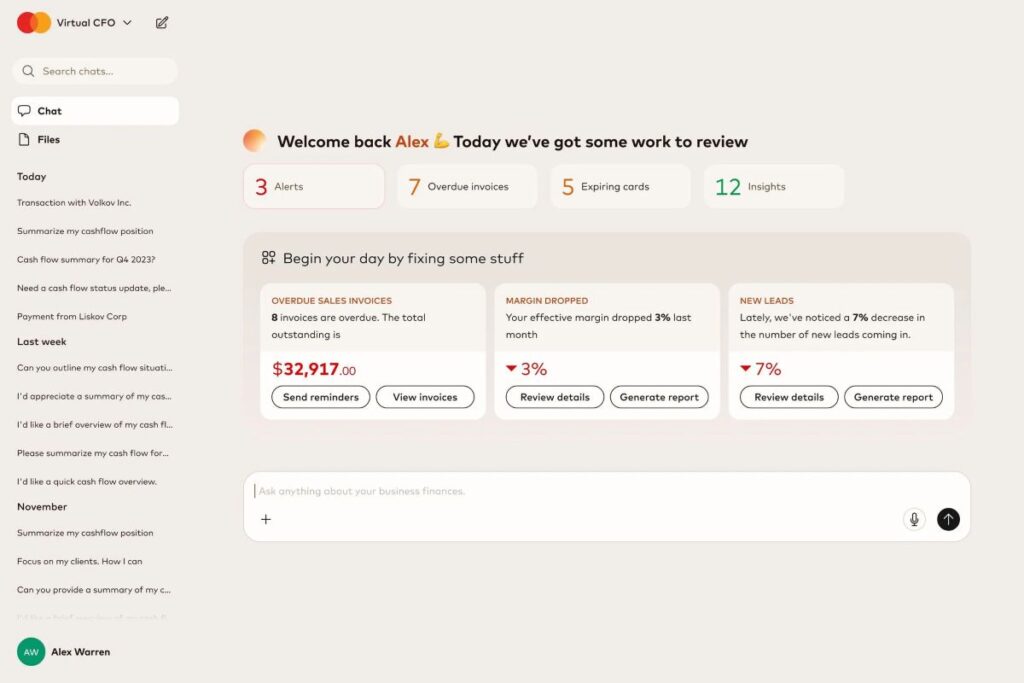
Once you integrate these AI-powered executives, they can analyze business performance, identify risks and opportunities, predict likely outcomes, and recommend steps and long-term actions to improve company operations. There are also user-friendly dashboards to explore and conversational interfaces so you can ask questions to the agent directly.
While it remains to be seen how popular the Virtual C-Suite becomes, I wouldn’t be surprised to see it get plenty of use among small businesses. This move by Mastercard is also a clear sign that the company wants to expand from simply being seen as a payment processor and move to having a larger role in areas like data and software.