
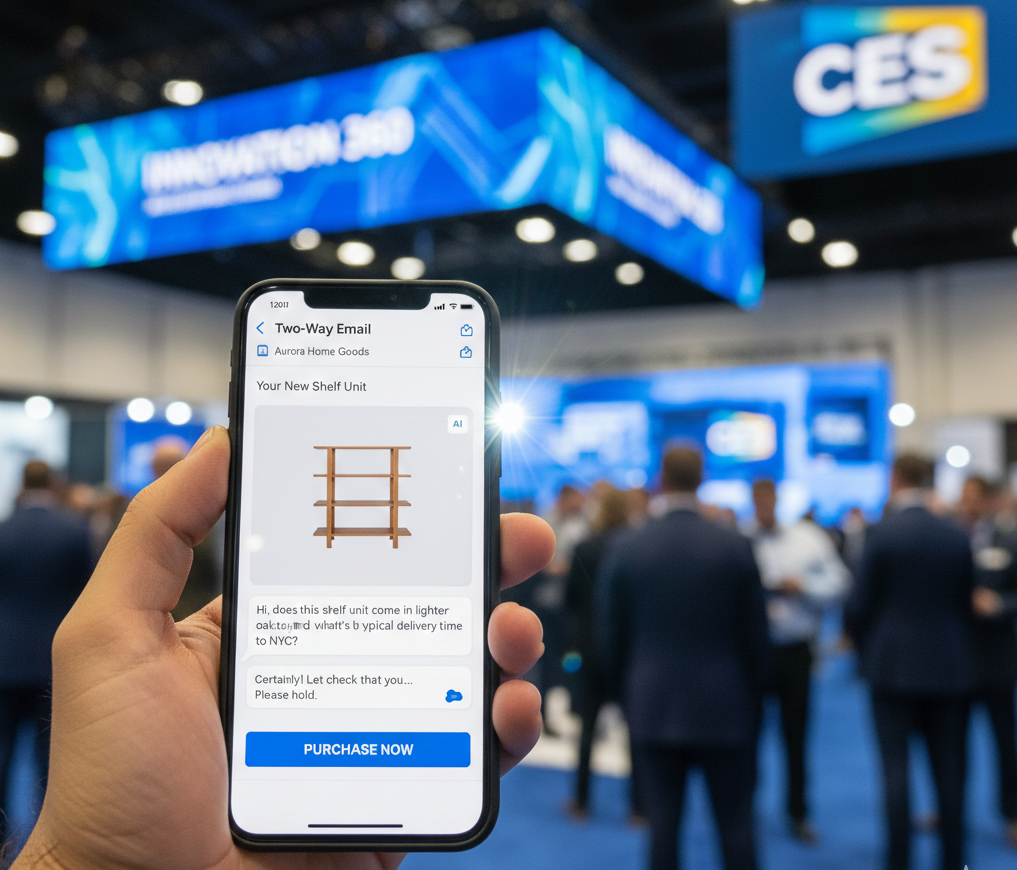
Salesforce kicked off the 2026 Consumer Electronics Show (CES) on Monday morning with a strategic pivot that fundamentally alters the digital storefront. The CRM giant unveiled Agentforce 360, a new commerce-enabled AI suite headlined by the Two-Way Email shopping feature that enables retailers to sell products directly inside email conversations. Agentforce 360 is Salesforce’s powerful gateway into the agentic commerce trend, which is reshaping e-commerce in 2026.
The suite is designed to close the gap between email engagement and transaction, effectively transforming traditional promotional emails into interactive storefronts where customers can ask questions, receive AI-generated responses, and complete purchases without ever clicking a link.
While email has been e-commerce’s most powerful traffic driver for decades, it is also one of its biggest bottlenecks. Brands invest heavily to get customers to open messages, only to lose them to slow-loading landing pages, forgotten passwords, or abandoned carts once they click through. Agentforce 360 is designed to eliminate that drop-off by letting the transaction happen where the conversation already lives.
How Salesforce’s Two-Way Email Shopping Actually Works
At a basic level, the experience looks deceptively simple. A retailer sends out a promotional email showcasing a few products. But unlike a standard campaign that works like a digital billboard, that email is now backed by Agentforce 360’s AI and commerce engine.
According to the company’s press release, the agents can:
- Handle size and fit inquiries: Shoppers can make queries such as, “Does this jacket come in medium?” or “Is there a black version?”, and receive a personalized answer based on their previous purchase history and inventory.
- Answer nuanced product questions: Using the company’s internal live data, the agents can explain technical product specifications or stock levels.
- Execute direct checkout: After making the selection, customers can confirm a purchase and pay without leaving the email interface. The purchase is processed using saved customer information, payment tokens, and Salesforce’s secure transaction layer, and a confirmation email is delivered within moments.
This turns what used to be a one-way marketing blast into a real-time, conversational shopping channel, dropping the Time-to-Transaction from minutes to seconds.
Why Salesforce Is Betting Big on Agentic Commerce
Salesforce built its empire on managing customer data and automating sales workflows. However, until now, it has largely stayed out of the actual transaction layer of e-commerce, leaving platforms like Shopify, BigCommerce, and Magento to handle the sale itself.
Agentforce 360 changes that. The “360” in the platform’s name refers to Salesforce’s unified data layer. Unlike traditional chatbots that often operate in silos, where the marketing bot doesn’t know what the service bot is doing and vice versa, Agentforce 360 runs on the Atlas Reasoning Engine.
This engine synchronizes and grounds AI agents in real-time customer data from the Salesforce Data Cloud. This ensures that if a customer has recently returned an item, the AI won’t mistakenly recommend that same product in an email thread. This level of synchronization aims to solve context fragmentation, a primary pain point for retailers who have struggled with disjointed AI deployments in 2025.
By embedding purchasing directly into email, Salesforce is positioning itself not just as a CRM or marketing tool, but as a commerce execution platform. This allows brands to monetize customer relationships without depending on external storefronts or ad-driven funnels.
While Salesforce is not trying to replace storefronts entirely, it is quietly redefining where commerce can happen. Platforms like Shopify and WooCommerce have focused on making websites more powerful, faster, and more customizable. Salesforce is betting that the future of buying is conversational, not navigational.
How Agentforce 360 Disrupts the Traditional Ecommerce Funnel
In the traditional e-commerce funnel, every click from email to landing page, to cart, to checkout, is a point of friction where a customer might drop off. By letting customers buy inside an email, Salesforce collapses that entire funnel into a single interaction.
For brands with large email lists, this could shift budget priorities overnight. If email becomes a high-conversion sales channel rather than just a traffic source, the value of owned audiences skyrockets. That could reduce reliance on paid advertising, social platforms, and even marketplaces like Amazon.
This shift fundamentally challenges the traditional utility of the web storefront. By moving the transaction entirely into an email or WhatsApp thread, merchants sacrifice the cross-merchandising real estate that typically drives higher attachment rates. While agentic commerce maximizes efficiency, it threatens to turn shopping into a purely utilitarian event, effectively neutralizing the suggestion impulses that bolster Average Order Value (AOV) and contribution margins.
What Agentforce 360 Means for Retailers in 2026
For retailers already using Salesforce Marketing Cloud or Commerce Cloud, Agentforce 360 offers a powerful new revenue stream with minimal additional infrastructure. Inventory, pricing, customer data, and order management remain in Salesforce’s ecosystem, the only difference being where the sale happens.
Early adopters are likely to be DTC brands, subscription businesses, and B2B sellers who rely heavily on email for promotions and account management. For these companies, Two-Way Email shopping can reduce sales cycles, improve conversion rates, and provide a more personalized buying experience.
It also opens the door to new types of campaigns. Instead of sending static product grids, brands can send dynamic, AI-powered catalogs that respond to each customer’s questions and preferences in real time.
However, this must be weighed against the already existing operating models, taking into account technical difficulties. Additionally, industry operators will need to monitor how two-way AI interactions affect ESP deliverability and DMARC compliance, as high volumes of automated replies could trigger spam filters if not properly managed.
Agentic Commerce in 2026
Agentic commerce is the trend to watch in 2026. Instead of forcing customers to browse and click, brands are deploying systems that listen, respond, and act on their behalf.
Salesforce’s approach is particularly powerful because it leverages a channel that customers already use every day. Email is something that doesn’t require a new learning curve; therefore, a smart AI-driven change is easier to adapt to.
Should the “Two-Way” shopping model successfully recover the 70% of carts typically abandoned during the site-navigation phase, the traditional e-commerce landing page may soon become a secondary tool in the retailer’s arsenal.