
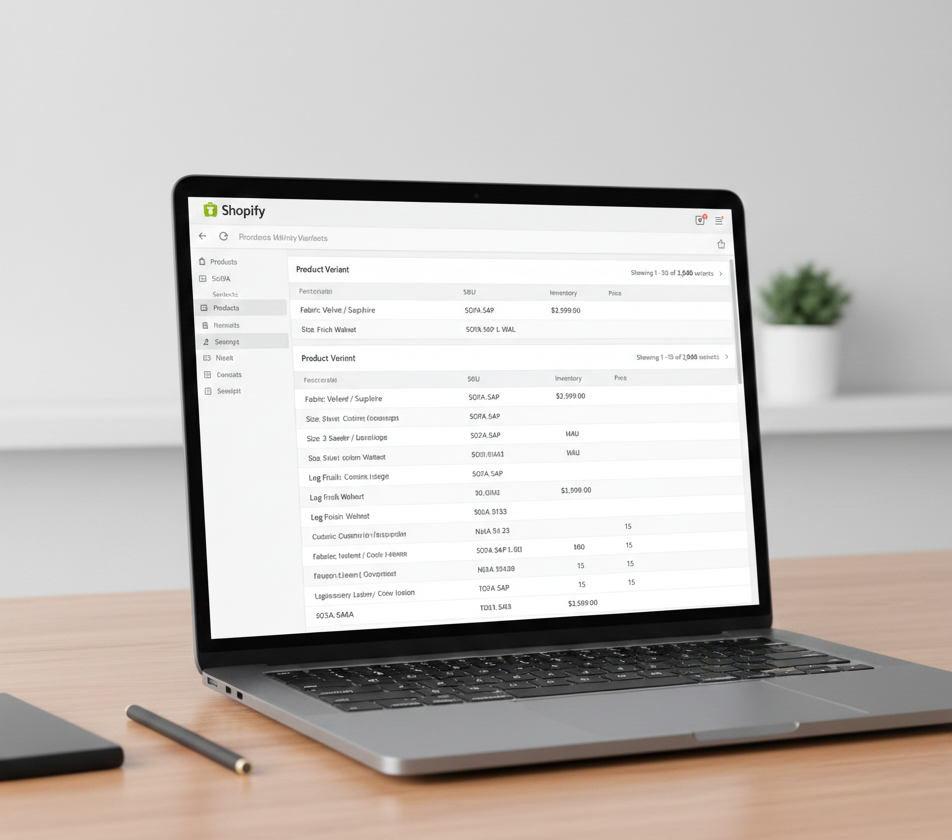
Shopify has officially broken one of the most persistent structural limits in modern ecommerce. On January 13, 2026, as part of its Winter ’26 Editions rollout, the company confirmed it has expanded its long-standing product variant cap to 2,048 variants per product, a dramatic increase from the historic 100-variant limit.
The move is part of a broader RenAIssance theme for the platform, signaling a shift from a commerce tool for growing brands to a dominant force in the high-end enterprise space. By removing the technical debt associated with SKU-heavy catalogs, Shopify is making a direct play for the market share currently held by Adobe Commerce, Salesforce Commerce Cloud, and custom-built stacks.
Alongside the variant expansion, Shopify also introduced B2B Store Credit, enabling wholesale merchants to issue credit at the company profile level rather than to individual buyers. Together, these updates represent a coordinated push to close long-standing enterprise gaps in both catalog architecture and B2B commerce workflows.
Why the Variant Limit Mattered More Than Shopify Admitted
The 100-variant limit was Shopify’s most controversial constraint. While sufficient for basic apparel or DTC brands, it proved crippling for industries like furniture, automotive parts, industrial equipment, and luxury fashion, where combinations of size, material, color, finish, region, and compliance requirements can easily exceed hundreds or thousands of permutations.
Until today, merchants with complex product configurations, think a sofa with 50 fabric choices, 10 leg finishes, and 5 sizes were forced into using fragile workarounds. These included using multiple product listings, complex API workarounds, or expensive third-party apps that slowed down site performance, increased operational complexity, degraded reporting accuracy, and often broke integrations with ERP and fulfillment systems.
Many enterprise merchants evaluated Shopify, then chose Adobe or Salesforce purely because those platforms could natively handle deep variant trees. However, with the move to 2,048 variants, Shopify removes one of the last objective blockers preventing large catalog brands from adopting its platform at scale.
Shopify’s 2,048-Variant Update Targets Adobe and Salesforce
Adobe Commerce (Magento) and Salesforce Commerce Cloud have long justified their higher cost and complexity by supporting extensive SKU variation and enterprise-grade catalog modeling. According to recent industry data, Shopify’s Total Cost of Ownership (TCO) is already roughly 30-35% lower than its enterprise competitors.
Shopify’s expanded variant ceiling directly targets that advantage, while retaining Shopify’s strengths in faster deployment, lower total cost of ownership, and a far broader app ecosystem.
The industries most affected by this update are those where product complexity is a feature. High-fashion brands with region-specific sizing and materials, furniture brands with dimensional and finish combinations, and automotive sellers with fitment-based options now have a credible reason to reconsider Shopify Plus as a primary platform rather than a secondary storefront.
What 2,048 Variants Means for Performance and Infrastructure
Raising the variant ceiling is not simply a UI change. Variant expansion impacts database indexing, search performance, storefront rendering, and checkout reliability, which are areas where Shopify historically prioritized speed over flexibility.
Shopify Engineering framed the update as the result of backend re-architecture designed to support large datasets without degrading performance. Shopify Engineering confirmed that the new limit is native, not an API-only or enterprise-only workaround.
This reduces technical debt and ensures compatibility with core features such as inventory tracking, analytics, checkout logic, and internationalization tools.
For developers and systems integrators, the change also simplifies architecture. Instead of distributing variant logic across multiple systems, merchants can now consolidate product complexity at the core catalog level, thereby reducing sync errors and long-term maintenance costs.
Shopify Introduces B2B Store Credit at the Company Level
Shopify also introduced B2B Store Credit, a critical upgrade for wholesale merchants that addresses another long-standing pain point, particularly for wholesalers and distributors.
Previously, issuing credit on Shopify B2B required assigning balances to individual buyer accounts. This clashed with real-world B2B purchasing, where credit is negotiated at the company level and shared across procurement teams.
With the new update, merchants can now issue store credit directly to company profiles, allowing multiple buyers within an organization to draw from a shared balance. This aligns Shopify’s B2B tooling more closely with traditional ERP and wholesale accounting practices, such as the following:
- Decentralized Access: Any authorized buyer under a company profile can apply the credit at checkout.
- Operational Agility: Credit can be issued for returns, goodwill gestures, or as part of a loyalty program, staying with the business entity rather than the individual user.
- Financial Visibility: New dashboards allow B2B sellers to track credit balances across entire corporate hierarchies.
In the world of enterprise B2B, purchasing is rarely done by a single person. One buyer might place an order, while a finance manager handles the accounting. Previously, store credit was tied to individual customer emails, which was frankly a logistical nightmare for large corporations with high employee turnover.
What This Update Signals for Shopify Plus and Enterprise Ecommerce
The expanded variant limit and B2B Store Credit signal a clear evolution in Shopify’s strategy. The company is no longer content with positioning Shopify Plus as enterprise-lite. Instead, it is systematically dismantling the technical arguments that once justified moving upmarket to heavier, slower platforms.
This does not mean Shopify will replace Adobe or Salesforce overnight. Highly regulated, deeply customized global enterprises will still require bespoke solutions. But for the vast middle of enterprise commerce, Shopify is becoming an enticing option.
For developers and agencies, this update triggers a massive migration cycle. Legacy apps that were built specifically to bypass the 100-variant limit are now obsolete. Merchants are being encouraged to audit their catalogs and consolidate ghost products into single, high-performing listings. As Shopify continues to integrate its Sidekick AI into the admin panel, the ability to manage 2,048 variants will become even more streamlined, with AI-driven suggestions for pricing and inventory management across massive SKU counts.