
Amazon has officially launched a 30-minute delivery pilot in London, signaling the next phase of its European logistics dominance strategy. The pilot, operating initially out of the high-density Southwark borough, offers near-instant delivery for groceries and everyday essentials, positioning Amazon in direct competition with local delivery giants.
According to Amazon UK, the Amazon Now initiative is designed to test whether ultra-fast delivery can be scaled sustainably in high-density European cities without relying on traditional same-day logistics infrastructure. While Amazon has previously experimented with rapid delivery formats through Prime Now and Amazon Fresh, this is its most prolific push into sub-hour delivery in a major European capital, and follows a similar launch in the U.S.
The launch reflects a broader shift in Amazon’s logistics strategy, moving away from centralized fulfillment centers toward hyper-localized micro-fulfillment hubs as a core pillar of urban commerce.
A Direct Play for the On-Demand Economy
While Amazon’s Same-Day Delivery was the industry’s gold standard for years, the rise of quick-commerce (q-commerce), pioneered by on-demand delivery platforms such as Deliveroo, Uber Eats, and Getir, has forced the commerce giant to shift its priorities in the European market.
The Southwark Amazon Now pilot focuses on a curated assortment of high-velocity items, including fresh groceries, packaged food, household essentials, and personal care products. Orders are fulfilled from local micro-fulfillment centers and delivered by a mix of Amazon Flex drivers and contracted couriers optimized for short-range routes.
The Amazon Now pilot utilizes AI-driven inventory forecasting to predict local demand with surgical precision. By stocking only the items most likely to be ordered by residents in the immediate postcode and surrounding areas, Amazon maximizes space efficiency.
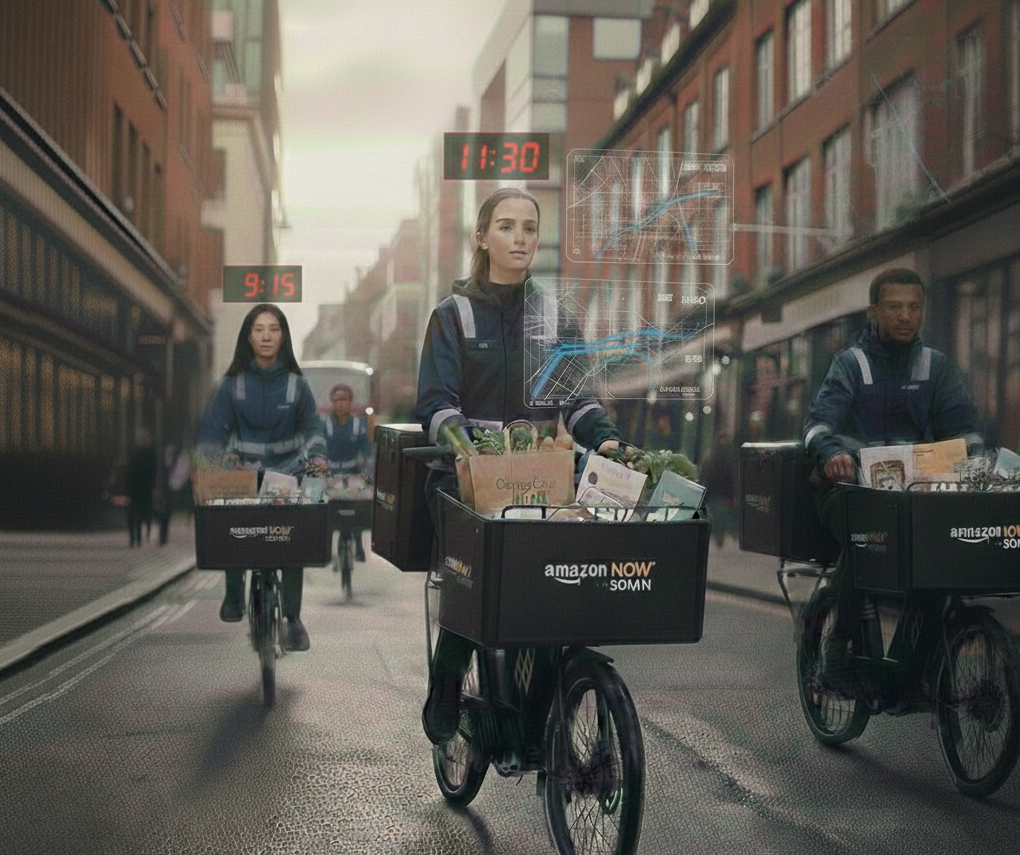
The pilot also utilizes a 100% electric delivery fleet, featuring custom-designed e-cargo bikes and electric mopeds capable of navigating London’s congested Low Traffic Neighborhoods (LTNs) more effectively than traditional transit vans.
This move also addresses the scrutiny regarding urban congestion, sustainability, and Amazon’s commitment to a zero-carbon delivery path for the London pilot.
Highlighting this transition, Amazon UK Country Manager John Boumphrey stated, “Our new e-cargo bikes, walkers, and growing electric vehicle fleet will help us make more zero-emission customer deliveries than ever before across London.”
More importantly, the reliance on e-bikes is a logistical necessity. In a city where van parking is scarce and fines are high, the agility of a bike-based fleet is the only way to hit a 30-minute KPI consistently. By leveraging these micromobility hubs, the company effectively bypasses the gridlock that often paralyzes traditional four-wheeled logistics.
Why London Is the Perfect Test Market
London represents a uniquely strategic test environment. With high population density, mature delivery infrastructure, and strong Prime penetration, the city offers Amazon the data richness needed to evaluate unit economics at scale.
Southwark, in particular, provides a mix of residential density, commuter traffic, and commercial activity, allowing Amazon to model peak demand fluctuations, courier efficiency, and inventory turnover in real-world conditions. If successful, the pilot could be expanded to other London boroughs and eventually to other European cities.
AI-Powered Micro-Fulfillment Powers Speed
At the core of the pilot is Amazon’s growing reliance on micro-fulfillment hubs. Unlike the massive, million-square-foot fulfillment centers, these micro-fulfillment centres (MFCs) are small, strategically located facilities designed to serve a limited radius with minimal delivery times. These hubs, embedded directly within the urban fabric, prioritize speed over assortment breadth, stocking only the most frequently ordered SKUs.
This model allows Amazon to reduce delivery distances, lower fuel costs, and improve courier utilization, all while meeting increasingly aggressive delivery promises. It also aligns with Amazon’s broader effort to regionalize its fulfillment network, a strategy the company began accelerating in North America in 2023.
Competitive Pressure on On-Demand Delivery Platforms
Amazon’s move is likely to intensify pressure on last-mile delivery platforms already operating on thin margins. While those platforms have historically dominated the convenience store, local supermarket, and restaurant delivery sectors, they often struggle with stock consistency and high service fees.
Unlike Deliveroo or Uber Eats, Amazon does not rely on delivery fees as its primary revenue driver. Instead, the service strengthens Prime membership value and increases order frequency, even if individual deliveries operate at minimal or negative margins in the short term.
For the Southwark pilot, Amazon is reportedly waiving additional delivery fees for Prime members on orders over £20, a move that could significantly undercut the unit economics of standalone delivery apps. This cross-subsidization capability gives Amazon a structural advantage that few competitors can match. As ultra-fast delivery becomes normalized, independent platforms may be forced to consolidate further, raise fees, or narrow their geographic coverage.
Furthermore, Amazon’s vertical integration gives it an edge. While Deliveroo must partner with Waitrose or Co-op to fulfill grocery orders, Amazon owns the entire stack, including warehouse software, shelf inventory, and last-mile courier. This allows for tighter margins and a more seamless user experience.
The Future of Ultra-Fast Urban Delivery
While Amazon has not confirmed a specific expansion timeline, the company stated it plans to roll the Amazon Now service out further in the coming months following the results of the Southwark trial. The company confirmed that performance metrics such as delivery time consistency, order frequency, and customer retention will determine the next phase of rollout.
While the pilot is currently limited in scope, its strategic implications extend far beyond Southwark. The initiative signals that Amazon is now positioning speed as a core pillar of its European commerce strategy.
By targeting densely populated zones, Amazon is effectively bypassing the cost and complexity of traditional last-mile delivery across sprawling metro areas. The move is Amazon’s clearest signal yet that it views ultra-fast delivery as a competitive necessity in major urban markets.
If successful, the 30-minute delivery model could redefine urban ecommerce logistics, pushing the industry toward a future where fulfillment speed is not a premium feature, but a baseline expectation.