
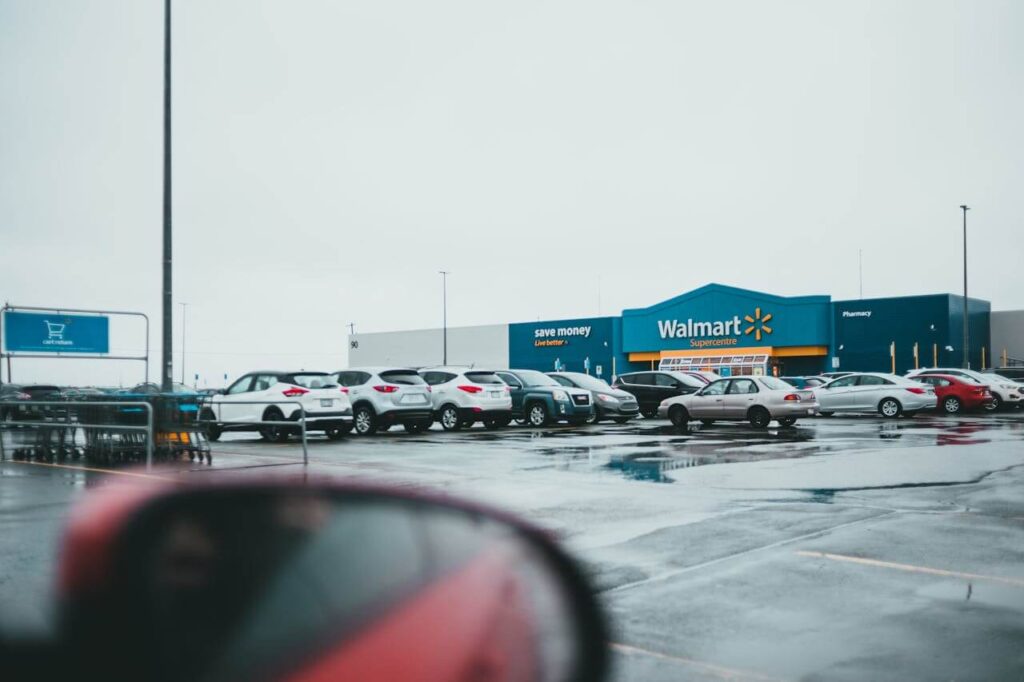
Walmart President and CEO John Furner, who’s on a three-day trip to India, said on Thursday that quick commerce has become a global trend, and that the US-based retailer is “bullish” on the emerging e-commerce segment.
His comments bear significance as Minutes, a 10-minute delivery vertical of Walmart-owned Indian e-commerce major Flipkart, is trying to make big moves in India’s highly disruptive quick commerce market.
Slightly late to the party, Furner-led Walmart wants to catch up fast with other players by expanding its Minutes platform. It will also ensure Walmart is not left behind in India’s ever-expanding e-commerce market, which is currently worth $50 billion.
Since its launch in August 2024, Minutes has expanded to around 800 dark stores (Q1 2026), behind top food-tech players like Blinkit (2,243), Swiggy (1,100+) and Zepto (1,100). Walmart rival Amazon is also ramping up its quick commerce capabilities and has opened around 300 micro-fulfilment centres in India’s major cities.
The presence of local startups and global e-retailers in one place has propelled India to the forefront of q-commerce globally. In terms of industry size, the country is only behind China, which leads at over $92 billion, followed by the US in third place.
Scaling up Minutes in the world’s most competitive market will definitely give Walmart an edge over Amazon, its biggest rival in the e-commerce space.
Why Incumbents Like Walmart Are Changing Their Stance
Walmart and Amazon are not just leading players in the retail and e-commerce space in the US, but they are competitors in key markets, including India, as well.
For example, in India, Amazon is already scaling fast, with the e-commerce giant now among the top seven players, according to Redseer data.
Walmart has the necessary war chest to scale Minutes to new heights. Furner’s latest statements make it clear that the company does not want to be left behind in the race, and India, with more than 900 million mobile internet users, is a perfect battleground to prove this point.
The steady rise of new-age startups in India, like Eternal (earlier named Zomato), Swiggy, and Zepto, has proved that the quick commerce playbook is scalable, and it’s clearly the future of e-commerce.
As compared to China, India is still behind but catching up fast. Traditional e-retail here still covers the biggest chunk, with 80% of the overall market, but q-commerce has grown at a double rate annually over the past two years. The total quick commerce market is expected to hit $65-$70 billion by 2030, according to Bain.
Within quick commerce, the growth is not limited to just groceries and essential items, which lead with a 71% market share. Non-grocery segments like fashion, BPC, home furniture, and e-pharma are slowly capturing market share.
The Real Economics Behind Quick Commerce
There is no credible data available on the global size of the quick commerce industry, but it’s estimated to hit $353 billion by 2030.
China will continue to lead. Its industry is estimated to hit around $134.17 billion by 2030, at a CAGR of 7.90%. The rise of quick commerce in China can be traced back to the post-pandemic period, when startups like Meituan, Alibaba, and Pinduoduo doubled down on opening dark stores across all major urban hotspots in China.
Like India, China’s Tier 1 metros captured around 45.93% of total q-commerce revenue in 2024. The food-tech leader Meituan leads the chart with around 6,000 flash-express warehouses.
Following China, India’s e-commerce market is expected to hit around $57 billion by 2030, according to Morgan Stanley. The q-commerce industry is forecast to see expansion beyond food and grocery to non-food categories like beauty, fashion, and electronics, creating around a $10 billion opportunity for these players.
Likewise, the US quick commerce market, currently at $42.77 billion, is forecast to grow at a CAGR of 6.7% to $55.52 billion.
The US quick commerce market is currently led by GoPuff, DoorDash, Uber Eats, and Amazon. Estimates suggest the sector will see consolidation in the next two to four years, with Walmart, Amazon, or GoPuff better positioned to improve unit economics due to their focus on automation, drones, and micro-fulfilment centres.
The EU quick commerce market is considered to be between €36 billion and nearly €50 billion by 2026, with the UK, France, and Germany being the primary hubs. Beyond groceries, the market is also expanding into other verticals like pharmacy, electronics, and home essentials.
What This Means For Global E-commerce And Retail
The quick commerce industry has emerged as a key business opportunity across the world. Apart from a few countries like China, India, and the US, most other economies are still figuring out how to bring unit economics down and scale profitably across different segments.
While markets like India are still seeing a market-share war between key players, the US has healthier economics, but slower growth in quick commerce. EU countries have seen major consolidation in the space, with startups like Gorillas collapsing due to high labour costs, strict regulations, and the funding winter. The EU market is now shifting from fast delivery towards profitability.
This also presents a unique opportunity for big e-commerce players like Amazon and Walmart to expand quickly using their existing logistical capabilities.
Their presence in all major economies makes it easier for them to scale up fast. However, solving the profitability riddle will be a key challenge for these big e-commerce players.