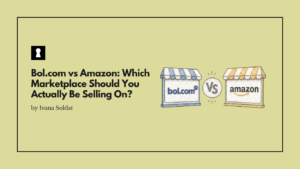

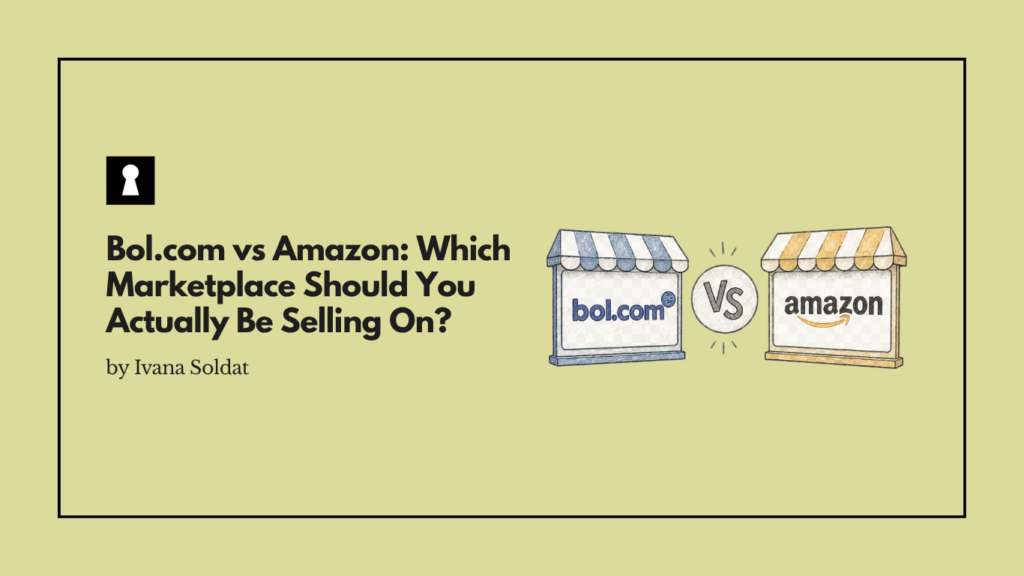
If you’re selling online in Europe and haven’t seriously thought about Bol.com, you’re either already on Amazon and too comfortable, or you’ve never heard of it. Both are fixable problems.
Here’s the full breakdown of the fees, fulfillment, advertising, seller support, returns, and who each platform is actually built for.
What You’re Choosing Between
Amazon is the world’s largest marketplace. It pulls over 2.5 billion annual visitors, carries 300 million products, and is roughly 20 times more likely to surface your product to a buyer on any given day. The audience is massive, the competition is brutal, and the fee structure in 2026 is the most complicated it’s ever been.
Bol.com is the dominant ecommerce platform in the Netherlands and Belgium. It consistently attracts 2 to 3 times as many monthly visits from Dutch users as Amazon.nl, and operates with a very different seller philosophy. Bol.com carries around 1.5 million products, meaning 200 times more room to actually stand out. Smaller pond, but you can actually be seen in it.
Account Setup
Amazon’s onboarding is notoriously painful. Sellers frequently describe endless verification steps, unclear requirements, and rejection with no explanation, and once you’re in, Seller Central itself is complex enough that experienced sellers still find it hard to navigate. Expect to spend real time getting your account live.
Bol is significantly easier to set up, but comes with its own gatekeeping. To sell on Bol, you need a valid VAT number from your country of establishment. For Dutch and Belgian companies, registration is straightforward. For international sellers outside the Netherlands or Belgium, you need to contact Bol directly and meet a separate set of minimum requirements, it’s not a self-serve process in the same way Amazon is. The admission requirements are strict, and guidance from a marketplace agency is often recommended to increase the chances of successful registration.
The short version: Amazon lets almost anyone try and then blocks you with bureaucracy. Bol filters you before you get in, but if you pass, the setup is cleaner.
What About the Fees?
This is where Bol has a structural advantage for new and smaller sellers. Bol operates on a pay-when-you-sell model, no fixed monthly subscription fee, just a fixed amount per sale plus a category-based commission percentage. For reference, electronics run around 4.2% commission on Bol, toys around 8.3%. You only pay when something sells.
Amazon requires a monthly commitment regardless of sales volume. The Professional selling plan runs €39 per month excluding VAT, on top of per-category referral fees. Amazon did announce one of its largest European fee reductions for 2026, averaging €0.17 per unit, but that headline needs context. Amazon simultaneously added a 3.5% logistics surcharge in 2026, new price-tiered fulfillment fees, and inbound placement fees that can run up to $6.50 per unit.
Sellers who benchmarked their FBA economics two or three years ago and never revisited them may be absorbing costs that no longer make sense. If you’re on Amazon and haven’t recalculated your margin recently, do it now.
Fulfillment: FBA vs LVB
Both platforms let you hand off fulfillment to the marketplace. Amazon calls it FBA (Fulfillment by Amazon). Bol calls it LVB (Logistiek via Bol).
FBA is powerful. FBA listings with the Prime badge convert at 18 to 25% blended, compared to 10 to 13% for non-Prime listings, which is why 82% of active Amazon sellers use it. The conversion uplift is real and significant. The downside is cost and complexity: FBA fees now vary by product price tier, aged inventory penalties kick in at 181 days instead of the previous 271, and inbound placement carries per-unit charges unless you split shipments across five or more locations. For heavy, slow-moving, or low-margin products, FBM or a 3PL hybrid is increasingly the smarter choice.
LVB is simpler, cheaper, and more predictable, but it’s purpose-built for Bol’s own order flow. LVB is built for Bol’s pipeline specifically; FBA is built for scale and multi-market dynamics. If you want to use Bol fulfillment infrastructure to serve orders from other channels, you can’t. It’s a trade-off: less flexibility, but fewer surprises on the invoice.
Advertising & Visibility
Both platforms offer paid advertising. The mechanics are similar; the maturity of the tools is not.
Amazon’s advertising ecosystem is vast, you can choose between Sponsored Products, Sponsored Brands, Sponsored Display, DSP, with sophisticated targeting, detailed attribution, and a huge body of third-party tools built around it. It’s powerful if you know how to use it, and expensive if you don’t.
Bol’s advertising is simpler. Sponsored Products on Bol run on a CPC basis, you set your maximum bid, and your product appears in search results when customers search for relevant terms. On average, Bol’s sponsored products generate four times as much in sales as the amount spent, with advertisers seeing an 18% increase in total revenue from campaigns. There’s also an organic bonus: driving traffic to your product page through ads increases your sales velocity, which improves your organic ranking in search results too.
One important constraint on Bol: your product must be in the BuyBox and have complete product information before your ad can go live. Shortcut your listing quality and you can’t advertise at all.
Winning the BuyBox: How Each Platform Decides?
Both platforms use a BuyBox system to decide which seller’s offer gets shown first. The difference is in what they reward.
Amazon’s BuyBox algorithm heavily weights price and Prime eligibility. In commoditised categories, this creates a race to the bottom where the cheapest FBA seller usually wins.
Bol’s BuyBox promotes sellers based on offer quality and delivery speed, not just price, which means premium products can actually compete without cutting margins. Specifically, Bol’s BuyBox factors in delivery speed, on-time delivery rate, track and trace performance, return rate, and price. Better seller behaviour = better visibility, even at a higher price point. For brands selling differentiated products, this is a meaningful advantage.
Returns & Customer Service
Both platforms offer 30-day returns as standard. Bol allows items to be returned within 30 days of receipt, provided the product is in its original state and packaging. Amazon’s return policy is similarly structured for most categories.
Where the platforms differ is in who carries the burden. With LVB, Bol handles the return logistics. With self-fulfilled orders on either platform, returns land back on you. Amazon’s FBA handles returns entirely, which sounds convenient, until you start getting refunds issued to customers before the product is even returned, or inventory marked unsellable without explanation. Both platforms have well-documented frustrations around how returns get managed in edge cases.
Assessment of the Seller Support
Neither platform has a great reputation here, and being honest about that is more useful than pretending otherwise.
Amazon sellers frequently report long response times, automated or generic responses that don’t address specific issues, and unhelpful advice. The core problem is Amazon’s attempt to automate as much of seller support as possible using systems that frequently produce nonsensical responses. When a real issue needs a real human, getting to one takes patience.
Bol’s seller support is generally considered more accessible and more human, but it’s not without problems. Sellers report that when disputes arise between buyers and third-party sellers, Bol has increasingly pushed independent sellers to take sole responsibility for damages and returns, with limited platform intervention. The smaller scale means you’re more likely to get a real response; whether that response actually solves your problem is another question.
International Selling & Cross-Border
Amazon wins this one clearly. Its Pan-EU FBA programme lets you list once and sell across Germany, France, Italy, Spain, the Netherlands, and more from a single inventory pool. Since June 2025, having stock in a Dutch Amazon warehouse is a requirement for Pan-EU FBA eligibility, but once that’s in place, the multi-market infrastructure is genuinely powerful.
Bol is a two-market platform: the Netherlands and Belgium. Bol has deep integration into everyday Dutch shopping habits, partnerships with local sellers, and Albert Heijn loyalty programmes, but if your ambition is broader than Benelux, Bol alone won’t get you there.
One interesting cross-border data point worth flagging: Austria sees 44% of its online spending flow to foreign webshops, which means if you’re already selling in Germany, you’re likely already capturing Austrian demand too through Amazon.de.
Quick Comparison
| Bol.com | Amazon | |
|---|---|---|
| Monthly fee | None | €39/month |
| Commission | ~4–8% by category | Varies by category |
| Fulfillment | LVB (Bol only) | FBA (Pan-EU eligible) |
| Market reach | Netherlands + Belgium | Pan-European |
| Advertising | CPC, simpler tools | CPC + display, advanced tools |
| BuyBox logic | Quality + price | Primarily price + Prime |
| Seller support | More accessible, patchy | Automated, often frustrating |
| Setup difficulty | Moderate (stricter entry) | Hard (bureaucratic) |
| Best for | Premium/niche, Benelux focus | Scale, multi-market, high volume |
Pick the Platform That Matches Where You Are, Not Where You Want to Be
The default assumption is that Amazon is the serious option and Bol is the niche play. That’s the wrong frame. Bol is dominant in a market of 18 million Dutch and Belgian shoppers who genuinely trust it, and that trust converts in ways raw traffic numbers don’t capture.
The fee structure difference matters more than most sellers realise at the start. No monthly subscription on Bol means zero fixed costs while you’re testing product-market fit. Amazon’s €39/month is fine at scale, but it’s dead weight when you’re still figuring out if a category works.
The clearest signal for which platform to start on: where does your product have a natural home?
If you’re selling something with broad European appeal and strong unit economics that can absorb FBA fees, then Amazon might be better. If you’re in home, kitchen, toys, baby, or anything where Dutch consumers have strong brand preferences and you want to build loyalty rather than just volume, then go for Bol first.
The smartest move in 2026 is both. But if you have to pick one, pick the one where your product fits the culture of the platform. Amazon rewards price and logistics efficiency. Bol rewards quality and reliability. Those aren’t the same business, and they don’t favour the same products.