
Vibe coding has definitely changed what’s possible with AI tools for ecommerce operators in 2026. Brands no longer need to rely on too many SaaS tools or professional developers to build features and workflows on their platforms. AI is turning them into builders without needing developers.
Sure, professional coders can’t be ignored if you are building mission-critical systems, but vibe coding has reached a level where brands can automate some of the routine, repetitive, but crucial tasks, thus saving real money.
The biggest problem that companies like Cursor, Replit, and Lovable are solving with vibe coding is removing the time and cost barriers to building custom ecommerce tools. They cut dependency on legacy SaaS platforms and give operators control to build, test, and ship features and tools quickly.
These tools understand your business requirements as a merchant and enable you to turn ideas into automated workflows without needing to rely on developers.
How Vibe Coding Helps Ecommerce
AI-assisted coding shortens development cycles by up to 40% for certain developer tasks, as per McKinsey research. This means brands with prior coding knowledge can experiment faster. Since coding models operate on natural languages, even non-coders can gradually build and iterate.
You want a feature to be added to your platform? Or tinker with it to create something exciting from scratch? Everything is possible with just a few prompts. For example, web hosting provider Hostinger has introduced built-in functionality in its Horizons vibe coding platform. It gives you a complete online store setup.
No third-party integrations, just simple prompts. It allows brands to list up to 600 products and choose payment gateways from over 100 options, with no extra transaction fees.
You don’t need to be a designer or a coder. Visual appeal, design elements, and product features. AI can handle it all.
AI democratises development and puts power in the hands of brand owners rather than developers. Once you start tinkering with these tools, they can help you communicate ideas better.
Top Use-Cases in Ecommerce
AI tools are empowering operators in all areas, from prototyping to development, but automation and workflow creation are where these tools have had the biggest impact. The use cases are increasing rapidly.
Among its use cases, vibe coding allows operators to convert supplier CSV files into Shopify-ready formats. Exporting orders, auto-invoice generation, handling mismatched billing, building REST APIs with checkout flows, and running A/B testing during peak sale seasons. All these are real use cases, and AI tools enable operators to execute these workflows end-to-end.
Automation is empowering businesses to save money by creating tech solutions for repetitive tasks. For example, if you want to see the impact of your month-long advertising campaign, you gather data, put it into a spreadsheet, create a macro, and then try to make sense of the signals.
Or, you can create a vibe coding workflow using simple prompts to auto-generate campaign reports, saving both time and money.
Friction Points in AI-Assisted Coding
Vibe coding is a great way to reach the prototype stage quickly. It’s easy, fast, and cheap. But AI-generated code or workflows are prone to errors and security risks.
Sometimes they work in the development stage, but often fail in production when real usage scales. Infrastructural areas like payments, logistics, and security are critical parameters where AI tools still struggle.
Once the product is generated, debugging poses another challenge, especially if you are a non-technical founder. Most vibe-coded projects cost less, but around 60-80% of them are estimated to need consistent fixing or code rewriting.
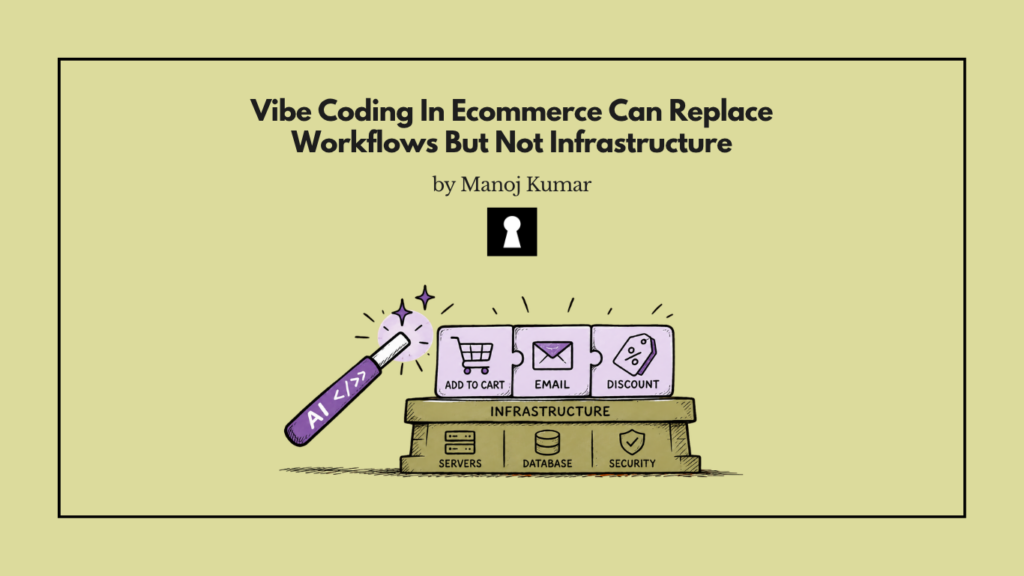
At this stage, it’s clear merchants can’t fully replace SaaS with vibe coding tools. However, these tools can certainly extend their capabilities and help scale prototypes beyond a minimum viable product.
Brands have to decide whether they want speed or reliability. Vibe coding offers speed, but reliability is still a critical missing piece.
Will Vibe Coding Replace SaaS?
Despite the shortcomings discussed above, there’s no denying that vibe coding levels the playing field to some extent and offers speed at a low cost. The results are visible. Like other segment apps, niche ecommerce tools and websites are surging in popularity.
There’s a clear shift, with brands focusing less on buying software and more on creating custom workflows to address their pain points.
If you are an operator, tinkering with technology will show you what’s possible with these tools. Prototyping and automation are clear impact areas, but fixing scaling and reliability issues is equally important.
In essence, vibe coding for ecommerce is an enabler. If you are an operator who codes, it can become your superpower, enhancing productivity by up to 50%. For non-coders, it’s a great way to experiment and build systems that may otherwise consume significant time and resources.
It can’t replace SaaS yet, but the coming months will be critical in determining which direction the industry takes.
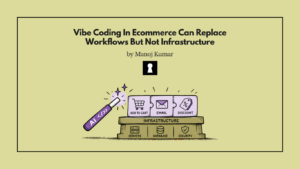
Right now, vibe coding is only a micro-builder layer on top of existing systems, which can, sometimes, become a source of technical debt.