
There is a version of shoppable TV that nobody finds particularly alarming. A cooking show recommends a spatula and there is a QR code on screen. A reality competition features branded products. A streaming service inserts a “buy now” overlay on a celebrity’s outfit. These are advertising formats in entertainment contexts, and viewers have been navigating the line between entertainment and sponsorship for long enough that the mechanics are understood, even if they are not always visible.
Then there is television news. And that is where things get more complicated.
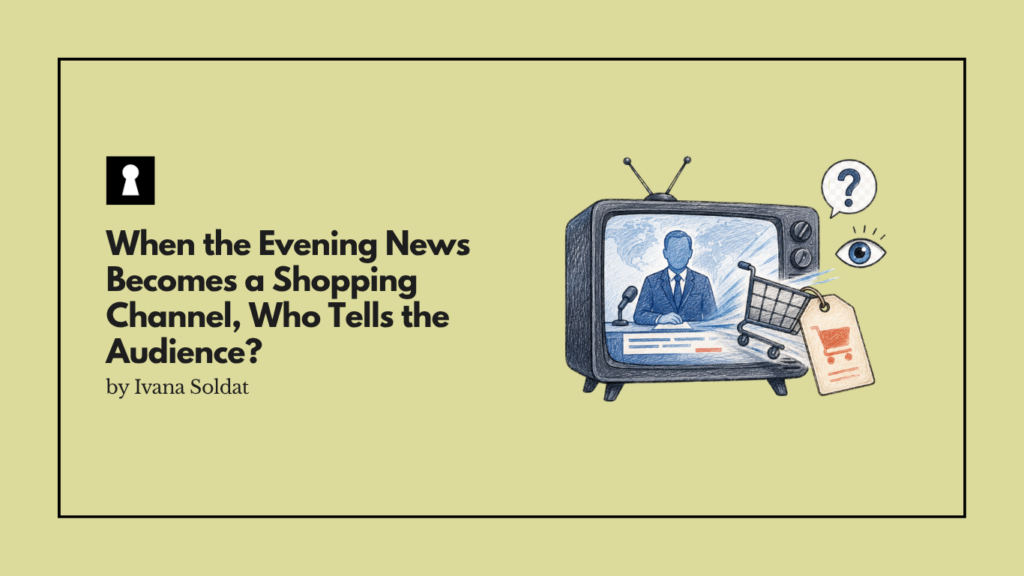
The LA Times reported this week that ecommerce pitches are creeping into TV news segments, the kind of programming that carries an implicit editorial credential that a cooking show or a reality competition does not. A morning news anchor recommending products with a shoppable link attached is doing something categorically different from a lifestyle host doing the same thing, because the viewer relationship with a news anchor is built on an assumption of journalistic independence that the lifestyle host never claimed.
The technology enabling this is not new and has been expanding rapidly. Shopsense AI, one of the leading shoppable TV infrastructure providers, has partnerships with Paramount, Univision, Nexstar Media Group’s The CW, Tastemade, and Bell Media in Canada. Its platform allows broadcasters to attach shoppable product overlays to programming, enabling viewers to scan a QR code or interact via a second screen to purchase items featured in or adjacent to the content they are watching.
The company’s own research puts TV-inspired consumer spending at $145 billion annually, a number that explains why everyone from local news stations to streaming platforms is looking at this category seriously.
What Shoppable News Actually Looks Like
The shoppable TV formats being tested in news-adjacent contexts tend to take a few forms. The clearest is the product segment, a “best of summer,” “what to buy for back to school,” or “deals we love” feature that has always existed in morning and lifestyle programming but now comes with direct purchase infrastructure attached. The segment was always commercial in spirit. The addition of a QR code or a shoppable link makes the commercial relationship explicit and measurable.
The more ambiguous version is product placement within editorial content, a story about a product category that happens to feature a brand whose products are purchasable through the station’s shoppable infrastructure. The journalist covering “the best air purifiers for wildfire season” and the retailer whose air purifiers are linked in the accompanying app experience are theoretically separate. Whether they are actually separate depends entirely on the editorial controls in place, which vary widely across local news operations.
Rising interest in shoppable TV reflects a broader effort by brands and retailers to insert themselves into cultural conversations. That insertion is more concerning in a news context than in an entertainment one, because the cultural conversation that news hosts has different rules about commercial participation.
The Revenue Logic Is Overwhelming
Local news in the US has been in structural financial distress for years. Advertising revenue has migrated to digital platforms. Newsrooms have been cut. The shoppable TV opportunity represents a revenue stream that is genuinely significant for organisations that are running out of other options.
62.7% of consumers find new brands or products through TV content, according to EMARKETER research. That discovery rate, combined with the purchase infrastructure shoppable TV provides, means a local news station with a loyal morning audience is sitting on a commerce media asset it has historically been unable to monetise directly. Affiliate revenue or retail media fees attached to purchases originating from news programming could be material for organisations whose traditional ad revenue is in long-term decline.
The commercial logic is so compelling that it will be very difficult for news organisations under financial pressure to resist it, which is exactly why the editorial question needs to be asked before the commercial infrastructure is fully in place.
The Credibility Collateral That Gets Spent
What shoppable news segments are spending is editorial credibility, the specific kind of trust that news audiences extend to news programming because it is supposed to be independent of commercial relationships.
A viewer who trusts their local news anchor because they believe the anchor is not selling them anything will extend that trust to a product recommendation in a way they would not extend to an influencer doing the same thing. When the product recommendation comes with a QR code and an affiliate arrangement, the trust is still being spent, but the viewer may not know it.
The FTC’s disclosure requirements for sponsored content apply broadly, but the specifics of how shoppable news content should be disclosed, whether a QR code on screen constitutes an ad, whether a product feature with a shoppable link requires an “ad” label, whether affiliate arrangements between news stations and retailers constitute endorsements that must be disclosed, are not yet clearly resolved for the broadcast news context.
Walmart, Amazon, and Target Are All Moving This Direction
The scale of retail media investment in shoppable TV makes the news question urgent rather than theoretical. Within a single fortnight in late June, Walmart agreed to buy a self-serve CTV platform, Target’s Roundel took a retail media network onto premium video for the first time, and Amazon switched on remote-enabled shopping inside Samsung’s streaming inventory. Three of the largest retail media operators moving into shoppable TV in the same two-week window is a category signal, not a coincidence.
The destination for that retail media spending is wherever audiences are, and morning news audiences are large, loyal, and demographically valuable. The path from “Walmart is investing in shoppable CTV” to “Walmart is a retail media partner in your local morning news’ shoppable product segment” is shorter than it looks from the outside.
Our Take
The Anchor Just Became an Affiliate. Did Anyone Tell the Audience?
The shoppable TV trend is real, commercially rational, and happening across every format simultaneously. The entertainment version of it is an evolution of product placement that most viewers can navigate. The news version of it is a more serious editorial question that most news organisations are probably not asking loudly enough, because the commercial pressure to not ask it is significant.
What is at stake is not just FTC disclosure compliance. It is the specific trust that news audiences extend to news content, a trust built over decades that will be degraded faster than anyone expects once audiences understand that the segment recommending the best back-to-school laptops is delivering affiliate revenue to the station.
The shoppable infrastructure is already in place. The editorial frameworks for using it responsibly are not, and the gap between those two things is where the credibility gets spent.