
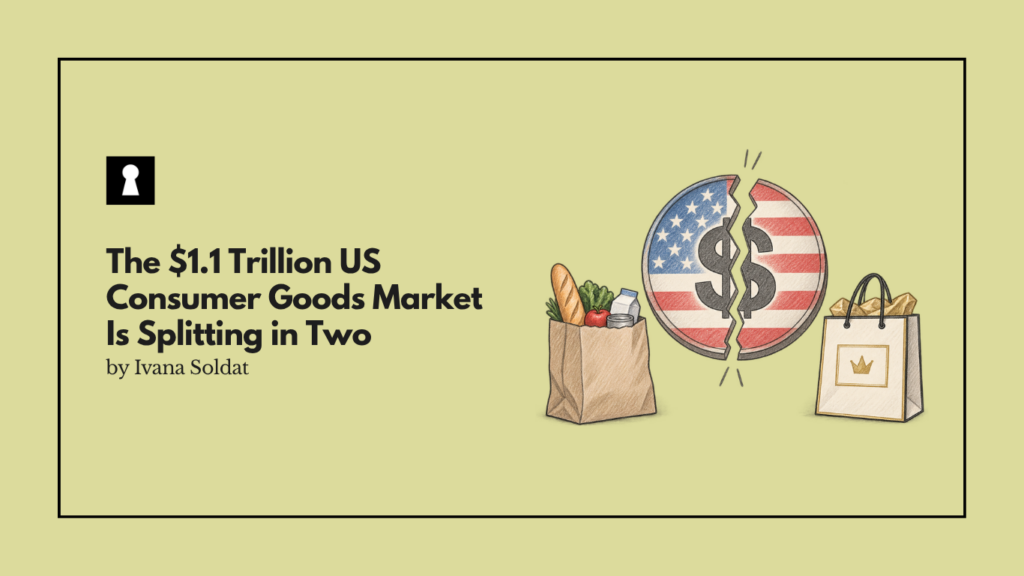
The more than $1.1 trillion FMCG market is increasingly polarising, with growth concentrated in premium and value tiers while mainstream products lose share. Premiumisation is strongest in wellness, beauty, and identity-driven categories, where consumers continue to pay more for perceived quality and benefits.
Younger generations are driving premium growth across categories including beauty, soft drinks, and salty snacks, with Gen Z spending power projected to reach $12 trillion globally by 2030. Private labels are increasingly competing at both the value and premium ends of the market, putting pressure on traditional brands from both directions.
“The US consumer hasn’t stopped spending, but rather, they have become much more intentional about where they spend,” said Ramon Melgarejo, President of Consumer Intelligence Initiatives and E-commerce at NIQ. “Consumers are increasingly asking whether a product truly earns a premium or whether a lower-priced alternative will do the job just as well. Products that fall in the middle are finding it harder to answer that question.”
The Same-Basket Behaviour That Changes Everything
American shoppers are routinely trading up and trading down within the same basket. A consumer may choose premium skincare products, specialty beverages, or wellness-focused items while simultaneously purchasing value-oriented household staples or private label products elsewhere in the store.
This behaviour makes demographic targeting progressively less useful as a planning input. A brand that sells to a consumer based on their income level, age, or geographic profile is making a prediction that those factors determine what they buy. The NIQ data says what actually determines the purchase is the category and the occasion. The same household buys premium skincare and private label cleaning products. Knowing their income does not tell you which category you are in.
“Younger consumers are proving especially influential in shaping premium growth,” said Liz Buchanan, President of North America, NIQ. “However, the broader story is one of increasingly selective consumer behavior, as shoppers of all ages become more deliberate and more willing to switch when products no longer justify their place in the basket.”
Why This Confirms Everything We Have Been Covering
The NIQ barbell market finding is the most rigorous quantitative confirmation yet of the pattern EcomWatch has been documenting across multiple data sources throughout August.
The Q2 retail earnings roundup we published last week showed Walmart reporting its slowest same-store sales growth since late 2020 while beauty categories outperformed across every retailer. Best Buy’s CEO described customers as “resilient but focused on deals and sales event periods.” Ralph Lauren raised prices 15% and added 1.5 million new DTC customers in a single quarter. Dollar General and Target benefited from trade-down behaviour while middle-market retailers faced the most pressure.
All of those data points are individual expressions of the same structural shift that NIQ is now quantifying with $1.1 trillion in FMCG market data. The consumer who buys premium skincare and value-priced detergent in the same basket is the consumer who made Prime Day record total spending while cutting basket size. The consumer who is “increasingly selective” is the same consumer Best Buy’s CEO called “resilient but deal-focused.”
The Private Label Pressure That Is Most Dangerous for Middle Brands
The NIQ report’s observation that private labels are increasingly competing at both the value and premium ends of the market is the data point that should concern the most brands.
Private label competing at the value end is the familiar story. Private label competing at the premium end is newer and more disruptive. Specialty grocery retailers and mass-market chains are launching premium private label lines with genuinely good product quality and positioning that competes directly with mid-range branded products.
A consumer who finds that a retailer’s premium private label delivers comparable quality at a lower price than the branded equivalent does not need the brand. The brand’s value proposition has to be strong enough to justify the price gap against both value private label from below and premium private label from above.
That is the squeeze the NIQ report is describing when it says mainstream brands risk being caught in the middle. It is not just about price. It is about whether the brand’s distinctiveness, quality signal, and identity value are clear enough to justify its position on the shelf against competitors at both ends.
The Gen Z Spending Power Projection
Gen Z spending power is projected to reach $12 trillion globally by 2030. The consumer who is buying premium beauty products today on a moderate income is the consumer whose premium brand relationships will compound in value as their income grows. The cost of acquiring that consumer now looks different when the lifetime value calculation includes the 2030 spending trajectory.
Our Take
The Middle Is Not a Safe Place to Be
The NIQ “Tale of Two Consumers” report lands on the day that should close out August’s consumer data picture. The $1.1 trillion US FMCG market is not growing uniformly.
It is growing at the premium end, where consumers who are convinced of the value trade up, and at the value end, where consumers who are not convinced trade down. The middle is shrinking. The brands that will navigate the next five years successfully are the ones that can answer the question consumers are increasingly asking: does this product truly earn a premium, or does a lower-priced alternative do the job just as well?
The brands that cannot answer that question clearly are the ones whose consumers are actively finding the lower-priced answer convincing.