
This is the EU regulatory story that has been almost entirely absent from ecommerce media coverage this month, which has focused on the July 1 parcel duty, the AI Act transparency rules from August 2, and the DMA/DSA enforcement escalation. All of those matter.
But the PPWR Article 45 deadline tomorrow has a more immediate and more broadly applicable compliance requirement, and it has received almost no attention in the ecommerce press.
Here is what it requires.
What Article 45 Actually Says
Article 45 of Regulation (EU) 2025/40 requires that any producer of packaging not established in the Member State where it first makes packaging available on the market must designate, in that Member State, an authorised representative for extended producer responsibility.
The trigger is two cumulative criteria. First, the producer must not be established in the Member State concerned. “Established” in EU law means the place of the producer’s registered office or, absent that, the place of effective business operations. Second, the producer must make packaging available on the market of that Member State for the first time, meaning the first supply for distribution, consumption or use in the course of a commercial activity.
“Producer” in PPWR terms means the entity that places the packaging on the market. For a brand shipping directly to EU consumers from outside the EU, that is the brand. For an EU brand shipping from Italy to consumers in France, that is also the brand. The Italian company does not have a French establishment. Under Article 45, it needs a French EPR representative.
The Cross-Border EU Seller Problem Nobody Is Talking About
The instinct is to read this as a rule for non-EU brands. That reading is incomplete.
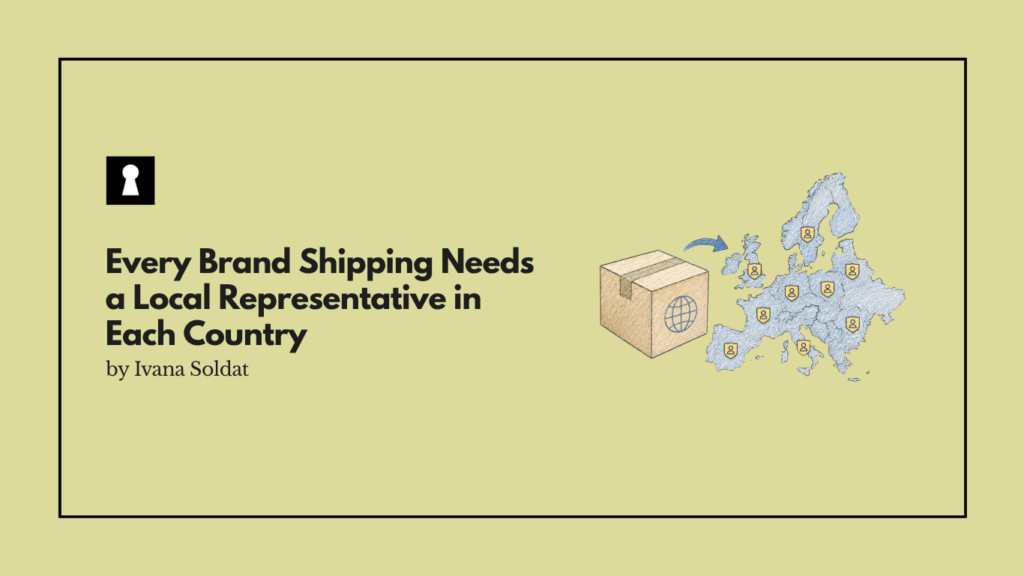
Article 45 applies not only to non-EU companies. It also applies to an EU business selling cross-border. An Italian Shopify store shipping to France, Germany, and Spain needs representatives in France, Germany, and Spain if it does not have legal establishments in those countries.
This is the detail that makes the PPWR Article 45 obligation significantly broader than the DTC media coverage of it suggests. A UK brand selling into the EU needs a representative in each EU country it ships to. A US brand selling into France and Germany needs a representative in France and a separate representative in Germany. An Italian brand selling to French, German, and Spanish consumers needs representatives in France, Germany, and Spain.
The only EU brands that are exempt are those with a registered legal establishment in each country they ship to. For most small and mid-market cross-border sellers, that means they need representatives in every EU destination market they serve.
There Is No Single-Window. This Is the Expensive Part.
A producer selling cross-border to France, Germany, and Italy needs three distinct representatives, one per Member State. Each representative is governed by the national EPR scheme of its Member State: LUCID in Germany, the new Italian packaging registry, French eco-organism schemes. There is no “one-stop shop” concept for representative designation under the PPWR, unlike VAT IOSS or product safety GPSR.
Each registration remains a separate national procedure with separate fees, separate IDs, and separate declarations. For a brand selling into 10 EU countries, that is 10 separate representatives, 10 separate registrations, and 10 separate ongoing compliance obligations.
What the “Suspended Until 2035” Story Means
Most of what has been written about PPWR Article 45 in ecommerce media includes a note that the obligation has been “suspended until 2035,” which has led many brands to conclude they have nine more years to worry about this. That reading is wrong, and the error is significant.
The European Commission proposed suspending the authorised representative obligation until 2035. This proposal applies only to producers already established within the EU. Non-EU companies are explicitly excluded from the suspension. For non-EU sellers, the August 12 deadline stands regardless of whether the suspension is adopted.
In June 2026, the Council reported that negotiations on the EPR representative suspension proposals had been discontinued because of strong reservations from a large majority of Member States. The suspension proposal has not been adopted as law. The current legal position is that Article 45 applies from August 12 to all producers, EU and non-EU alike, that are not established in the member state where they place packaging on the market.
What the Authorised Representative Does
The authorised representative manages EPR registration, packaging data reporting, and fee payments on behalf of the producer. The mandate transfers the operational EPR obligations to the representative.
In practice, the representative handles the producer registration in the national EPR system, submits annual reports on packaging volumes placed on the market, calculates and pays the EPR fees due to the national scheme, and serves as the legal contact point for national authorities in that country. The representative must be established in the relevant member state with a registered legal seat.
A French representative covers France. A German representative covers Germany.
The Enforcement Dimension
Article 44 requires a producer to register in every Member State where it first makes packaging or packaged products available. It also states that producers must not make covered packaging available in a Member State if they or the relevant representative are not registered there.
That last sentence is the enforcement provision. A brand that is not registered and does not have a representative in a member state is not permitted to sell packaged goods into that market under PPWR. Whether national authorities will immediately enforce against non-compliant sellers is a practical question separate from the legal one. The legal position is clear: from August 12, selling packaged goods cross-border into an EU member state without an EPR representative in that country is not compliant with EU regulation.
Our Take
Tomorrow. Multiple Countries. No Single Window.
The PPWR Article 45 deadline arrives tomorrow and has received a fraction of the attention given to the EU AI Act, the parcel duty, or the DMA enforcement escalation.
The practical stakes for cross-border ecommerce are significant: any brand, EU or non-EU, that ships packaged goods into EU member states where it does not have a legal establishment is in scope, and the compliance requirement is country-by-country with no single EU-wide solution.
The “suspended until 2035” narrative that has given many brands false comfort applies only to EU brands, has been proposed but not adopted, and the Council has discontinued negotiations on it. If you sell packaged goods into multiple EU countries and do not have legal establishments in each, August 12 is the date that should be at the top of your compliance calendar today.