
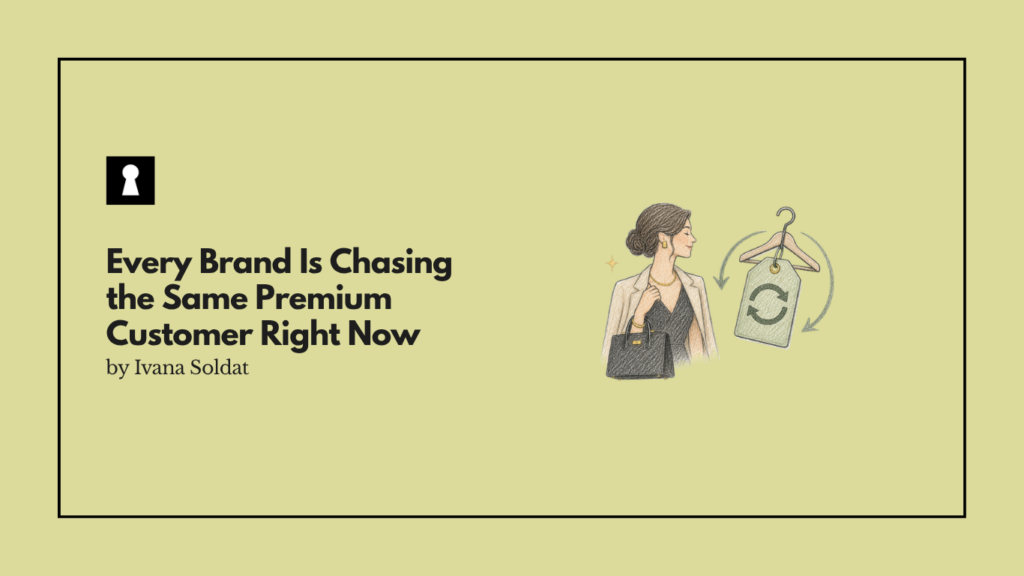
The strategy makes sense on paper. The K-shaped economy has split consumer spending along income lines: top earners kept spending through inflation, tariffs, and economic uncertainty while middle-income and lower-income consumers pulled back. If you need growth and the bottom half of the market has closed its wallet, the obvious move is to chase the half that still has money.
Moody’s data supports the urgency: spending by the top 10% grew 62% between the third quarter of 2020 and the third quarter of 2025. That is a real and significant divergence. The problem is that everyone is doing it simultaneously, which creates a specific competitive pressure: brands that were never premium are claiming premium positioning, diluting what premium actually means to the consumers they are trying to attract.
The Wayfair Case Study
Wayfair’s Perigold is the clearest large-scale example of the premiumisation strategy working. Perigold sales grew more than 35% in Q2 2026 while Wayfair’s overall revenue grew 7.5% year over year.
The key design decisions Wayfair made for Perigold are about service architecture. Free white-glove delivery. Physical stores in Houston and West Palm Beach where 20% of staff are trained designers offering complimentary design services. Average order values in stores running higher than online.
That distinction matters for any brand considering premiumisation. Calling yourself premium and having the infrastructure that premium customers expect are different things.
The Caraa Framework: Premium vs Luxury
Caraa founder and CEO Aaron Luo offers a useful distinction that most brands fumbling toward premiumisation have not made. In his framing, a premium customer has a combined household income of $500,000, cares deeply about function and quality, and makes purchasing decisions based on design and craftsmanship. A luxury customer is more driven by status and logos.
“You cannot go to an AOV of $120 to an AOV of $350 or $400 overnight,” Luo said. “If your product doesn’t resonate with a higher-income customer because you have been perceived as a discount brand or value brand, a customer is not gonna buy your stuff.”
Caraa has spent three years repositioning, investing approximately 3X what it spent four years ago on R&D and marketing, developing collections for specific affluent sports like tennis and fencing, and building product details that signal genuine understanding of those customer communities.
Mike Duda of investment firm Bullish frames the commercial rationale clearly: “How do you attract a consumer that is not as sensitive to 20% off, or buy-one, get-one free?” That question is the right one in a market where Temu and Shein have made it structurally impossible to win on price.
The Part That Should Give Every Brand Pause
According to Bain and Co research, the personal luxury market decreased 2% in 2026. The affluent consumer that every brand is chasing is not spending freely. And half of all luxury shoppers now consult the secondhand market before buying new.
That last data point is the most significant in the entire piece. Secondhand consultation before new purchase is not confined to budget-conscious shoppers. It is now mainstream among luxury buyers. The customer who can afford a $400 Caraa bag is the same customer who is checking what that bag sells for on The RealReal before deciding whether the new price is worth paying.
This connects directly to the China 618 data EcomWatch covered last month: secondhand electronics grew 80% during the festival period while new product platforms grew at under 1%. The consumer caution in 2026 is crossing income brackets.
The Secondhand Market Is Where the Premium Customer Goes to Think
The 50% of luxury shoppers checking secondhand before buying new should be reshaping how premium brands think about their competitive environment.
The competition is not just other new products at similar price points. It is the same product, pre-owned, at a discount, from a buyer who paid full price once and is now monetising the asset.
For brands pursuing premiumisation, this creates a specific challenge: the better the product quality and the stronger the brand, the better the secondhand market for it, and the more readily a prospective buyer can find a compelling alternative to the new purchase. Brands that have successfully built premium positioning have inadvertently strengthened the secondhand market for their products.
Our Take
You Cannot Buy Your Way Upmarket. You Have to Earn It.
The premiumisation rush is rational given the K-shaped spending environment, but it is running into two problems simultaneously. The first is supply-side crowding: when every brand claims premium positioning, the signal degrades for the consumer who actually cares about quality.
The second is the secondhand market’s role as a pressure valve: the affluent consumer who is the target of every premium pitch is already using the secondhand market as a price anchor and a substitute.
The brands that will succeed at premiumisation are the ones that invest in genuine product differentiation and service architecture, as Wayfair did with Perigold and as Caraa is doing with its R&D spend.