
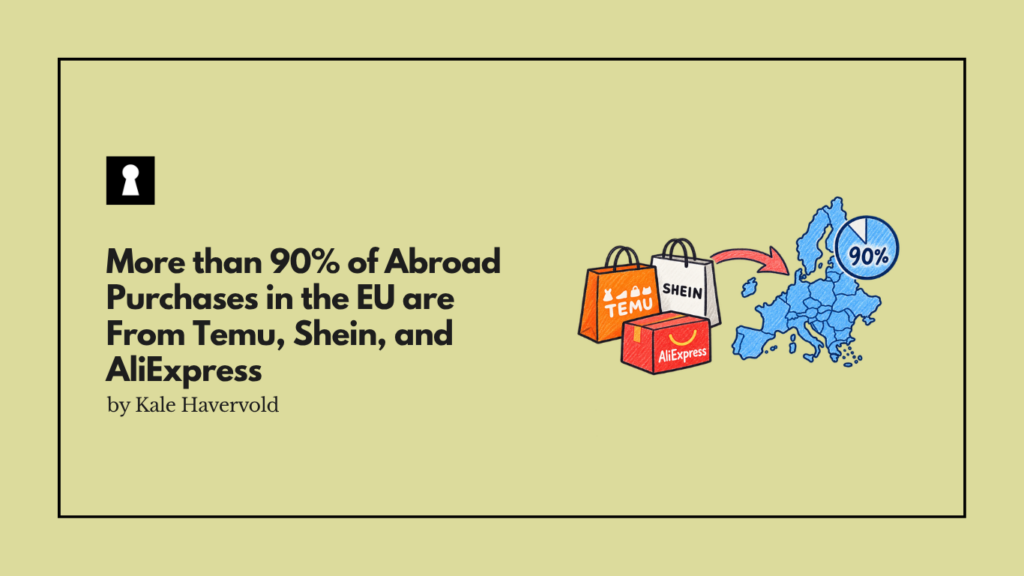
While the growth of cross-border commerce has made it easy for EU customers to buy things from anywhere, most Europeans buying items online are doing so from major Chinese marketplaces like Temu, Shein, and AliExpress.
These platforms have become incredibly popular for their ultra-low prices and huge variety of products, and their popularity has helped dramatically increase the growing share of online purchases being made from abroad in the region. However, some regulatory changes in Europe could put a stop to the meteoric growth of these low-cost importers.
Most Abroad Purchases in the EU are on Temu, Shein, or AliExpress
Temu, Shein, and AliExpress dominate the abroad purchases in Europe, as a huge majority of euros spent on online purchases within the region were spent on one of these platforms. In fact, according to recent ECDB data, 90.2% of the euros spent by EU consumers on cross-border commerce went to China.
To break it down by numbers, the total online spend on physical goods in Europe during 2025 was 421 billion euros, with 55.1 billion euros being spent abroad (13.1% of total spend).
Of this 55.1 billion euros that were spent outside of the EU, 49.7 billion euros were spent in Greater China. The next highest country is the USA at 2.7 billion euros, followed by the UK at 2.6 billion euros, highlighting just how much China is truly dominating cross-border commerce in the EU.
Cross-Border Commerce Has Experienced Strong Growth in Europe
Cross-border commerce has been rising steadily in recent years in the EU, with these popular Chinese marketplaces likely being major contributors to this growth. Back in 2020, total online spend on physical goods in the EU was 335 billion euros, with only 8 billion euros being spent abroad.
Here’s a breakdown of how it grew over the following years:
- 2021: 383 billion in total online spend (9 billion abroad)
- 2022: 366 billion in total online spend (15 billion abroad)
- 2023: 374 billion in total online spend (24 billion abroad)
- 2024: 393 billion in total online spend (41 billion abroad)
- 2025: 421 billion in total online spend (55 billion abroad)
- 2026 Estimated: 453 billion in total online spend (69 billion abroad)
As you can see, while the total spend has also increased, the purchases abroad have grown at a much quicker rate. While abroad purchases only made up 2.3% of online spend in 2020, this rose to 13.1% in 2025, and is expected to reach over 15% in 2026.
In addition to the spend increasing, the amount of imports entering the region also jumped. The growth was especially large during 2025, as the number of low-value ecommerce packages entering the EU climbed to 5.8 billion, which was a 26% increase over the previous year.
Fashion Dominates The List of What Europeans Buy Abroad
While people can buy just about anything online today, fashion dominated the list for 2025. In fact, fashion made up 46% of what Europeans bought abroad throughout the year. This makes plenty of sense, as fashion is the most popular category on marketplaces like Temu and Shein.
Also, the cheap per-unit cost and low weight of clothing have traditionally made them some of the most affordable items to buy and ship globally, as well. Other categories where Europeans frequently purchase things abroad include electronics (19.5% of total abroad purchases), furniture and homeware (10.2%), care products (9.5%), and hobby & leisure (9.5%).
Our Take
The Numbers for 2026 May Look Different, But These Retailers Aren’t Going Anywhere
While this growth has been staggering over the past few years, some people are expecting to see purchases abroad actually drop for 2026 compared to 2025. This is largely because of the removal of the EU’s customs duty exemption, and the addition of a 3 euro customs duty on ecommerce parcels valued at under 150 euros.
These regulatory changes are already having an impact on how these Chinese retailers operate in the EU. For example, parcel volumes from China entering the EU have fallen dramatically since the customs duty took effect, and many of these leading Chinese marketplaces have pulled back on ads in the region.
However, while some expect these Chinese retailers to pack up and leave the market due to these higher costs, it wouldn’t be surprising to see them stay and simply adopt a localized warehousing model as a way to pay bulk duties, rather than duties on each individual parcel.