
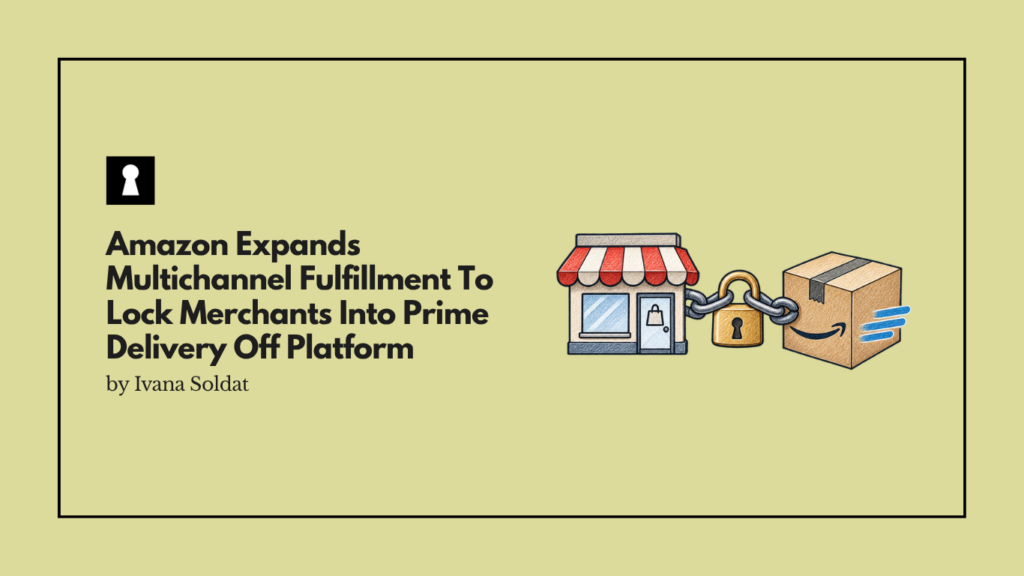
Amazon is aggressively extending its logistics tentacles beyond its own marketplace. The company announced that new and existing Multichannel Fulfillment merchants in the United States can now add the Prime badge and delivery speeds directly to their independent websites.
This move is a calculated play to capture off-Amazon commerce volume and bind merchants to Amazon’s infrastructure through sheer operational convenience.
Prime Badges On Independent Sites Are A Trojan Horse For Logistics Lock In
Amazon claims merchants can activate this Prime delivery option more than 70 percent faster on average compared to enabling standalone Buy with Prime.
By integrating directly into platforms like Shopify and leveraging the Selling Partner API, Amazon removes the friction of traditional third-party logistics onboarding.
The result is a seamless transition where independent brands unknowingly surrender their fulfillment autonomy. Once a merchant relies on Amazon’s network for their direct-to-consumer orders, migrating to a competing logistics provider becomes a prohibitively expensive operational nightmare.
The Ten Percent Sales Lift Masks A Dangerous Dependency
Amazon highlights a case study where a merchant experienced a nearly 10 percent increase in sales and a drastic reduction in customer service inquiries after enabling the feature.
The company also cites survey data indicating that 40 percent of Prime members are more likely to make a first-time purchase on a site displaying the Prime logo . While these metrics are undoubtedly attractive to growth-starved founders, they represent a Faustian bargain.
The sales lift is not generated by the merchant’s brand equity. It is generated by consumer trust in Amazon, effectively training the buyer to value the logistics provider over the product creator.
Preferred Pricing Discounts Are Designed To Crush Competing Third Party Logistics Providers
Alongside the Prime delivery integration, Amazon introduced the MCF Preferred Pricing Program, offering merchants a 15 to 25 percent reduction on fulfillment fees.
This aggressive discounting is a classic loss-leader strategy aimed at starving independent third-party logistics providers of volume. By subsidizing the cost of fulfillment for merchants who consolidate their volume with Amazon, the company creates an artificial price floor that smaller logistics networks simply cannot match.
Merchants celebrating these short-term savings are ignoring the long-term reality of having no viable alternative when Amazon inevitably raises its rates.
Early Adoption Rates Prove Merchants Are Desperate For Operational Relief
Amazon reports that more than 40 percent of eligible orders from early merchant adopters have already shipped with Prime delivery. This rapid uptake underscores a broader crisis in the direct-to-consumer sector.
Independent brands are drowning in the complexity of modern logistics, from fragmented inventory management to unpredictable carrier surcharges. Amazon is positioning itself as the only viable life raft.
However, accepting this rescue means handing over the keys to the entire post-purchase experience, including the customer data and shipping metrics that are critical for long-term brand building.
Our Take
Amazon is Actively Commoditizing Your Entire Operational Backend
The expansion of Multichannel Fulfillment to independent websites is a masterstroke of platform enclosure.
Amazon is successfully convincing merchants that outsourcing their most critical operational function is a mark of sophistication rather than a surrender of control. Founders must recognize that every order fulfilled by Amazon is a data point harvested to refine the very algorithms that will eventually compete with them.
If your brand cannot survive without borrowing Amazon’s trust badge, you do not have a sustainable business model.