
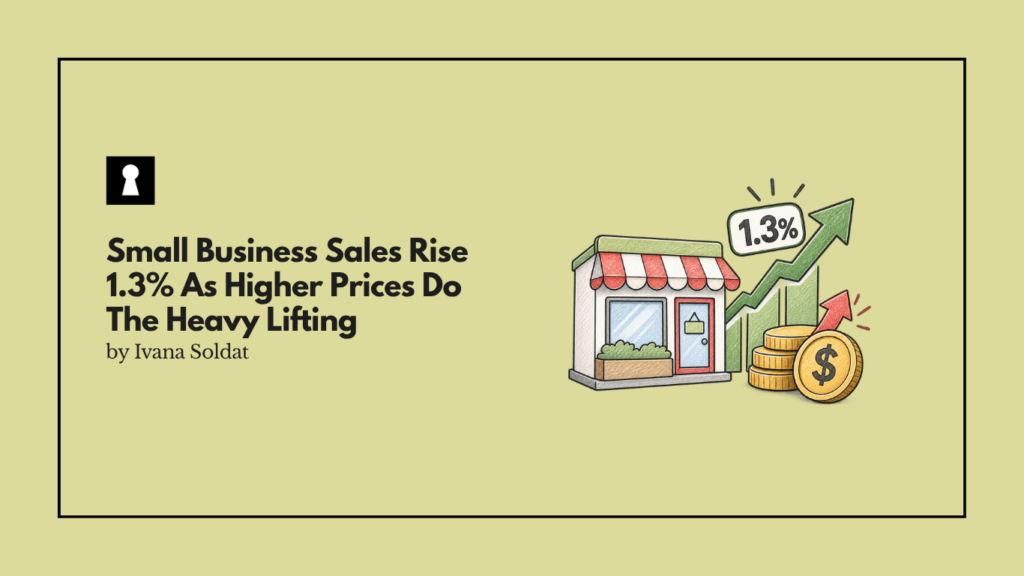
The latest Fiserv Small Business Index reports that small business sales rose 1.3 percent month over month, matching the high watermark set in June. On the surface, this appears to be a robust indicator of consumer demand.
However, the company explicitly notes that higher prices again did the heavy lifting to drive these results. When nominal sales growth is entirely decoupled from unit volume growth, it signals that merchants are successfully passing inflationary costs onto consumers, but they are not actually acquiring new customers or increasing transaction frequency.
Pricing Power Is Replacing Organic Demand
The fact that a 1.3 percent month-over-month increase is considered a high watermark reveals the underlying stagnation in real economic activity.
Small businesses are relying on their pricing power to maintain revenue floors. While this protects gross margins in the short term, it is a dangerous long-term strategy. Consumers have a finite tolerance for continuous price hikes on everyday goods and services.
Once that threshold is breached, transaction volumes will inevitably collapse, leaving merchants with high prices but no buyers.
The Illusion Of Health In The Small Business Ecosystem
Payment processors often use aggregate transaction data to paint a picture of economic vitality. By highlighting that sales matched June’s high, Fiserv is attempting to reassure investors and merchants that the consumer is still spending.
But spending more dollars for the exact same amount of goods is not economic growth; it is inflationary erosion. Small business owners celebrating a nominal bump in their payment processing statements must look closely at their unit sales.
If the number of items sold or services rendered is flat or declining, the business is not growing; it is merely surviving on borrowed time.
Margin Compression Forces A Tax On The End Consumer
The reliance on higher prices to drive sales growth underscores the severe margin compression facing independent merchants. Between rising supply chain costs, increased labor expenses, and elevated commercial rent, small businesses have very little room to absorb shocks.
The only available lever is the price tag. By continuously adjusting prices upward to match the 1.3 percent monthly growth target, merchants are effectively turning their customer base into a captive revenue source.
This dynamic accelerates customer churn as price-sensitive shoppers migrate to larger competitors who can subsidize costs through economies of scale.
Our Take
Pricing Your Way to Growth is a Slow-Motion Customer Exodus
The Fiserv Small Business Index is a masterclass in framing inflationary pain as commercial success.
Celebrating a 1.3 percent month-over-month sales increase driven entirely by higher prices ignores the reality that consumer wallets are not expanding; they are just being stretched thinner.
Small business owners who rely on continuous price hikes to match these index targets will eventually hit a wall of consumer resistance.
If your growth strategy depends on charging more for the exact same experience, you are not building a brand; you are just testing the absolute limit of your customers’ patience.