
The decision to offer 24/7 customer support sounds straightforward when framed as a customer satisfaction question. If customers are shopping at midnight, they should be able to get help at midnight. But framed as a cost-structure question, it looks significantly different, and most mid-market retailers approach it with the simple math of “three shifts means three times the cost” and are surprised to find the reality is worse than that.
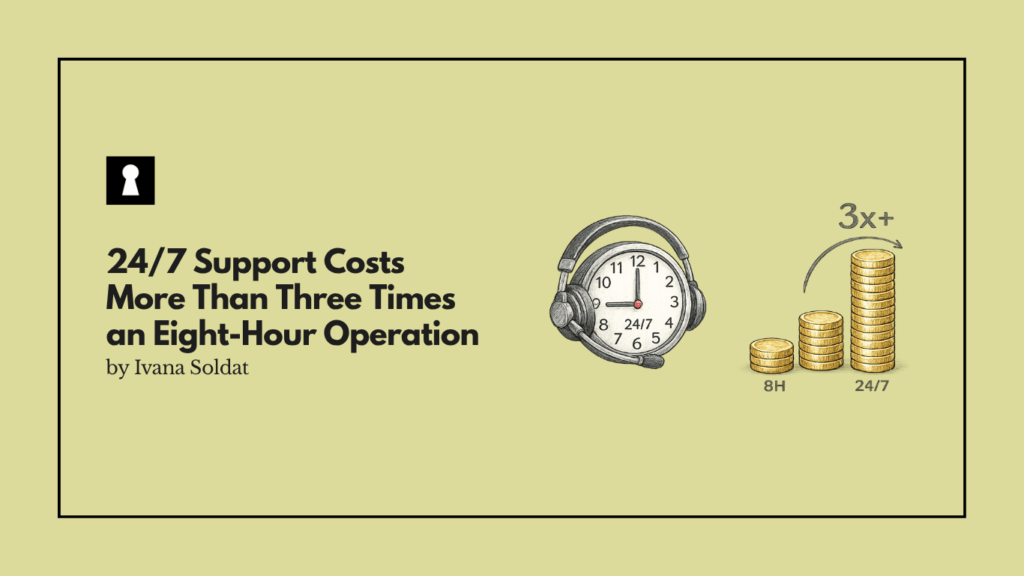
A 24/7 support desk costs more than three times an eight-hour operation. Overnight coverage comes with wage premiums, higher attrition, dedicated supervision, and minimum staffing requirements that make the per-contact cost significantly higher than daytime coverage alone.
The reason is structural, not merely additive. A daytime operation can staff to demand. An overnight operation has to staff to minimum viable coverage regardless of whether the phones are ringing. That irreducible floor, even in low-demand overnight windows, represents a fixed cost that daytime operations do not carry.
Add the wage premiums that overnight shifts command, the higher attrition rates overnight workers experience, and the dedicated supervisor costs that round-the-clock operations require, and the actual cost of 24/7 coverage can be two to four times the equivalent daytime rate per contact.
Whether You Actually Need It is the Question
The first and most important question is whether your customers are actually contacting you outside business hours in numbers that justify the cost. Before signing a contract, review at least 90 days of ticket, order, and contact data. If a significant share of orders, cart-abandonment issues, payment problems, or customer inquiries occurs outside business hours, delayed responses may be affecting revenue, customer satisfaction, and chargeback rates.
The data question matters because demand patterns vary enormously by category and customer base. A brand selling to international markets across multiple time zones has genuinely distributed overnight demand.
A brand selling primarily to domestic customers in a single time zone may find that overnight contact volume is a small fraction of daytime volume and that asynchronous response is adequate for the actual complaints being received.
If overnight demand remains low, a well-designed asynchronous support model combined with strong self-service resources may be more cost-effective than maintaining live overnight coverage. This is the answer most vendors of 24/7 support solutions will not give you, because their commercial interest is in selling you coverage you may not need.
How Follow-the-Sun Staffing Actually Works
For brands that do need genuine overnight coverage, the most cost-effective human staffing model is follow-the-sun: transferring support coverage between teams in two or three time zones so agents in each location are working local daytime hours, eliminating night-shift premiums.
A common setup for a US retailer combines a nearshore team in Mexico covering US business hours with an offshore team in the Philippines or Eastern Europe whose local daytime aligns with the US night. Each team operates during normal working hours, which improves retention and reduces errors associated with overnight work.
The tradeoff is not the cost of agents but the cost of coordination. Follow-the-sun introduces handoff moments, overlap hours where both teams are simultaneously active, and the operational complexity of managing multiple sites. Handoffs are where context gets lost, tickets fall between teams, and customers have to re-explain their situation.
Getting handoff quality right is the primary operational challenge of the follow-the-sun model, and most implementations underinvest in the handoff process relative to finding the right agents in the right time zones.
The Hidden Cost That Understates Every Vendor Quote
High turnover is the hidden cost most buyers undercount. Every agent departure triggers recruiting, onboarding, and ramp-to-productivity costs that never appear on your invoice.
The industry average monthly attrition rate for BPO customer support agents is 6 to 8%. Over a 24-month contract with a 20-agent team, that is 12 to 16 additional ramp cycles that you are paying for through reduced quality, slower resolution times, and repeat training costs, none of which appear in the hourly rate comparison you made when choosing the provider.
A provider at $10 per hour with 8% monthly attrition and a 12-month average client tenure will almost always cost more over 24 months than one at $14 per hour with 2.8% attrition and a 5-year partnership record.
The three metrics that reveal total cost of ownership more accurately than hourly rate are monthly agent attrition, average CSAT across active programs, and average client tenure. Those three numbers tell you how stable the team will be, how well they perform for comparable clients, and how satisfied other clients have been over time. Hourly rate tells you only what you will be invoiced, not what you will actually spend.
The AI Layer and Where It Does and Does Not Help
AI chatbots and virtual agents are genuinely effective at handling a specific category of overnight contact: high-frequency, low-complexity queries with deterministic answers. Order tracking, shipping status, return policy, size guides. These queries have correct answers that do not require judgment, and an AI handling them at 2am costs almost nothing per contact compared to the fully burdened cost of a human agent.
The challenge is that the most consequential overnight contacts are rarely in that category. A customer whose payment failed during a flash sale is not looking for order tracking. A customer who received the wrong product and is leaving on a trip in the morning is not a FAQ case.
We covered this dynamic in our Klarna chargeback piece earlier this month: Klarna’s consumer app allows buyers to initiate disputes with a button, and disputes arrive at merchants before the product has been returned, because the automated process does not require human judgment to trigger. The AI speeds up the process. The process that gets sped up is not always the one the merchant wants moved faster.
The correct model for most mid-market retailers is a tiered AI-first approach: AI handles the deterministic queries at any hour, routes complex and high-stakes contacts to the next available human agent with full context, and does not attempt to resolve complaints that require judgment, authority, or emotional intelligence.
That model reduces the headcount required for overnight coverage without eliminating it, because the contacts that reach a human at 2am are the ones that most require a human.
Our Take
Black Friday Is 14 Weeks Away. Your Support Model Needs to Be Set Before Then.
The 24/7 support question is one of the decisions mid-market retailers most often make on instinct and competitor imitation rather than on their own contact data and cost modeling. The answer is not always yes.
For some brands, well-designed asynchronous support with strong self-service resources is the right answer. For others, follow-the-sun with AI triage is the right answer. For a small number, genuine 24/7 human coverage is justified by their contact patterns and customer expectations.
Which category you are in is determined by your contact data, not by what your competitors are doing. The worst time to figure out your overnight support model is during a flash sale at 11pm on Black Friday, when your queue is backed up and your options are limited. August is when this decision should be made. The data to make it with is sitting in your support platform right now.