
While your B2B ecommerce site may be up and running, and you get some sales here and there, it’s hard to know just how successful your site is without tracking key performance indicators (KPIs). These indicators and metrics give you an inside look into the real performance of your site.
Not only that, but tracking the right B2B ecommerce KPIs over time gives you plenty of useful insights, which can do everything from improving your decision-making to driving more growth. Read on to learn more about why tracking KPIs is so important, and some of the most important ones for B2B companies to measure.
What are B2B Ecommerce KPIs?
B2B ecommerce KPIs are specific, trackable, and measurable metrics that you can use to judge the performance of various aspects of your business. These metrics may be specific data points related to sales, marketing, finances, customer service, HR, or essentially any other aspect of your business.
In addition to providing information and helping you track the success (or failure) of certain aspects of your business over time, ecommerce KPIs also help you see how you’re progressing toward specific goals, outcomes, or targets that you’ve set for the business.
They also help to turn raw data about your business into actionable insights that help you make better decisions and choices in the future.
Why Tracking KPIs Is So Important?
One of the main draws of tracking KPIs is that it eliminates guesswork. Instead of having to guess certain things about your company and its performance, based on assumptions, feelings, or basic data, you can get clear and comprehensive data that lays out exactly what’s happening behind the scenes, good or bad.
For example, instead of guessing how efficient your marketing has been during your latest campaign, you can track things like return on investment (ROI) and customer acquisition cost (CAC) to get a sense of how much money you made for what you spent, and the total cost of gaining a new customer, which often shows you whether your marketing was successful or not.
Overall, KPIs help to show and prove that your efforts are producing positive results, or let you know right away that things aren’t working, so you can adjust. Without measuring KPIs, you may be using ineffective tactics or methods for months before you realize they’re not helping you grow.
Running a business is expensive enough as it is, and you don’t need to be wasting more money on ineffective marketing, useless sales channels, or tools that don’t deliver actual results.
The Most Important B2B Ecommerce KPIs to Track
Now that you know what these KPIs are in general, and why tracking them is so important to your company’s success, let’s go over a few that you want to ensure you’re monitoring.
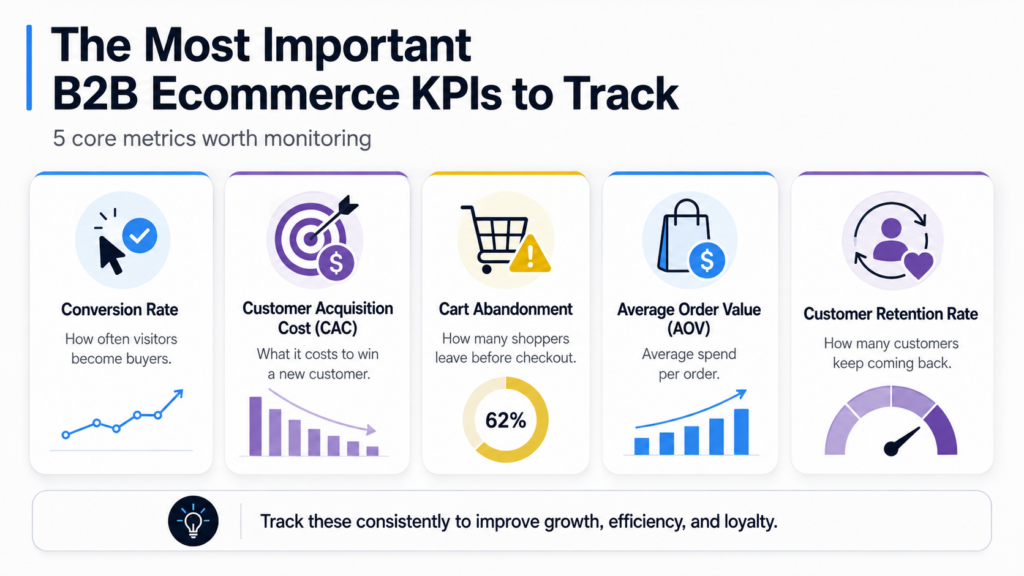
Conversion Rate
Conversion rate is a metric that measures how often you’re able to turn a site visitor into a customer who makes a purchase. The goal of every B2B company should be to have as high a conversion rate as possible.
However, conversion rates are generally quite low. While they vary depending on the industry and channel, they often hover around 3%. Because improving your conversion rate directly helps you increase sales, every brand should make an effort to do so.
Some ways to potentially boost conversions include reducing checkout friction, ensuring your site performs well, having transparent and honest pricing, and having a high-quality and smart site search. Basically, your goal is to make things as clear and straightforward as possible for someone to make a purchase.
Customer Acquisition Cost (CAC)
Customer acquisition cost (CAC) is the amount you spend to gain a new customer, and often helps to evaluate how effective your marketing and sales efforts have been. Average CAC can vary in B2B ecommerce, as companies targeting small businesses may only spend a few hundred dollars, while B2B organizations targeting enterprises may spend thousands or more.
As you could imagine, businesses would love to keep their CAC as low as possible. If your CAC is high, it could mean you’re targeting incorrectly with your marketing efforts or making things like your marketing journey too complicated for potential customers.
Cart Abandonment Rate
While traditionally more of a B2C metric, the increasing use of self-service digital storefronts in B2B means that cart abandonment rate is something B2B organizations should consider tracking. This KPI measures how many of your visitors put an item in their cart, but fail to actually check out and make a purchase.
A high cart abandonment rate often has something to do with friction in the checkout process. This could be a confusing checkout layout, hidden fees or costs, or even something as simple as a laggy, unresponsive, or slow checkout experience.
Many people have a low tolerance for slow sites, so make an effort to ensure your checkout and entire site are responsive and quick, on all devices.
Average Order Value (AOV)
Average order value (AOV) is all about determining how much, on average, is spent on each transaction. Of course, all brands would love to have a higher AOV, as that directly means more revenue and that people like what you sell, as an increasing AOV over time often means customers are buying more than one item or service.
If your AOV is low or going down, it may mean that customers aren’t happy with the range of items you offer, and are generally just buying the one or two things they usually buy, without ever expanding. To try and increase AOV, you can introduce bundle pricing, improve your cross-selling efforts, or offer personalized product recommendations.
Another tip for increasing AOV is to offer free shipping/delivery if a customer spends over a certain amount. This often drives AOV up, especially if someone is already close to the “free delivery” threshold.
Customer Retention Rate (CRR)
Customer retention rate (CRR) measures how many of your customers are loyal and continue to make purchases from you over time. Because keeping customers is often far less expensive than reaching new ones, all B2B brands need to do what they can to keep customers coming back.
Most successful businesses have repeat customers, and a high CRR often means a business is healthy and that customers like the products and/or services you sell. However, a low CRR may mean that your products or services aren’t as good as advertised, your customer service efforts are failing, or your onboarding is subpar.
Final Thoughts
Tracking and monitoring these KPIs ensures a B2B ecommerce brand has all of the insights and data it needs to make better decisions, monitor its progress over time, and achieve its goals. Measuring KPIs is often much more effective than relying on guesswork, and has the potential to save you tons of time, effort, and money.
Of course, make sure to focus on actionable and relevant KPIs, ensure you’re acting on the insights you uncover, and let them help you make data-driven decisions and choices, rather than just looking at them and doing nothing in response.
B2B Ecommerce KPIs: FAQs
Here are a few common questions about B2B ecommerce KPIs, along with their answers.
How to track ecommerce KPIs?
You can track KPIs through your built-in store analytics, by using manual spreadsheets, or by relying on certain kinds of ecommerce reporting tools.
How many KPIs should I track and monitor?
There’s no right or wrong number of KPIs you should track, as it depends on your goals and milestones. However, try to avoid tracking too many, as it may be overwhelming or distract you from what really matters. While every company is different, tracking anywhere from five to 10 core metrics may be the sweet spot for many brands.
What happens if an ecommerce brand doesn’t track ecommerce KPIs?
If brands don’t track KPIs, they’re operating blindly and don’t truly have insights on whether their sales and/or marketing efforts are actually delivering results. They may miss things that are easily catchable by measuring KPIs, such as wasted ad spend, stocking wrong inventory levels, dwindling profits, and more.