
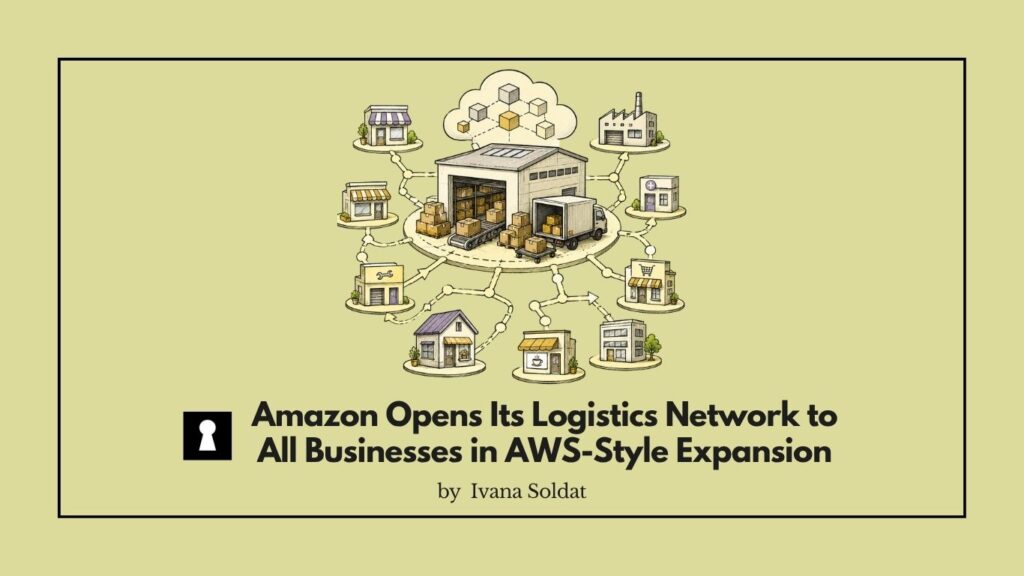
Amazon has launched Amazon Supply Chain Services (ASCS), making its freight, warehousing, fulfillment, and parcel delivery infrastructure available to any business, not just sellers on its marketplace.
The move represents the most significant expansion of Amazon’s logistics business since it began offering Fulfillment by Amazon to third-party sellers in 2006.
The Network That Built Amazon Is Now Open for Business
Announced on May 4, 2026, ASCS gives businesses across retail, healthcare, automotive, and manufacturing access to the same network that moves billions of items annually for Amazon and its marketplace sellers. The offering spans ocean, air, ground, and rail freight, bulk warehousing and inventory distribution, and a parcel shipping service promising two-to-five-day delivery seven days a week.
Procter & Gamble, 3M, Lands’ End, and American Eagle Outfitters are among the launch partners already using the network. Lands’ End is drawing on Amazon’s unified inventory pool to fulfill orders across multiple sales channels simultaneously.
American Eagle is using Amazon’s parcel network to ship directly from its own website to customers nationwide. P&G and 3M are using the freight layer for raw material and finished goods transport between manufacturing sites and distribution centers.
Businesses can access all services through a new centralized console launched alongside the announcement.
This Has Been Coming for Three Years
Amazon has been methodically building toward this moment for at least three years, during which hundreds of thousands of marketplace sellers have already used its logistics infrastructure for shipments to non-Amazon channels. That quiet expansion served as a proof of concept, and the results were evidently strong enough to justify a full commercial launch.
The AWS parallel Amazon draws is deliberate and instructive. Amazon built its cloud infrastructure to serve its own needs, then recognized the infrastructure itself had standalone commercial value. The same logic applies here. Its logistics network was constructed to win on delivery speed as a competitive differentiator in retail. Having scaled it to handle billions of units, Amazon is now treating it as a product in its own right.
Amazon says sellers using its end-to-end supply chain solutions currently see nearly 20% higher sales, a figure the company attributes to improved delivery speed and inventory positioning. Whether that figure holds for non-marketplace customers operating in different sectors is untested, but it reflects the internal benchmark Amazon is selling against.
The timing also connects to broader pressure on global supply chains. Businesses that relied on fragmented networks of freight brokers, third-party logistics providers, and last-mile carriers have faced persistent cost and visibility problems since 2020.
A single-provider model with end-to-end tracking has obvious appeal, particularly for mid-market companies without the procurement scale to negotiate competitive rates with multiple carriers.
Why Your Shipping Bill Might Never Look the Same Again
For existing Amazon marketplace sellers, the practical shift is consolidation. Sellers who already use FBA and Multi-Channel Fulfillment can now route more of their supply chain through a single Amazon relationship, from factory shipments and customs clearance through to delivery on their own DTC site or other platforms.
The unified inventory pool, which allows a single stock position to serve multiple sales channels, is particularly relevant for brands managing both Amazon and off-Amazon volume.
For retailers and brands that do not sell on Amazon at all, ASCS opens a new option in a market currently dominated by FedEx, UPS, DHL, and a range of regional 3PLs. The parcel shipping layer puts Amazon in direct competition with FedEx and UPS for commercial shipping contracts.
Amazon’s seven-day delivery operation and its density in residential last-mile delivery could give it a cost advantage in certain lanes, especially for direct-to-consumer brands with high residential delivery volumes.
The freight and distribution layers compete more directly with established operators such as XPO, Geodis, and Flexport. The decision by P&G and 3M to use Amazon for raw material and finished goods transport suggests the network has reached a scale and reliability threshold that makes it credible for complex, high-volume industrial logistics, not just consumer parcel delivery.
FedEx, UPS, and Every 3PL Just Got a New Rival
The launch sharpens Amazon’s competition with Shopify on one front and with traditional logistics providers on another. Shopify has built its own fulfillment network and positioned end-to-end logistics as a core part of its merchant value proposition.
Amazon’s ASCS, combined with its existing Multi-Channel Fulfillment product, offers comparable scope but with significantly greater infrastructure scale and the added dimension of freight and bulk warehousing that Shopify does not currently offer.
FedEx and UPS face a more direct threat. Both companies have invested heavily in their ground networks to serve ecommerce shippers. Amazon’s residential delivery density, built over years of Prime fulfillment, gives it a structural cost advantage in the delivery lanes these carriers compete hardest for. ASCS formalizes the competition rather than creating it.
Before You Sign Up, Read This
The immediate question for ecommerce operators is whether the pricing and service terms Amazon offers are competitive with their existing carrier and 3PL contracts. Amazon has not published rate cards for ASCS, and the launch announcement makes no specific claims about cost relative to incumbent providers.
Merchants evaluating the service should request direct comparisons on their actual shipping lanes, package profiles, and volume tiers before drawing conclusions from headline capabilities.
Brands that sell on Amazon and operate their own DTC channels should think carefully about what consolidating inventory into Amazon’s unified pool means over time. Handing Amazon greater visibility into total sales volume and inventory levels across all channels is a meaningful data tradeoff, even if the operational benefits are real.
For businesses outside retail, particularly in healthcare or automotive, the more pressing question is whether Amazon’s network carries the specialized certifications, handling protocols, and compliance infrastructure those industries require. The announcement names these verticals as target markets but provides no detail on how those requirements are met.
Amazon Did This With Cloud. Watch What Happens Next.
Amazon has framed ASCS explicitly as its AWS moment for logistics, and the comparison sets a high bar for what follows. AWS took years to move from internal tool to dominant market platform.
ASCS is launching with credible enterprise partners already signed, which accelerates the credibility curve, but the real test will be whether Amazon can convert mid-market and enterprise logistics relationships at scale while maintaining the service levels its marketplace sellers depend on.
The next signals to watch are pricing transparency, the pace of enterprise contract signings beyond the initial four launch partners, and whether Amazon moves to formally compete in commercial freight RFPs alongside FedEx Freight, XPO, and DHL Supply Chain. If that happens, the scale of the market Amazon is entering will become very clear, very fast.