
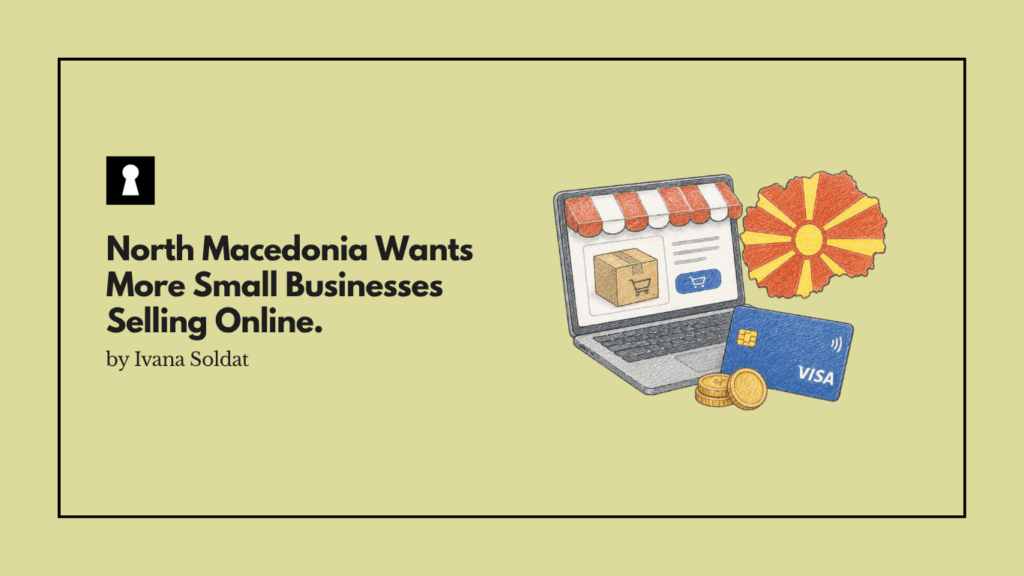
This looks like a small business grant. It is actually a supply-side ecommerce intervention.
North Macedonia’s online shopping market is already growing quickly. AETM’s analysis of National Bank data found that online transactions in the country reached €950 million in 2025, up 32% from 2024. But the growth is not being captured evenly by domestic sellers. Macedonians spent €428 million with foreign e-merchants in 2025, up 45%, while the share of total ecommerce value flowing to domestic e-merchants fell from 59% in 2024 to 55% in 2025.
That is the real reason this program matters. Demand is rising. Local supply is still catching up.
What Selected Companies Will Get
The program is aimed at Macedonian micro, small, and medium-sized companies that do not currently sell online, either through their own store or through a marketplace. Selected companies will receive a support package worth up to €1,000 for opening a new online sales channel. The money can go toward setting up a store on an existing local marketplace platform, including a marketing package, or toward developing a standalone software solution for the company’s own e-store.
The support is not just technical. Selected companies will also attend a one-day practical training course called “From Local Business to Online Store,” covering e-store management, digital marketing, and social media advertising. The training is expected to take place in September 2026 in Skopje, and participants will receive a certificate after completing the program.
AETM and Visa have already supported 55 domestic companies through the first three editions of the initiative. This fourth round adds another 15, bringing the program’s total reach to 70 companies if the new cohort is completed as planned.
Who Can Apply
The call is narrowly targeted. Applicants must be registered legal entities, must fall into the micro, small, or medium-sized business category, must not currently sell online, and must not have already received AETM support for opening an e-store through this or a similar initiative. AETM says up to two representatives from each selected company can attend the training.
There is also a small inclusion mechanism built into the scoring. Women entrepreneurs and applicants under the age of 29 receive an additional five points in the evaluation process. That matters because the program is not only trying to increase the number of e-stores. It is trying to broaden who gets pulled into the digital economy.
An online information session is scheduled for July 13 at 11 a.m., where the program and participation conditions will be explained. Applications must be submitted by July 20, 2026, and the selected companies will then go through evaluation, onboarding, store setup, and training.
The Bigger Problem is That Macedonian Businesses Are Still Not Digitized Enough
The program lands at a useful moment because North Macedonia’s ecommerce problem is not only consumer adoption. It is merchant readiness.
AETM’s Western Balkans ecommerce analysis found that only 19% of surveyed Macedonian companies sell products or services online, placing the country below the regional average. The same analysis found that only 41% of Macedonian companies have a website, only 33% use corporate email, and 23% do not use any of the listed digital tools at all.
That creates a structural gap. Consumers are shopping online, but many local businesses still do not have the basic digital infrastructure needed to compete for those orders. The result is predictable: more spending leaks to foreign platforms, while domestic merchants remain dependent on offline sales, social media inboxes, or informal ordering flows.
AETM’s own 2025 data shows that domestic ecommerce is growing, but foreign ecommerce is growing faster. The association reported 1,396 active e-sales points in 2025, 84 more than the previous year, but it also flagged the faster growth of transactions toward foreign e-merchants as a concern for the domestic economy.
Why Visa Is Involved
Visa’s role is not just sponsorship. Digital payments are part of the same adoption problem. In AETM’s announcement, Visa said its partnership with the association is meant to strengthen local economic growth and digital transformation, and cited Visa Pulse research showing that 42% of consumers in North Macedonia shop online at least once a month, while one-third shop online more often.
That puts pressure on merchants. If consumers are already forming online buying habits, local businesses that remain offline are not simply missing a secondary channel. They are missing where customer behavior is moving.
For Visa, more e-stores also means more digital payment acceptance. For AETM, more e-stores means a broader domestic ecommerce ecosystem. For small businesses, it means a lower-cost entry point into a market they may know they need to enter but do not know how to operationalize.
Our Take
This is a Small Program with a Bigger Signal Behind It.
A €1,000 support package will not transform a business by itself. Opening an e-store is the easy part. The harder parts come afterward: product data, photography, pricing, payments, delivery, returns, customer support, advertising, inventory updates, and trust. A store that launches without those basics becomes another inactive sales point.
But the structure of this program is smart because it does not treat ecommerce as just a website problem. It pairs store setup with practical education, and it targets companies that are not already selling online. That is exactly where the bottleneck is in markets like North Macedonia: not only getting consumers to shop online, but getting more local merchants ready to serve them professionally.
The bigger story is that ecommerce growth is already happening. The question is who captures it. If domestic companies do not move online fast enough, foreign platforms will continue taking a larger share of Macedonian online spending. AETM and Visa’s program will not solve that alone, but it is aimed at the right problem: turning offline local businesses into actual digital sellers before the market moves further without them.