
We’ve been covering the EU parcel duty story since before it took effect on July 1. The France national parcel tax that failed, the EAEU that missed its own equivalent deadline, Switzerland watching from the sidelines, Germany’s bevh chief executive saying the platforms would route around it through container logistics, and Temu losing 3.6 million Polish users as the price advantage eroded. Today’s data point is the first concrete measurement of what actually happened to Chinese parcel volumes in the six weeks since the duty took effect.
They fell 20%.
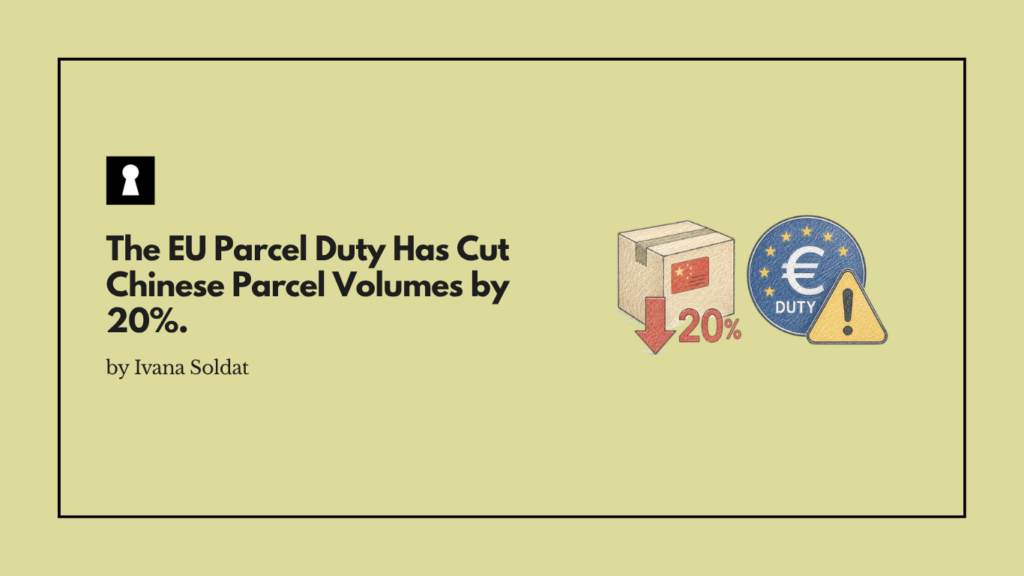
Parcel volumes from China entering the EU have declined approximately 20% since July 1. The projection, if the trend continues at this rate for a full year, is approximately 10 billion fewer parcels annually entering the EU from Chinese platforms.
What Is Driving the Drop
The 20% decline reflects three distinct dynamics happening simultaneously.
The first is genuine demand destruction. Some consumers who were buying low-price items from Temu, Shein, and AliExpress primarily because they were effectively duty-free have recalculated at the new price point. A €3 per-category duty on a €10 order is a 30% price increase on that order. For marginal purchases, the economics no longer work for the buyer.
The second is order consolidation. Platforms and logistics operators have been actively encouraging buyers to combine multiple purchases into fewer, larger orders to reduce the duty burden. A buyer who previously ordered five separate €8 items as five separate shipments, each incurring €3 duty, can now consolidate them into one shipment incurring a single €3 duty. Parcel volume falls but product volume and platform revenue do not fall proportionally.
The third is the warehouse transition. As we reported in the Germany H1 data piece and the JD.com European logistics story we covered this week, Chinese platforms have been building European warehouse networks that move goods into Europe via container before distributing them domestically within the EU. Parcels shipped from those European warehouses are not subject to the small parcel duty. As more volume shifts to this model, parcel-level import data understates how much product is actually reaching European consumers.
The Response: Warehouses and Consolidation
Temu, Shein, and AliExpress are not absorbing the duty cost as a margin hit. They are restructuring their European logistics operations.
Warehouse construction: all three platforms are accelerating the build-out of European fulfilment infrastructure. Goods imported in bulk via container, warehoused within the EU, and shipped to consumers from a European location are not subject to the small parcel duty. The economics of European warehousing look significantly more attractive after July 1 than they did before it.
Order consolidation: platforms are restructuring checkout and shipping logic to encourage buyers to combine purchases, reducing the number of individual parcel shipments that cross the border. This reduces per-unit duty costs while maintaining product volume.
The strategic implication is that these responses do not reduce Chinese platform competition in Europe. They transform it from a parcel-based cross-border model into a warehouse-based regional model. The €3 duty is being bypassed at scale, not absorbed.
What This Means for European Brands
The 20% drop in Chinese parcel volumes sounds like a win for European retailers. The warehouse transition means it is not an unambiguous win.
A Chinese platform shipping from China and incurring the €3 duty has higher logistics costs. A Chinese platform shipping from a European warehouse has European logistics costs but no duty burden, and potentially faster delivery, better return handling, and eligibility for the same delivery programmes that European consumers expect.
The parcel duty has not eliminated the competitive advantage of Chinese platforms in Europe. It has changed the infrastructure model through which that advantage operates. European brands and retailers that were hoping the duty would price Chinese competition out of the market are looking at a situation where the competition has responded by becoming more like them, with local warehouses and faster delivery, while retaining the manufacturing cost advantage that started this story.
Our Take
The EU Parcel Duty Worked. The Platforms Adapted. Both Things Are True.
The 20% drop in Chinese parcel volumes is the first concrete evidence that the EU’s July 1 policy change is having a measurable effect on cross-border trade flows within six weeks rather than months.
Whether the European Commission treats this as a success depends on what success was defined as. If the goal was reducing parcel volumes and generating customs revenue from cross-border ecommerce, it is working. If the goal was permanently levelling the competitive playing field between Chinese platforms and European retailers, the warehouse transition data suggests the levelling is temporary and the platforms are building their way around it.
The next six months will show whether the 20% reduction is a sustained shift or a transitional dip that stabilises as the warehouse infrastructure becomes operational and European consumers discover that Temu still delivers in three days, it just ships from Germany now.