
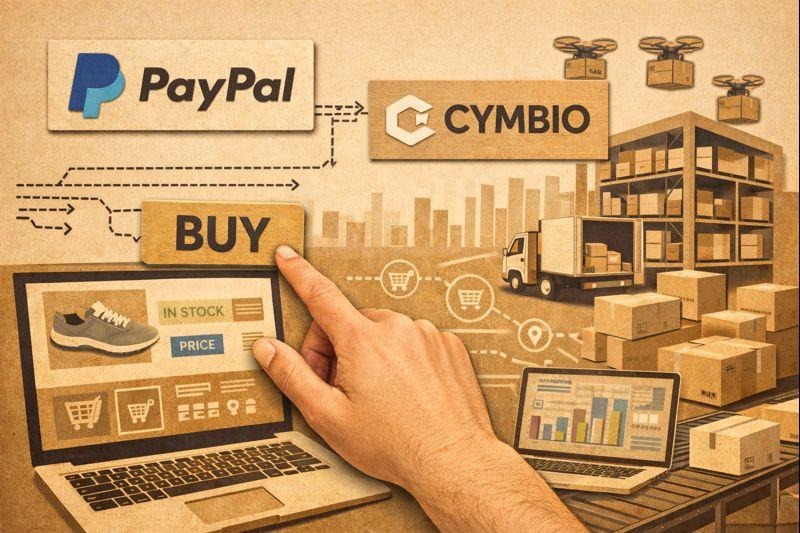
PayPal Holdings, Inc. announced recently that it has entered into a definitive agreement to acquire Cymbio, a leading brand-to-retailer automation and multi-channel orchestration platform. The move is a decisive and strategic play signaling PayPal is positioning itself not just as a payment processor, but as the transaction infrastructure powering AI-driven shopping across fragmented retail ecosystems.
Cymbio is best known for enabling brands to seamlessly syndicate product catalogs, inventory, pricing, and fulfillment logic across dozens of online retailers and marketplaces. Its platform automates dropshipping workflows and real-time inventory synchronization, all of which are capabilities that become exponentially more important when AI agents, rather than humans, initiate and execute purchases.
The acquisition arrives at a moment when major commerce platforms prepare for agentic commerce, a model where AI assistants research products, compare prices, check availability, and complete transactions autonomously on behalf of consumers.
The acquisition, reported on January 28, 2026, follows a successful strategic partnership between the two companies launched in late 2025. While financial terms were not disclosed, the deal is expected to close in the first half of 2026.
Why Agentic Commerce Changes How Shopping Actually Works
For the uninitiated, agentic commerce refers to an ecosystem where AI agents, or more specifically, autonomous bots powered by models like OpenAI’s ChatGPT, Google’s Gemini, or Perplexity, do the shopping for you. Instead of a consumer browsing a website, an AI agent finds the best price, checks inventory, and executes the purchase on the consumer’s behalf.
The challenge? Agentic commerce introduces a new level of operational complexity, in that AI agents require perfectly structured, real-time data to “see” products. This is where Cymbio comes in.
Cymbio’s core value proposition of automated brand-to-retailer connectivity directly addresses this complexity. Its system already handles:
- Real-time inventory synchronization across channels
- Automated order routing and dropshipping logic
- Catalog normalization between brands and retailers
- Scalable onboarding for multi-retailer distribution
When combined with PayPal’s payments, risk, and identity infrastructure, the result is a more complete transaction layer that can support autonomous purchasing at scale.
How PayPal Plans to Control the Full AI Shopping Pipeline
Historically, PayPal’s role in e-commerce has been narrowly defined. Its core responsibilities revolved around facilitating checkout, managing risk, and moving money. But as AI begins to compress the shopping funnel, payments alone are no longer a defensible moat.
By integrating Cymbio’s technology, PayPal aims to bridge the gap between an AI’s recommendation and a completed delivery. Cymbio’s platform automates the complex logistics of dropshipping and marketplace synchronization, ensuring that when an AI bot places an order, the inventory is actually available and shipping is handled seamlessly across different retailer platforms in real-time.
Specifically, Cymbio will power PayPal’s Store Sync service. This tool allows merchants to:
- Make product catalogs discoverable to AI interfaces like Microsoft Copilot and Perplexity.
- Maintain Merchant of Record status, keeping control of the customer relationship.
- Seamlessly drop orders directly into existing fulfillment systems.
PayPal’s acquisition suggests it wants to ensure that when an AI agent clicks “buy,” PayPal is the system that validates, routes, and settles the transaction across brand, retailer, and logistics partners.
The Quiet Infrastructure War Behind AI-Powered Commerce
The acquisition signals PayPal’s intent to stay ahead of rivals, such as Mastercard, which recently ramped up their own agentic infrastructure. The deal also reflects growing competitive pressure from other ecosystem players. Shopify, Salesforce, Amazon, and even Google are all investing in AI-driven commerce workflows that blur the lines between marketing, checkout, and fulfillment.
If AI assistants increasingly bypass traditional storefronts, the value of e-commerce shifts toward whoever controls the transaction rails and fulfillment verification. PayPal’s move mirrors similar strategic expansions seen elsewhere in the industry, where ownership of orchestration layers is becoming more important than front-end brand experiences.
“Acquiring Cymbio’s technology and team will enhance our agentic commerce capabilities and accelerate the expansion to more of our merchants,” said Michelle Gill, Executive Vice President and General Manager of Small Business and Financial Services at PayPal.
Currently, brands such as Abercrombie & Fitch, Fabletics, and Newegg are already utilizing these agent-ready services. With the acquisition, PayPal expects to scale this capability to millions of smaller merchants, positioning itself as the primary gateway for the bots that will soon handle our grocery lists and gift shopping. It also strengthens PayPal’s relevance to large brands that rely on distributed retail networks rather than direct-to-consumer alone.
What PayPal’s Cymbio Deal Means for Brands and Marketplaces
For brands already using Cymbio, the acquisition could unlock tighter integration with PayPal’s financial tools, including faster settlement, enhanced fraud protection, and potentially embedded financing options.
Retailers, meanwhile, may see PayPal evolve into a more influential intermediary that not only processes payments but also helps determine which inventory is surfaced to AI agents and how orders are fulfilled.
This raises strategic questions for merchants. As agentic commerce scales, visibility to AI decision-makers may become just as important as SEO or marketplace rankings. Infrastructure providers that feed clean, reliable data into AI purchasing systems will have disproportionate influence.
Why Owning the Transaction Layer May Decide AI Commerce
Unlike splashy consumer-facing AI launches, PayPal’s acquisition of Cymbio is a quieter infrastructure play. But it may prove more durable.
Agentic commerce will not succeed on intelligence alone. It requires deep, reliable inventory accuracy, fulfillment certainty, and transaction trust. By bringing Cymbio in-house, PayPal is betting that the future of shopping will be decided less by interfaces and more by invisible systems that make autonomous buying possible.
If that bet pays off, PayPal could emerge as one of the foundational platforms powering agentic commerce long after the novelty of chat-based shopping assistants fades.
In the race to enable machines to shop for humans, owning the transaction layer may be the most strategic position of all.