
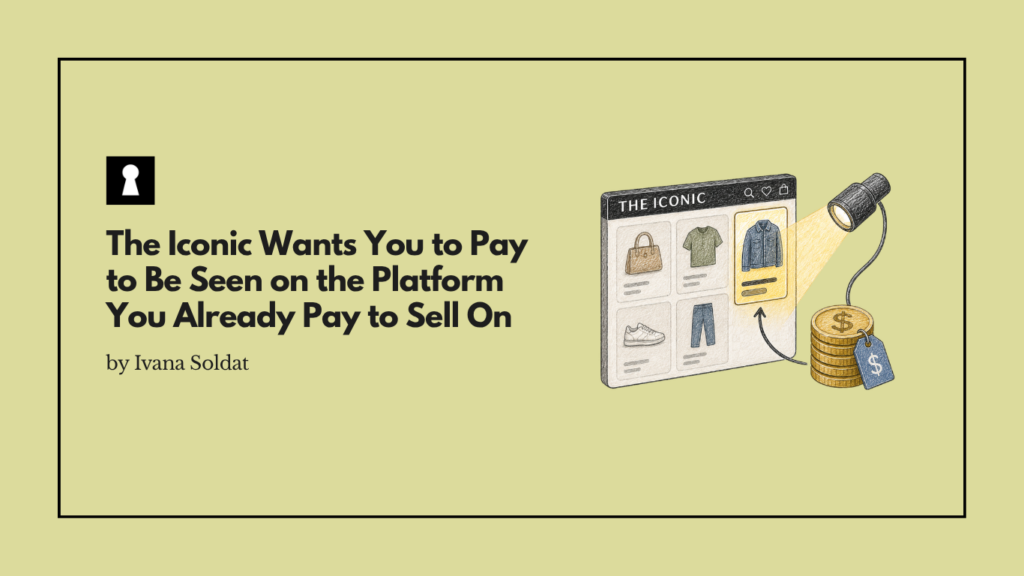
There is a moment in the life of every successful ecommerce marketplace when someone in a strategy meeting looks at the platform’s first-party shopper data and says “we should be selling this.” The Iconic has reached that moment.
THE ICONIC Media, formally introduced as a new retail media network in the H1 2026 ANZ Retail Media Report Card compiled by Mars United Commerce, positions Australia’s dominant online fashion destination as an advertising platform. Brands selling through The Iconic can now buy sponsored placements, display inventory, and targeted advertising using The Iconic’s purchase data to reach shoppers actively browsing and buying fashion online.
The launch is explicitly framed as a competitive move against Amazon’s growing Australian retail media presence.
The Playbook Everyone Is Running
Australia’s retail media market has been building fast. Cartology launched first for Woolworths. Coles 360 followed and became the first Australian retail media network to enter the IAB Australia and IAB Europe Retail Media Certification Program. The H1 2026 ANZ Retail Media Report Card introduced five additional networks including THE ICONIC Media alongside CommBank Connect, DoorDash Ads, Priceline Pharmacy Retail Media, and Briscoe Group. Afterpay has launched its Commerce Network. Petbarn, Australia Post, Adore Beauty, Bunnings, and Officeworks have all moved into retail media.
The logic is consistent across all of them: retailers own data about real purchase behaviour from authenticated customers. That data is more accurate, more privacy-resilient, and more directly attributable to sales than any third-party targeting available through Google or Meta. Brands advertising on a retailer’s own platform can measure whether their ads drove actual purchases with a directness that digital advertising almost never delivers elsewhere.
US advertisers spent $60.32 billion on retail media in 2025 and will spend $71.09 billion in 2026, with retail media ad spending growing 17.8% year-over-year, outpacing both social and search ad spending growth rates. Australia is following that trajectory with roughly a two to three year lag.
What Makes The Iconic’s Launch Different
Most of the Australian retail media networks launched so far are grocery-adjacent. They are reaching shoppers buying replenishment categories with predictable purchase cycles. The Iconic’s shopper base is fashion-specific, which is a meaningfully different data profile.
Fashion purchase data captures style preferences, brand loyalty, size consistency, gifting behaviour, seasonal patterns, and the relationship between browsing and buying in a category where the consideration window is longer and the emotional dimension of the purchase is higher. A brand advertising through THE ICONIC Media is reaching people who are thinking about how they want to dress, a higher-intent, higher-value moment for fashion brands specifically.
And The Iconic has something most Australian retail media networks do not yet have: significant scale in a single category. That concentration of fashion intent data in one platform is the asset THE ICONIC Media is selling access to.
The Part Fashion Brands Should Think Carefully About
When a retailer launches a retail media network, the relationship between the retailer and the brands selling through it changes in a way worth naming clearly.
Previously, a brand selling through The Iconic was a supplier: it provided inventory, the retailer sold it, and the relationship was primarily commercial. With retail media, the brand also becomes an advertiser on The Iconic’s platform, paying The Iconic not just for access to its distribution but for access to its audience. An audience the brand helped create by selling through the platform in the first place.
There is also a visibility dynamic that every brand entering retail media should understand. Brands that spend on advertising receive better placement. Brands that do not spend receive worse placement, not through any punitive mechanism, but through the straightforward mathematics of paid inventory taking the premium positions. Over time, the pressure to advertise in order to maintain visibility on a platform where you are also a seller creates a cost structure that brands need to model explicitly before they start.
The Home Depot Orange Apron Media piece we covered earlier this month noted that Home Depot is now selling its customer data to brands that do not even sell at Home Depot. THE ICONIC Media is starting with brands that do sell through The Iconic. The trajectory of retail media networks, as they mature, is consistently toward expanding the advertiser base beyond the seller base, which is when the data business and the retail business become genuinely separate revenue streams.
Our Take
Australia Is Going to Have a Data Concentration Problem.
The Iconic’s move into retail media is rational, well-timed, and exactly what any platform with its data position and market share should be doing in 2026. The brands that should engage with it carefully are the ones already selling through The Iconic who have not thought through what it means to also become an advertiser on the same platform. Retail media is not just advertising.
It is a new layer of commercial dependency on an infrastructure that controls your visibility, your data, and increasingly your customer relationship. That is not a reason to avoid it. It is a reason to enter it with a clear-eyed understanding of what you are buying and what you are agreeing to, because the brands that treated retail media as simply “more advertising” have consistently found that the compounding costs and dependency structures look different at year three than they did at launch.