
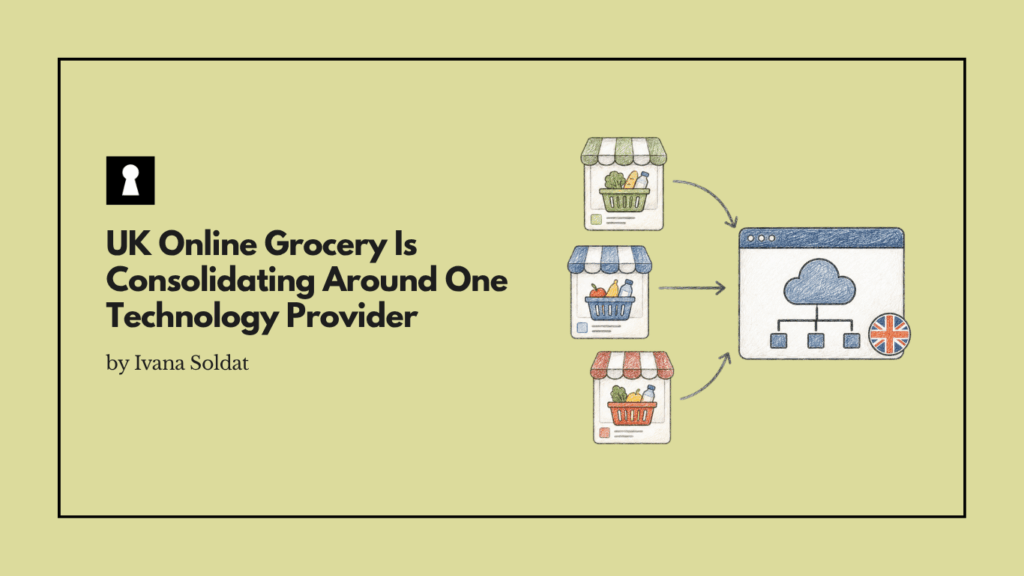
In 2027, a British shopper will be able to order groceries from Asda, Morrisons, or M&S online. All three will be powered by Ocado’s technology. The webshop experience, the picking software directing store staff, the routing algorithm planning the delivery van’s route, all of it running on the same platform, built and maintained by the same company.
Ocado confirmed the Asda timeline this week in its half-year results, following the partnership announcement in May. The deal is comprehensive: Asda’s customer-facing ecommerce site migrates to the Ocado Smart Platform, Ocado’s In-Store Fulfilment software takes over order picking in Asda stores, and Ocado’s routing technology handles last-mile delivery planning.
This is the right move for Asda individually. The grocer has been losing market share while rivals invested heavily in digital, and its existing online infrastructure has not kept pace. The technology works. The choice makes sense.
The question worth asking is what happens when three of the UK’s largest grocery retailers are all running on the same ecommerce infrastructure.
One Platform, Three Competitors, One Point of Failure
Ocado Smart Platform now powers Morrisons’ online grocery business, Ocado Retail (the joint venture with M&S), and from 2027, Asda. Together, these three represent a substantial and growing portion of UK online grocery, a channel that now accounts for 13.4% of the total UK grocery market, up from 12.5% a year ago.
Vendor concentration risk is well understood in supply chain management but rarely discussed in the context of ecommerce infrastructure. When multiple competitors in the same market outsource their technology stack to the same provider, they gain operational efficiency and access to best-in-class tooling. They also create a shared dependency that did not previously exist.
The risk scenarios are not hypothetical. A significant outage at the Ocado Smart Platform level does not affect one retailer. It affects every retailer running on it simultaneously. Asda, Morrisons, and M&S shoppers could all find themselves unable to place orders, track deliveries, or access their accounts at the same moment, because the failure point is shared infrastructure rather than separate systems.
This has already happened in a different form. In 2021, a fire at Ocado’s Erith customer fulfilment centre caused significant disruption to Ocado Retail. That was a physical infrastructure failure affecting a single warehouse. A software-level failure in the Ocado Smart Platform, a security incident, a major bug in a platform update, a service disruption at the cloud layer, would be felt across every retailer running on it.
The Kroger Comparison
The Asda deal is notably different from Ocado’s deal with Kroger in the US, which involves dedicated automated customer fulfilment centres. Asda will fulfil orders from its existing store estate using Ocado’s software, a lower-cost model that avoids the capital expenditure and long build times of dedicated warehouses.
That distinction matters for Asda’s economics and speed to market. It also means Asda’s online operation is more deeply integrated with Ocado’s software layer. There is no Asda warehouse to fall back on. The store picking, the routing, and the webshop are all Ocado’s domain.
What Ocado Is Actually Building
Seen from Ocado’s perspective, the accumulation of UK grocery clients is the validation of a business model that took fifteen years and enormous capital to prove. The Asda deal, following Morrisons and the M&S joint venture, is the licensing model working at scale.
Having multiple major UK grocers as platform clients is transformative for Ocado’s commercial position. Platform revenue is recurring, grows with partner GMV, and creates switching costs that make clients sticky. Once Asda has migrated its webshop, its picking operations, and its delivery routing to Ocado’s platform in 2027, the cost and disruption of switching to an alternative would be substantial.
That stickiness is valuable to Ocado and worth noting by anyone thinking about the long-term dependency structure the UK grocery ecommerce market is building.
The Silence Around Single-Vendor Infrastructure Risk
What is conspicuously absent from coverage of this deal is any serious discussion of what the UK Competition and Markets Authority makes of a situation where a single technology provider is becoming the dominant infrastructure layer for online grocery. This is not a market share question in the traditional sense, Ocado is not selling groceries in competition with Asda and Morrisons.
But it is a structural dependency question: when the operating software of multiple major competitors is controlled by a single firm, that firm has leverage that extends beyond normal B2B relationships.
A platform pricing change. A service level renegotiation. An access restriction on data that retailers generate through the platform. Any of these, applied simultaneously to Asda, Morrisons, and M&S, would affect a meaningful portion of UK online grocery with limited immediate recourse.
Our Take
One Company Is Quietly Becoming the Infrastructure for UK Online Grocery
The Asda-Ocado deal is good for Asda, good for Ocado, and good for UK grocery shoppers who will get a better online experience from 2027. It is also the latest step in a concentration of ecommerce infrastructure that deserves more scrutiny than it is getting. Outsourcing operational complexity to a specialist platform provider is rational for any individual company.
When multiple major competitors in the same category do it to the same provider, the individual rationality creates collective fragility. The UK online grocery market is building a dependency structure where a single vendor’s reliability, pricing decisions, and strategic choices will increasingly determine the competitive landscape for all of them. That is not obviously a problem today.
It is the kind of structural condition that becomes obviously a problem only after something goes wrong.