
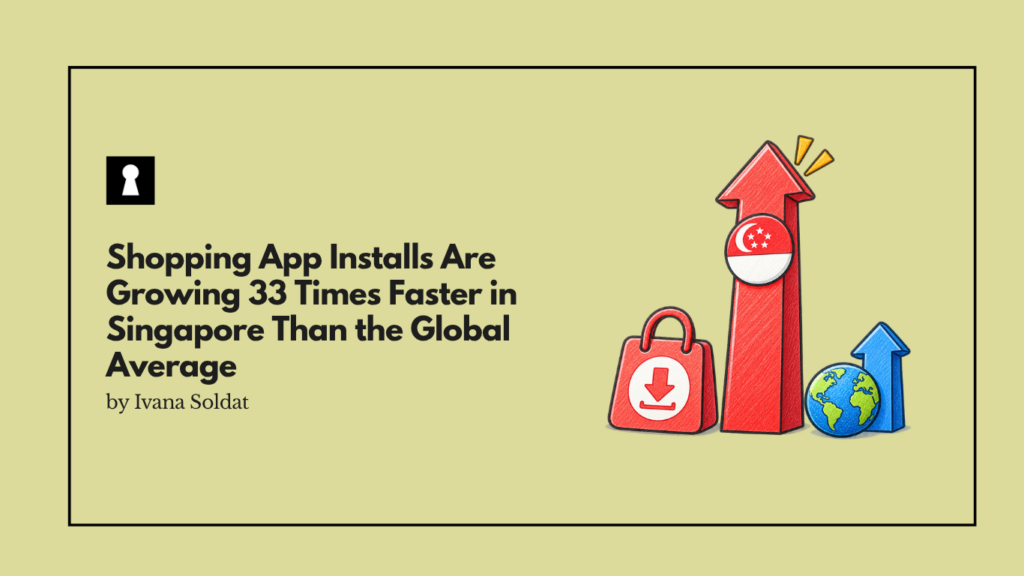
Two percent. That is how fast shopping app installs grew globally in the first half of 2026. It is a number that reflects mature market saturation: consumers in North America, Western Europe, and developed Asian markets already have the shopping apps they use.
Then there is Southeast Asia.
Singapore shopping app installs grew 67% year-on-year, the strongest increase of any market tracked globally. Vietnam grew 42%. Indonesia grew 36%. The Philippines grew 16%. Malaysia grew 14%. Every tracked market in Southeast Asia grew at least seven times faster than the global average. Singapore grew thirty-three times faster.
These are not noise. They are the data signature of a regional ecommerce transition that is still in its accelerating phase rather than its consolidating phase. The consumers installing shopping apps in Singapore, Hanoi, Jakarta, Manila, and Kuala Lumpur are not replacing old apps with new ones. Many are entering mobile commerce for the first time, or graduating from browser-based to app-based shopping, or adding a new platform to a portfolio they are actively building.
Sessions Are Growing Even Faster Than Installs
The install number tells you how many new users entered the market. The session number tells you how engaged they are once they arrive.
Global shopping app sessions grew 15% year-on-year. Indonesia and Singapore recorded the strongest session growth of any market globally, at 62% and 58% respectively.
Session growth running at four times the rate of install growth means that users who installed shopping apps in those markets are using them with dramatically increasing frequency. In mature markets, engagement tends to plateau as users establish habits. In Indonesia and Singapore, both the acquisition curve and the engagement curve are still climbing simultaneously.
The engagement intensity data strengthens this picture. Singapore ranked among the strongest markets globally for retention, with 16% of users returning a day after installing an app and 1.45 sessions per user on the day of installation, trailing only Japan. A consumer who opens a shopping app 1.45 times on the day they install it is not a casual downloader. They are an active shopper who found something worth returning to within hours.
Vietnam’s Acquisition Shift Is the Most Interesting Data Point
The paid-to-organic acquisition ratios describe market maturity and competitive dynamics, and the most dramatic shift in the Adjust data belongs to Vietnam.
Globally, the ratio of paid to organic installs reached 0.72, up 26% from 2025. Vietnam moved in the opposite direction, its ratio falling 54% to 0.89 from 1.92 a year earlier.
A ratio of 1.92 means that a year ago, Vietnamese shopping app installs were almost twice as likely to come from paid advertising as from organic discovery. A ratio of 0.89 means more Vietnamese users are now finding shopping apps through organic channels than paid ones.
This is a maturity signal. Early in a market’s ecommerce development, platforms have to spend heavily on paid acquisition because consumers do not know what apps to look for. As the market matures, brand awareness builds, word-of-mouth accelerates, and organic installs grow. Vietnam’s dramatic ratio shift in a single year suggests the market moved through a maturity threshold faster than most observers expected.
The implication for brands: the paid acquisition playbook that worked in Vietnam in 2025 is less necessary and less efficient in 2026. Brands that invested in organic presence and community building last year are now benefiting from that investment at exactly the moment when organic installs have surged.
Malaysia Is Going the Other Way
Malaysia had the highest reliance on paid acquisition of any market, at a ratio of 1.11, more paid installs than organic. The Philippines eased 34% to 0.73.
Malaysia’s ratio suggests the ecommerce app market is still in a phase where platforms need to spend aggressively to drive discovery. For brands planning Malaysian market entry or expansion in H2 2026, paid acquisition remains the primary channel and should be budgeted accordingly.
Who Is Being Downloaded
Temu ranked as the most downloaded shopping app worldwide in the first half of 2026, leading in Europe, Latin America, the Middle East and North Africa, and North America. SHEIN and Shopee’s Indonesian app took second and third place globally. In the Asia-Pacific region, Meesho and Shopee Indonesia topped downloads, ahead of Flipkart, Douyin’s shopping app, and Amazon.
Temu as the world’s most downloaded shopping app is significant context for EcomWatch’s EU parcel duty coverage this month. We reported that EU Chinese parcel volumes dropped 20% after the July 1 duty, and that Temu lost 3.6 million Polish users in six months. In Europe, Temu is losing ground. Globally, it is still the most downloaded shopping app. The headwinds in one region have not overcome the momentum the app is generating in others.
The Asia-Pacific regional picture, Meesho and Shopee Indonesia ahead of Amazon and Flipkart, reflects the structural reality that Southeast Asian ecommerce is dominated by regional platforms with deep local integration rather than the global giants that lead in Western markets.
The Advertising Concentration Signal
Several Southeast Asian markets, including Vietnam, Thailand, Indonesia, and Singapore, had cut the number of advertising partners they worked with, a sign of marketers concentrating spending on better-performing channels.
This is consistent with what we have been covering in global advertising markets: the consolidation of ecommerce advertising spend toward fewer, higher-performing channels as measurement matures. For brands planning regional advertising spend in H2 2026, the implication is concentration rather than diversification, identify the one or two channels delivering the best-attributable returns in each market and allocate accordingly.
Our Take
Southeast Asia Is Not One Market. The Data Proves It.
The Adjust data is the clearest quantitative picture available of what every operator who has visited Southeast Asian ecommerce markets in the past year already knows: the region is not a single market and it is not at a single stage of development.
Singapore at 67% install growth and 1.45 sessions on install day is a highly engaged, rapidly maturing market that rewards product quality and organic presence. Vietnam at 42% install growth and a dramatically improving organic acquisition ratio is a market that just crossed a maturity threshold and is rewarding early brand investment. Indonesia at 36% install growth and 62% session growth is a massive market in active acceleration.
Malaysia at 14% install growth but the highest paid-to-organic ratio is a market where competitive intensity is still high and paid acquisition is still necessary. Any brand or platform treating these five markets as a single “Southeast Asia” strategy is misreading data that is telling five different stories.