
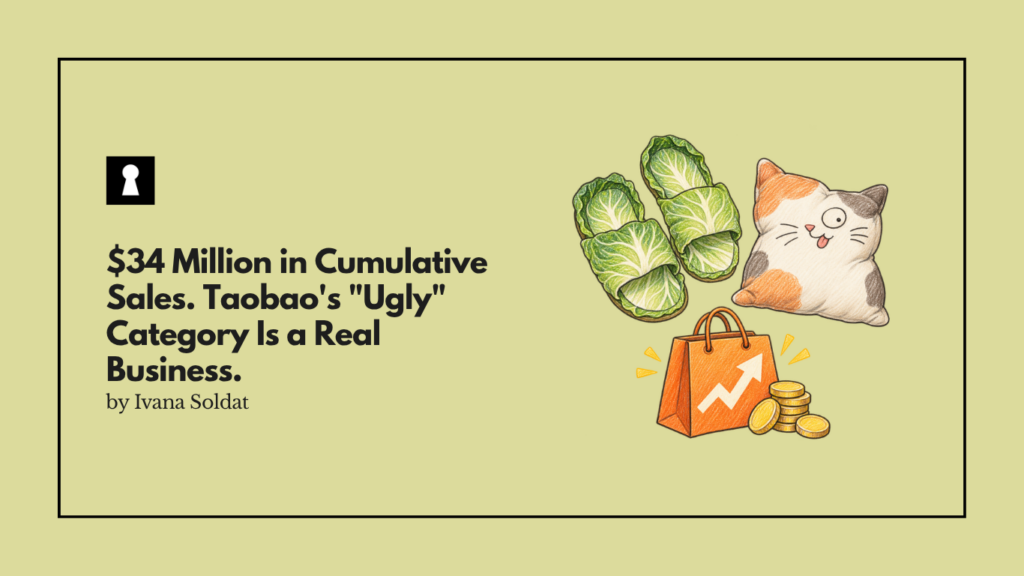
Cumulative sales of ugly products on Taobao have surpassed 230 million yuan since 2020, when Taobao launched its Uglies Award. This year marks Taobao’s second Treasured Uglies Art Exhibition, themed “Ugly, But Mine”, in Hangzhou, covering an area nearly twice as large as last year’s inaugural event, open through September 27.
“Consumers are not just buying oddly shaped goods, but the emotions, stories and self-expression they carry,” said Hu Yu, project lead for the Uglies Award. “Some keep these items on their work desks, while others wear them to show their personal styles.”
Why 230 Million Yuan Matters More Than It Sounds
The number needs context. 230 million yuan accumulated over six years across Taobao’s entire marketplace is not large relative to Alibaba’s total GMV. It is, however, 130 percent larger than it was a year ago, when the cumulative figure stood at 100 million yuan.
That growth rate is the signal. The ugly product category is not a static novelty. It is compounding. And the exhibition that Taobao is running around it, growing from one year to twice the size the next, is a merchandising and brand investment that Alibaba would not be making if the commercial returns were not there.
The Consumer Psychology Behind It
The “emotional consumption” framing that Taobao uses to explain the category connects directly to several consumer trends EcomWatch has been documenting all year.
The kidulting piece we published this week described adults buying toys, blind boxes, and creative products as a form of self-expression and stress relief, with brands like Lego Botanicals tapping into the same “affordable luxury with emotional resonance” positioning. The NIQ barbell market report quantified the $1.1 trillion US FMCG market splitting, with the brands winning premium doing so through identity alignment rather than functional superiority.
Younger consumers are fuelling the popularity of these products because they want to express their individuality. As the economy languishes, they are also looking for affordable luxuries. “In recent years, emotional consumption has become more and more of a ‘blue ocean’, meaning it’s becoming increasingly popular, turning into a new spending track,” said Yu Hu.
The “blue ocean” framing is the part that should attract attention from brand strategists. A blue ocean is a market space where competition is minimal because the category itself has not been clearly defined. Taobao is explicitly claiming that ugly, quirky, emotionally resonant products at accessible price points represent an underserved market that is growing rapidly as younger Chinese consumers move away from the hyper-polished aesthetic that has dominated ecommerce product photography for a decade.
The Labubu Connection
The best-known global example of this aesthetic category is Labubu, the ugly-cute toy character from Pop Mart with wide eyes and a toothy grin, which generated a global buying frenzy with celebrity fans including Rihanna and David Beckham. Labubu is not conventionally beautiful. Its appeal is specifically in its unconventional features and the emotional reaction those features generate.
Pop Mart’s success with Labubu, and the global reach of that success, demonstrates that the Chinese youth consumer trend toward ugly-cute emotional consumption is not a domestic Chinese niche. It exports.
What This Means for Product Strategy Outside China
The most directly applicable insight for non-Chinese ecommerce brands is not about aesthetic choices. It is about the consumer relationship between product and identity.
A consumer who buys a conventionally beautiful product has made a safe choice. A consumer who buys something intentionally strange or quirky has made a statement about their taste, their individuality, and their willingness to reject the homogeneous aesthetic of algorithm-optimised ecommerce.
This is the same consumer psychology that drives streetwear limited drops, designer collaborations that are deliberately bizarre, and the blind box mechanic we covered in the kidulting piece: low-stakes self-expression with emotional stakes that punch above the price point.
For any brand trying to differentiate in a crowded category where product quality differences are marginal and price competition is intense, the ugly products category offers a counterintuitive template. The market does not always reward the most polished product. Sometimes it rewards the product that gives the buyer something to feel.
The Second Annual Exhibition Is the Signal
Taobao running a second annual exhibition twice the size of the first is not a marketing campaign. It is a category investment: a competition, an award, a physical exhibition, a content and community ecosystem. That is the kind of investment a platform makes when it has identified a durable consumer behaviour rather than a passing trend.
Our Take
Ugly Sells. The Data Now Proves It.
The Taobao ugly products category is easy to dismiss as a novelty and miss the commercial significance underneath it. The 130 percent cumulative sales growth in twelve months, combined with Alibaba’s growing exhibition investment, describes a category that has crossed from trend to business.
The consumer driver, emotional consumption and individual self-expression among younger consumers navigating economic pressure, is not China-specific. It is the same dynamic driving kidulting growth in the US and UK, Pop Mart’s global Labubu phenomenon, and the NIQ barbell market finding that brands winning in the premium tier are doing so through identity alignment rather than functional superiority.
The ugly products category is an extreme expression of that dynamic. The question it poses to every ecommerce brand is a useful one: are you building something people want to be associated with, or something people want to own? The former is harder to replicate.
The former is also what 230 million yuan in cumulative Taobao sales and Labubu’s global celebrity following suggest consumers are willing to pay for.