
The battle for the future of ecommerce is no longer about who has the best website. It is about who controls the artificial intelligence agents that will soon make purchasing decisions on behalf of consumers.
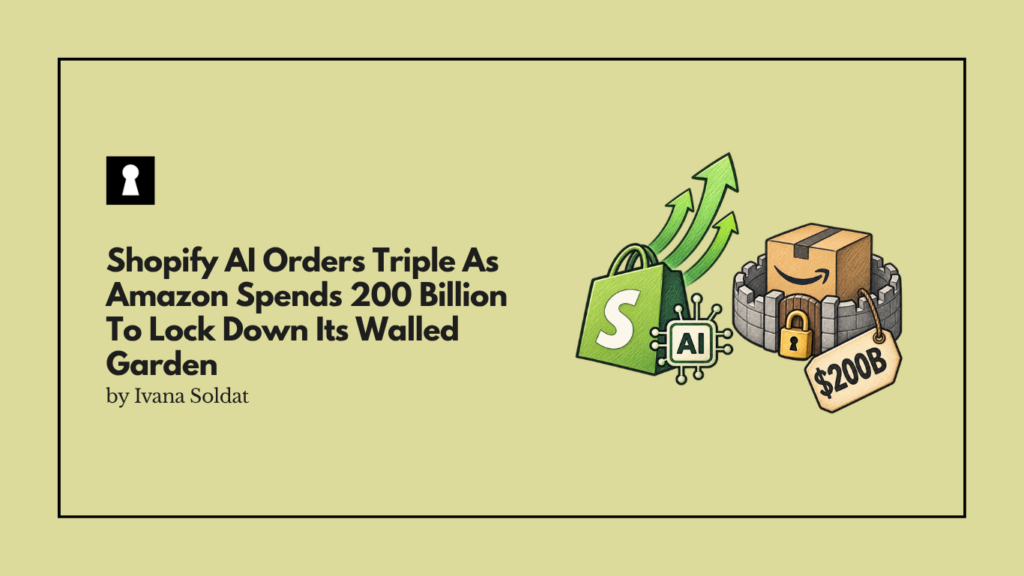
Amazon and Shopify recently reported quarterly results that reveal a fundamental schism in how the industry will handle this transition. Amazon is building higher walls to keep transactions inside its proprietary network, while Shopify is laying pipes to ensure its checkout runs behind every AI agent on the open internet.
Amazon Monetizes Captive Audiences While Blocking External Agents
Amazon generated $200.61 billion in revenue during the second quarter of 2026, representing a 19.6 percent increase. A significant driver of this growth is its closed AI ecosystem.
Over 350 million customers used Alexa for Shopping in the past year, and shoppers who click a sponsored prompt convert to a sale 48 percent more often.
Furthermore, advertising revenue surged 26 percent to $19.81 billion. Amazon is actively blocking external AI shopping agents from interacting with its marketplace, ensuring that any AI-driven discovery ultimately funnels back into Amazon’s own monetization loop.
Shopify Bets The Farm On Open Web Checkout Infrastructure
Shopify took the exact opposite approach, growing revenue 33.7 percent to $3.58 billion with gross merchandise volume reaching $115.57 billion. The company reported that AI-driven orders tripled year over year.
Shopify’s Catalog now lists more than one billion products, and AI searches powered by this structured data converted at twice the rate of traditional scraped data searches.
By making every merchant ready for the Universal Commerce Protocol, Shopify allows external AI agents to build carts and check out seamlessly through Shop Pay, which recently surpassed $400 billion in lifetime accelerated gross merchandise volume.
The Hidden Cost Of Open Ecosystems Is Rising Loan Losses
Shopify President Harley Finkelstein stated that agentic transactions carry the exact same economics as a standard online store transaction. However, the financial reality of scaling an open checkout network is already showing cracks. Transaction and loan losses rose to $141 million from $80 million in the previous period.
As Shopify opens its doors to a wider array of autonomous AI agents, the platform assumes greater fraud and credit risk. The company must prove that the volume of tripled AI orders can outpace the escalating costs of managing open ecosystem vulnerabilities.
Capital Expenditures Reveal Amazon Defensive Posture
Amazon plans to spend roughly $200 billion on capital projects in 2026, driving its trailing twelve-month free cash flow to negative $7.6 billion.
This massive outlay is not just for server farms. It is a defensive moat designed to integrate brands directly into Amazon’s supply chain network, as seen in recent partnerships with Procter and Gamble and 3M.
Amazon is spending heavily to ensure that when an AI agent needs to source, fulfill, and deliver a product, the path of least resistance leads directly back to an Amazon warehouse.
Our Take
Control of the Checkout is the Only Metric that Matters in the Agentic Commerce Era
The narrative that Shopify is democratizing AI commerce is a convenient framing for a company that lacks the logistics network to compete directly.
Shopify’s open model is a brilliant survival tactic, but it turns the company into a commoditized payment pipe for whoever builds the smartest AI agent. Amazon, conversely, is willing to burn billions in free cash flow to ensure it owns the entire stack from discovery to delivery.
Independent merchants cheering for Shopify’s open web utopia must realize they are simply trading one master for another, as AI agents will inevitably favor the platform that guarantees the fastest and most reliable fulfillment.