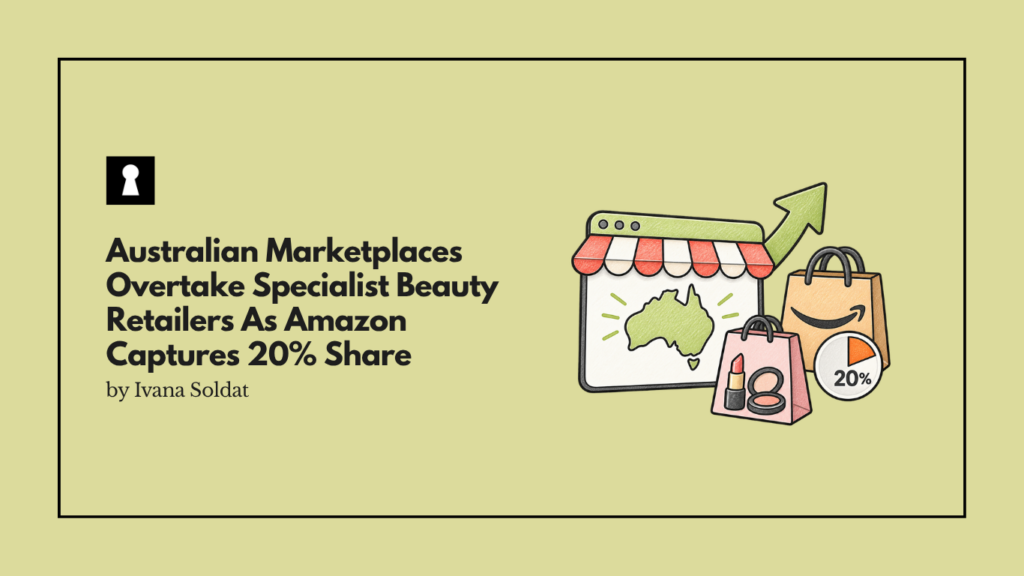
The era of specialty beauty retailers dominating the Australian digital landscape has officially ended. In the fourth quarter of 2025, online marketplaces generated approximately $200 million in beauty sales, edging out the combined $199.3 million total of Mecca, Sephora, Adore Beauty, and Chemist Warehouse.
This crossover event is not a temporary anomaly but a fundamental rewiring of how consumers discover and purchase cosmetics, driven by algorithmic search and frictionless checkout.
Amazon Captures Twenty Percent Of The Market Through Relentless Convenience
Amazon drove the majority of this marketplace advance. The company’s local beauty and personal care turnover rose by $66.7 million year on year, lifting the operator to a 19.9 percent share of Australia’s total online beauty spend.
Shopper intent points to further consolidation of this dominance. Research indicates that 71 percent of Australian digital beauty shoppers plan to purchase products on Amazon over the next twelve months. Perhaps most damaging to legacy brand equity is the finding that 43 percent of consumers will switch to an alternative brand if their first choice is out of stock.
This proves that logistical convenience now decisively trumps traditional brand loyalty in the beauty sector.
Social Discovery Funnels Leak Directly Into General Marketplaces
Discovery patterns are actively pulling shoppers away from traditional storefront browsing. Nearly half of surveyed beauty shoppers reported buying items based on creator recommendations, a figure that dwarfs the 15 percent seen across non-beauty retail sectors.
While Instagram and Facebook shape purchase intent for 47 percent of beauty shoppers, discovering an item on social networks rarely results in a direct in-app checkout. Instead, 39 percent of buyers who spot products on social feeds complete their transactions on standalone retailer or brand websites.
Crucially, another 32 percent head directly to Amazon to finish the order. Specialty retailers are effectively funding the top of the funnel for general marketplaces to close the sale.
Artificial Intelligence Is Rewiring The Product Research Phase
Artificial intelligence assistants are now actively routing consumer purchase paths, bypassing traditional retail search bars entirely. Data shows that 38 percent of Australian beauty shoppers use AI tools more frequently than they did last year to search for products online.
Roughly 27 percent of consumers have relied on ChatGPT or comparable conversational tools to research or buy cosmetics, and 55 percent express confidence in AI-generated product advice. This shift transfers power away from proprietary retail media networks and toward generative platforms that aggregate recommendations without retailer bias.
Global beauty conglomerates are already adapting, with companies like Estee Lauder partnering with marketing startups to optimize brand visibility across generative platforms including ChatGPT and Google Gemini.
Specialty Retailers Face An Existential Margin Squeeze
For dedicated beauty retailers, the loss of market share to general merchandise marketplaces threatens the high-margin basket sizes that have long supported domestic store networks.
Department stores and specialty chains can no longer rely on exclusive supplier arrangements to protect digital footfall when marketplace logistics offer faster shipping and lower barriers to checkout. Brand owners face an equally sharp operational trade-off. Direct-to-consumer storefronts carry heavier customer acquisition costs as search engines and social platforms shift toward algorithmic discovery.
This forces brands to list on Amazon or risk losing sales to competing formulations, effectively surrendering their margin to the very platform undermining their independence.
Our Take
Convenience has Officially Defeated Curation in the Australian Beauty Market
Specialty beauty retailers built their empires on the illusion of exclusive curation, but Amazon has proven that consumers value frictionless fulfillment over expert advice.
The data showing 43 percent of shoppers will swap brands for immediate availability is a death knell for legacy retail loyalty programs. Brands must recognize that their direct-to-consumer storefronts are becoming increasingly expensive vanity projects.
If you cannot match the logistical speed and algorithmic visibility of a general marketplace, you are merely serving as a free showroom for Amazon’s eventual dominance.