The Halloween season has evolved from a single-day event into a prolonged, high-stakes retail battleground. According to a recent survey of 1,500 U.S. consumers by Deloitte, shoppers plan to spend an average of $285 per household on the holiday this year.
This total is split between $66 dedicated to experiences and $219 allocated directly to retailers.
While two-thirds of respondents report they can comfortably afford these expenditures, the underlying financial mechanics reveal a more fragile consumer base.
Buy Now Pay Later Is Subsidizing Festive Consumption
The most alarming trend in this year’s seasonal spending is the normalization of debt for discretionary holiday purchases.
Despite a majority of shoppers expressing confidence in their ability to pay, one in five Halloween shoppers will use BNPL services or other financing to cover their costs. This behavior is directly tied to macroeconomic anxiety, as 42 percent of respondents anticipate the economy worsening in the year ahead.
Retailers are inadvertently becoming facilitators of consumer debt, relying on third-party financing to keep average order values elevated when disposable income is constrained. This creates a dangerous dependency where Q4 revenue growth is artificially propped up by credit rather than genuine wage growth.
The Timeline Is Accelerating As Shoppers Front Load Purchases
The traditional October rush for Halloween goods is collapsing into a September phenomenon. More than half of shoppers, or 56 percent, planned to make their Halloween purchases by the end of September, with 37 percent aiming to finish most of their shopping before October 1.
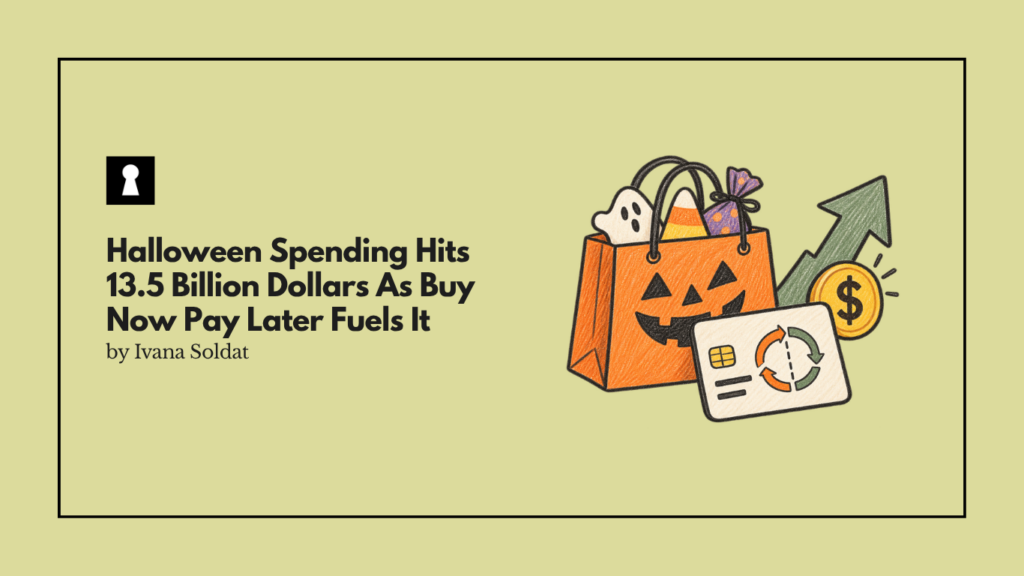
This acceleration is corroborated by broader industry data. The National Retail Federation predicts that shoppers will spend a total of $13.5 billion on Halloween this year, up from $13.1 billion the prior year, with nearly half of those shoppers planning to begin their errands in September or earlier.
For retailers, this means inventory must be fully staged and marketing campaigns must peak weeks earlier than historical norms, compressing the operational window for error.
Grocery Stores Are Winning The Seasonal Foot Traffic Battle
While e-commerce remains a critical channel, capturing a third of all Halloween shopping intent, physical retail is dominating the category. Two-thirds of respondents are buying their items in stores, but the destination mix is highly revealing.
Over half of respondents are headed to grocery stores, outpacing big box stores at 47 percent, discount and dollar stores at 40 percent, and specialty Halloween stores at 36 percent.
This indicates that consumers are prioritizing convenience and consolidation, preferring to pick up candy, basic decorations, and last-minute costumes during their routine weekly food runs rather than making dedicated trips to specialty retailers.
The Breakdown Of Seasonal Wallet Share
The allocation of the $285 average household budget highlights where retailers should focus their inventory investments.
Consumers plan to spend an average of $57 on costumes and accessories, $54 on decorations, $48 on candy, food and beverages, and $32 on dining and social outings.
The heavy weighting toward consumables and low-cost accessories suggests that while top-line spending is growing, consumers are still trading down on big-ticket seasonal items, opting for incremental, lower-risk purchases that can be easily financed or absorbed into a regular grocery budget.
Our Take
Holiday Spending is Now a Measure of Access to Credit
Retailers celebrating the projected $13.5 billion Halloween haul must look past the top-line vanity metric and examine the financing mechanisms driving it.
When one in five shoppers relies on BNPL to afford a holiday that is fundamentally discretionary, the foundation of that growth is highly unstable. Brands that aggressively push early September inventory without offering flexible payment options will lose market share to those who do.
However, relying on debt-fueled consumption is a short-term strategy that will inevitably lead to a painful reckoning when credit limits are reached and the bill comes due in Q1.