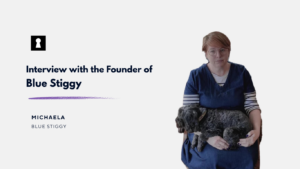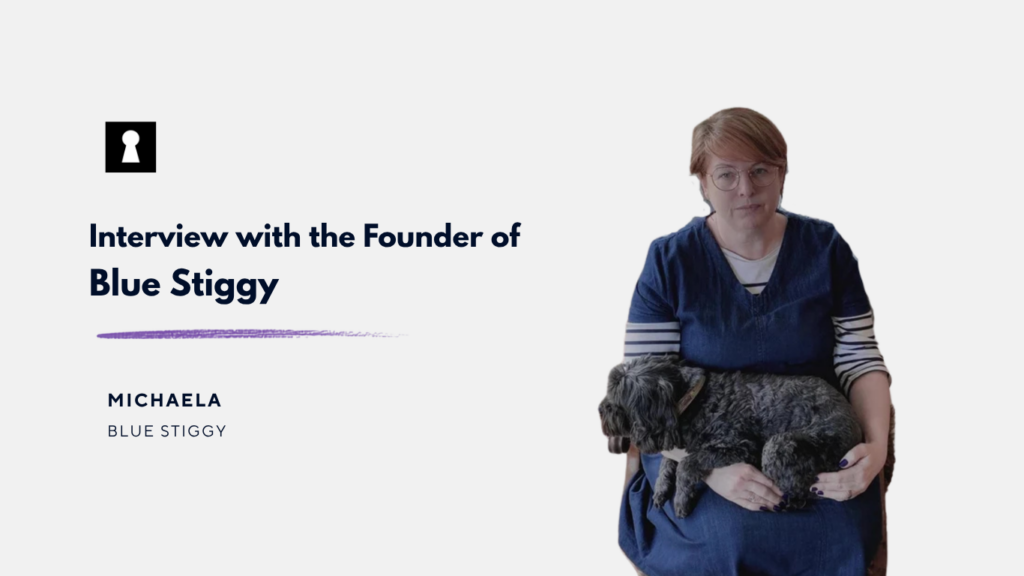
For Michaela Bere, one of the most important people in her business isn’t actually a person.
It’s Dorothy, her vintage typewriter.
From her studio in the Lincolnshire countryside, Michaela runs Blue Stiggy, creating handmade, eco-conscious notebooks and stationery. Each notebook is hand-painted and hand-stitched, with customers able to have their own words typed onto the cover by Dorothy.
It’s a deliberately analogue product being sold in a very digital world.
Blue Stiggy began on Etsy, where a collaboration with Etsy and Tan France would eventually send Michaela’s shop to another level. But that success also exposed one of the vulnerabilities of building a business around someone else’s platform.
Today, Michaela sells through a mix of Etsy, her own website and Holly & Co, while increasingly focusing on growing direct sales, building her email list and returning to wholesale.
We spoke to her about standing out in a crowded stationery market, the reality of selling handmade products online, why her personalised notebooks outperform everything else and the ecommerce experiments that have actually worked.
Can you introduce yourself and tell us what Blue Stiggy does?
“Blue Stiggy is in Lincolnshire, in the countryside, and we make – I say ‘we’, like it’s me and my typewriter. It’s just me,” Michaela laughs.
More accurately, perhaps, it’s Michaela and Dorothy.
Blue Stiggy primarily creates handmade personalised notebooks and stationery, with a strong focus on environmentally conscious materials.
The distinctive part comes at the end of the process: customers can choose the words that appear on their notebook, which Michaela types individually using Dorothy, her vintage typewriter.
That combination of handmade production and old-school personalisation has become central to the identity of the business.
How did you come up with the idea?
It didn’t begin with a grand ecommerce plan.
Michaela’s children had been given a couple of typewriters and used them to write Minecraft stories when they were younger.
Eventually, they grew out of them.
So Michaela borrowed one.
“I called it Dorothy and put her to work.”
At the time, Michaela was working more as a textile artist, experimenting with dyeing and botanical contact printing. She wanted to make something practical and started thinking about books.
Her first idea was to type directly onto fabric.
That didn’t work.
But during the process she discovered cotton rag paper made using waste from the textile industry.
“I thought, ‘Oh, we could do that.’ And it just emerged from there.”
She put the resulting personalised notebooks on Etsy.
Then, as Michaela puts it, the idea “just grew legs”.
The notebooks started selling, customers responded to the personalisation, and Blue Stiggy gradually moved away from textile art towards the product that had found its audience.
You started on Etsy. When did you decide you also needed your own website?
Etsy was the obvious starting point.
“For somebody very first starting out, I’d still recommend it,” Michaela says. “Just start off while you prove your concept.”
She estimates she has been selling there for around a decade, beginning with Etsy before adding markets and becoming involved with what was then the Nottingham Etsy team.
Growth initially came slowly.
Then something happened that dramatically accelerated it.
Michaela landed a collaboration with Etsy and Tan France.
“That skyrocketed my shop,” she says. “That was a big catalyst to big success on Etsy.”
There was one problem.
At that point, Michaela didn’t have her own ecommerce website.
She understood the danger intellectually. Depending on one platform meant depending on one source of sales.
“I knew that it wasn’t a good idea to rely on one source of income, and I knew the bubble would burst,” she says.
But understanding the problem and actually finding the time to fix it were two different things.
“I didn’t make the time to do the work to find my own means of selling.”
Eventually, she decided that had to change.
“I really needed a website. I really needed my own place to sell as well.”
Today, she still hasn’t abandoned Etsy. Instead, the objective is diversification rather than replacement.
What proportion of your sales now comes from your website versus Etsy?
Michaela’s sales are now spread across several channels.
The main three are her own website, Etsy and Holly & Co.
“My website definitely takes more,” she says. “But it is good to have a good mix rather than rely on one place.”
The website has also opened up a type of customer that doesn’t necessarily fit neatly into the traditional direct-to-consumer model.
Michaela receives larger business orders from yoga instructors, wellness coaches and similar businesses, which might order 10, 20 or 30 personalised notebooks at a time for workshops or to give to clients.
Those buyers have become an increasingly interesting part of Blue Stiggy’s customer base.
And they demonstrate one of the advantages of owning the customer journey rather than relying entirely on a marketplace: different use cases and types of buyers can find the business directly.
Stationery is a crowded ecommerce category. How do you make Blue Stiggy stand out?
Michaela’s answer is straightforward.
Dorothy.
“As far as I can see, there’s nobody else in the world doing it how I do it,” she says.
“Nobody else is personalising handmade notebooks on a typewriter.”
She jokes that Dorothy is really the business rather than her.
The differentiation doesn’t stop with the typewriter. The notebooks themselves are hand-painted, making Blue Stiggy fundamentally different from stationery businesses built around illustrations that can be printed repeatedly at scale.
That distinction comes with a trade-off.
Mass-produced or printed stationery can generally be sold more cheaply than something individually painted, stitched and personalised by hand.
In retail environments, that can make competition difficult.
But Michaela isn’t trying to win by being the cheapest notebook on the shelf.
The handmade process and personalisation are the product.
Which products perform best?
The personalised notebooks.
By far.
“That’s the thing you just can’t get anywhere else,” Michaela says.
Customers can put virtually whatever they want on the front, which becomes particularly powerful when the notebook is being bought as a gift.
For Michaela, the most enjoyable orders are sometimes the ones she understands the least.
“My favourite ones to type are the ones that make absolutely no sense,” she says, “because it means it’s something really, really personal between the giver and the receiver.”
If she can’t understand the words or the joke, she’ll sometimes invent a backstory herself while making the notebook.
But personalisation can also take on a much deeper significance.
Shortly before our conversation, Michaela had been asked to create a memory book for a customer whose father had died. The book would be used to collect messages, stories and memories from people who knew him.
“It’s always such an honour to be trusted to make something like that.”
It’s an example of something that’s difficult to replicate through mass-produced personalisation: the maker knows that the words they’re typing can carry real meaning for the person receiving the finished product.
What has been the biggest challenge with selling online?
For a handmade business, simply getting a product online can represent a surprising amount of work.
A new item doesn’t just need to exist.
It needs to be photographed, described, uploaded and presented properly before anyone can buy it.
“Getting something online just takes so much more time,” Michaela says.
That makes one-of-a-kind products particularly difficult.
She might create new books while demonstrating her stitching at a market and sell them there without ever listing them online.
To put the same products on her website would require an entirely separate process of photography, descriptions and product-page creation.
For that reason, she tries to avoid building too much of the online business around one-off pieces.
But an even bigger problem is one familiar to almost every independent ecommerce brand.
Visibility.
“I think that’s probably the biggest thing for most small brands,” Michaela says.
It’s an area she’s actively trying to improve.
Creating the product is one job. Getting enough of the right people to discover it is another.
What is the hardest part of running the business in general?
Juggling everything.
Or, in Michaela’s slightly more creative description, “wearing all the platforms, plates and spinning all the hats.”
The problem with running a small business is that progress in one area can quickly reveal neglect somewhere else.
“You feel like you’re getting somewhere with something and you’re doing really well with this,” she says. “But then this thing over here needs attention too.”
Marketing, products, orders, the website, marketplaces, wholesale and everything else compete for the same person’s time.
“There is so much stuff to juggle.”
Michaela now uses comprehensive Notion databases to try to keep it under control.
Which marketing or upselling techniques have actually worked?
Michaela admits she’s only recently started treating her promotional calendar more seriously instead of, in her words, “bumbling around”.
But some of her most successful promotions haven’t looked much like conventional promotions at all.
One is her Secret Stationery Cupboard.
Access is reserved for email subscribers.
Michaela uses it for unusual or one-of-a-kind pieces that don’t necessarily fit into the main online catalogue, including books she produces while teaching bookbinding or demonstrating her craft at markets.
Rather than simply discounting them, she turns access into a benefit of joining the email list.
“Only people that subscribe can even buy it.”
She can then promote the cupboard on Instagram, giving followers a reason to move from a social platform onto an audience that Blue Stiggy owns.
“Come join my email list and you can be in my Secret Stationery Cupboard.”
It has worked well enough that Michaela is continuing to experiment with the concept.
Another successful campaign was considerably more playful.
For Easter, she hid digital Easter eggs around the Blue Stiggy website.
Customers had to explore the site to find them, with different eggs containing different prizes or discounts.
“That worked really well,” she says. “And it’s good fun.”
It’s a very different approach from simply putting 20% OFF across a homepage.
And that’s partly the point.
The promotions that fit Blue Stiggy best feel like an extension of the personality of the brand.
What’s next for Blue Stiggy?
Visibility remains the biggest priority.
Etsy and Holly & Co continue to play important roles, and Michaela says her website is performing better than either of them.
But she wants to push it further.
“I want it to be even more and even better.”
Wholesale is another area returning to the agenda.
While juggling different parts of the business, Michaela admits she allowed wholesale to “slip completely off my radar”.
She now wants to spend the coming months rebuilding that side of Blue Stiggy.
At the same time, she’s particularly interested in the business customers already purchasing multiple notebooks for workshops, retreats and clients — such as wellness coaches and yoga instructors.
They’re not quite traditional wholesale buyers, which can make them particularly attractive.
Michaela is also experimenting with entirely different ways to generate revenue and grow her audience.
She recently organised an online event, essentially a summit, although she deliberately avoided calling it one because the word felt “really businessy”.
The experiment worked.
“It brought in good revenue and grew my email list, and everybody liked it.”
She plans to run it again, although definitely not during the fourth-quarter rush.
What’s the best advice you’ve picked up during your entrepreneurial journey?
Early on, Michaela paid close attention to people who were already several steps ahead of her.
When she joined the Nottingham Etsy team, she watched what more experienced sellers were doing and learned from them.
Eventually, she became captain of the team herself.
But perhaps the more important lesson came from repeatedly putting herself forward before she felt entirely ready.
Joining that Etsy team was one of those moments.
At the time, Michaela estimates she had made only around 26 Etsy sales.
She certainly didn’t consider herself qualified to advise experienced sellers.
But the team needed people to help.
Her thought process was simple.
“I’m a person. I can help.”
So she volunteered.
Looking back, she believes that one decision may have eventually helped lead to the Tan France collaboration — not immediately, but through a long chain of relationships and opportunities over several years.
“That specific thing probably led to the Tan France collaboration after a very long series of steps.”
It has shaped the way she approaches opportunities today.
“Put yourself forward for things that you’re not quite sure you’re ready for yet, but you think you can do.”
“It’s a little bit scary, but I just took the decision I was going to do it and did.”
And there is one other lesson she’d give ecommerce founders.
One she learned after watching her Etsy shop take off.
“Don’t rely on one source of income.”
You can check out Blue Stiggy shop at: