
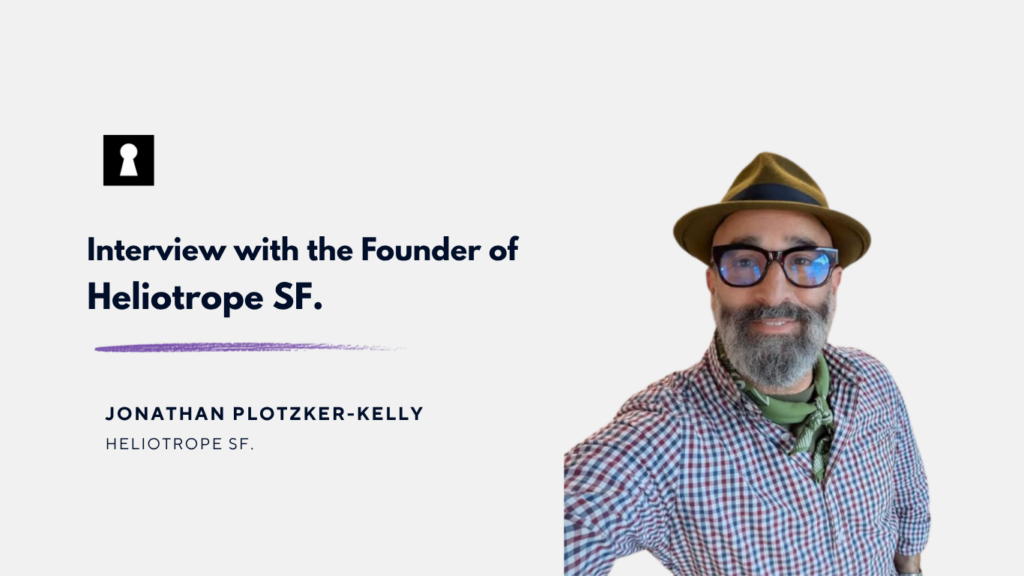
Jonathan Plotzker-Kelly has spent much of his life in two of the most diverse urban communities in the United States.
Born and raised in The Bronx, he now lives in Oakland, where he runs Heliotrope SF, the all-natural skincare company he founded in 2010.
That background feels fitting for a company that has never tried to become a faceless national beauty brand. Heliotrope has remained deliberately local, small, family-owned, and personal, qualities Plotzker-Kelly sees less as limitations than as reasons customers continue to support the business.
Long before sustainability and refillable packaging became common talking points in beauty, he was already thinking about how skincare products were made, packaged, customized, and reused.
Learning the business before launching Heliotrope
Plotzker-Kelly’s introduction to the beauty industry came through Bare Escentuals, now BareMinerals, where he worked in the mid-1990s.
During his time there, he developed relationships with small Bay Area chemists and contract manufacturers and became familiar with natural product development. The company was also experimenting with ideas that would later become much more common across beauty and personal care, including product customization and refilling.
“We were doing customizing and refilling way before the current wave of sustainability,” he says.
As Bare Escentuals grew into a major cosmetics company, those programs eventually disappeared.
Plotzker-Kelly took the ideas in a different direction.
When he opened Heliotrope’s first small shop in San Francisco’s Noe Valley neighborhood in 2010, refilling was built into the business from day one. Customers could bring back empty containers and receive discounted refills, while frequent buyers could purchase favorite products in bulk — sometimes by the gallon.
There was another layer of customization too. Most products were offered fragrance-free, but customers who wanted scent could have them customized with pure essential oils.
More than 15 years later, those same ideas remain central to the brand.
Standing out without constantly reinventing the brand
Natural skincare has become dramatically more competitive since Heliotrope launched.
Thousands of brands now talk about clean ingredients, sustainability, small-batch production, and transparency. But Plotzker-Kelly has not responded by repeatedly repositioning the company.
Instead, Heliotrope has continued doing many of the same things that differentiated it in 2010.
Customers can still refill products at the company’s Oakland studio, while refill-focused retailers around the Bay Area and elsewhere in the United States stock Heliotrope products in bulk.
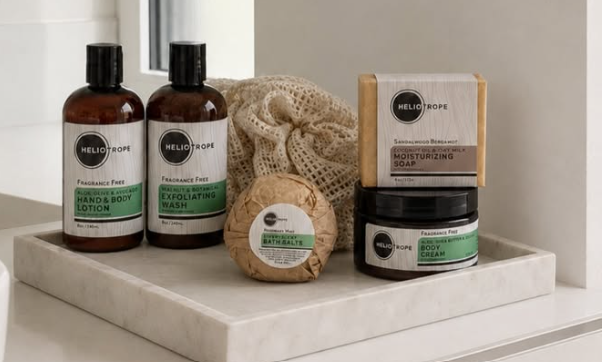
Most of the range remains fragrance-free, without synthetic fragrances or artificial colors. For customers who do prefer scented products, the company offers 36 essential oils and blends for customization.
Heliotrope also continues producing in small batches, helping control inventory and reduce unnecessary waste.
And the company makes little attempt to hide the humans behind it.
Plotzker-Kelly and his family regularly appear in Heliotrope’s social content, reinforcing the sense that customers are buying from an independent company rather than an anonymous beauty conglomerate.
“We’re local, we’re still small and family owned,” he says.
Selling something customers cannot smell through a screen
Skincare presents a particular challenge in ecommerce.
A shopper cannot feel the texture of a lotion, smell a cleanser, or test a serum before checking out. For an unfamiliar brand, that can create substantial hesitation.
Heliotrope compensates for that uncertainty with longevity, reviews, transparency, and a deliberately informal brand voice.
After 16 years in business, the company has accumulated a long record of customer feedback, with the overwhelming majority of its product reviews receiving five stars.
Its fragrance-free range also removes one common source of uncertainty when purchasing skincare online. Customers who do want fragrance can customize products with familiar essential oils such as lavender.
Product education plays another role.
Heliotrope describes its ingredients in detail rather than relying solely on broad beauty claims, while its website, emails, and social channels maintain what Plotzker-Kelly calls a “homey” writing style.
That lack of polish is intentional.
He believes the company’s approachable copy and “amateur-and-friendly” social presence help shoppers trust both him and the brand.
The uncomfortable economics of free shipping
Another challenge for small ecommerce brands is shipping.
Customers have become accustomed to free delivery, but independent brands do not have the logistics networks or shipping discounts available to major retailers.
Heliotrope recently increased its free-shipping threshold from $50 to $60 as costs rose.
Plotzker-Kelly believes customers generally understand the trade-off.
The company does not treat shipping as a profit center, and its small-business identity gives customers some context for why delivery cannot simply be absorbed into the cost of every order.
The threshold also has a measurable commercial benefit: it increases average order value.
Plotzker-Kelly regularly sees customers add a second product, or a second unit of the same product, to qualify for free shipping.
For Heliotrope, it is a reminder that even a necessary operational decision can influence purchasing behavior.
Refills create a natural reason to return
Repeat purchasing is especially important in personal care because products such as cleanser, deodorant, lotion, soap, and shaving products are inherently replenishable.
Heliotrope does not need to invent an elaborate retention mechanism around that behavior.
For local customers, refilling provides a built-in incentive to return. They can bring back packaging rather than buying another container every time they run out.
Even customers outside the Bay Area respond to the principle behind the program, Plotzker-Kelly says. Supporting a company committed to refilling and reducing packaging can itself strengthen customer loyalty.
Bulk purchasing provides another option. Customers who know they love a particular product can purchase more at once, lowering packaging usage while saving money.
Quality remains the foundation.
“If customers love our products, it’s not hard to imagine they want to come back and purchase it again,” he says.
Subscriptions are useful — but they are not the business model
Many direct-to-consumer brands have made subscriptions central to their retention strategy.
Heliotrope offers them, but Plotzker-Kelly is realistic about their importance.
“It’s more of a service for those clients who don’t want to worry about running out of their favorite serum or soap bar,” he says.
The company has also experimented with Discovery Kits as an acquisition tool. Rather than becoming a major product category themselves, the kits provide an easy entry point for email and social campaigns, encouraging prospective customers to click through and explore the broader range.
Sampling has been part of the company’s ecommerce strategy from the beginning.
Outbound orders regularly include samples of products such as hand soap, body lotion, or soap bars, allowing existing customers to discover another part of the range without committing to a full-size purchase.
Why Heliotrope chose wholesale instead of Amazon
One of Plotzker-Kelly’s strongest views concerns where Heliotrope does, and does not, sell.
The company has consciously avoided major retailers such as Amazon and Walmart.
His objection is philosophical as much as commercial. He believes companies such as Amazon benefited from small businesses while simultaneously making it harder for many independent retailers to survive.
Instead, Heliotrope’s strongest growth channel has become wholesale.
Traditional packaged products are part of that business, but bulk products sold by the gallon are particularly important.
Across the United States, more refill stores are opening with a model resembling an expanded natural-food-store bulk aisle. Customers bring their own containers and refill household and personal-care products from larger dispensers.
For Heliotrope, those stores are a natural match.
A customer browsing a local refill shop might encounter Heliotrope lotion, shower gel, facial cleanser, or another product without ever having discovered the brand through an Instagram ad or Google search.
That distribution model expands reach while reinforcing the sustainability practices Heliotrope has promoted since its earliest days.
Finding alternatives to running another store
Heliotrope still uses social media and email, but neither has solved the brand’s customer-acquisition challenge.
Social is primarily a place to have fun, communicate the personality behind the company, and reinforce its authenticity.
Email is effective at reminding existing customers to reorder, but growing the mailing list has proven difficult.
More recently, Plotzker-Kelly has found another retail model he likes: collectives.
For the past two years, Heliotrope has joined stores where independent brands occupy a shelving unit, individual shelf, or tabletop display.
The store operator handles staffing, transactions, sales tax, and day-to-day management. Heliotrope is responsible for keeping its section stocked and pays the retailer a commission.
For Plotzker-Kelly, it delivers many of the advantages of physical retail without recreating the operational burden of owning a store.
He can still visit, meet customers, and represent the brand in person — without being responsible for everything happening behind the counter.
Sometimes a sales channel is valuable even when it does not make much money
One of Heliotrope’s more unusual channels started almost accidentally.
Years ago, while Plotzker-Kelly was participating in a pop-up, someone preparing to open a high-end restaurant approached him. The restaurant wanted a locally made natural liquid hand soap.
He agreed, despite not yet knowing whether the idea could work as a business.
That conversation became Heliotrope’s amenities program.
Today, cafés, restaurants, yoga studios, bed-and-breakfasts, and other hospitality businesses purchase products at a special amenities price, below traditional wholesale pricing.
Plotzker-Kelly admits the program is not necessarily a major profit generator.
But that is not the only way he evaluates it.
Many customers use Heliotrope products in branded bottles or display signage identifying the company. Someone who washes their hands in a restaurant restroom or uses a product at a yoga studio may therefore encounter Heliotrope for the first time.
The program functions partly as distribution and partly as marketing.
Despite significant increases in Heliotrope’s own costs, the company has never increased its per-gallon amenities pricing.
For Plotzker-Kelly, the exposure and relationships still make the channel worthwhile.

Trust gets easier after 16 years. Customer acquisition does not.
One advantage of longevity is that customers have considerably more evidence to evaluate.
Heliotrope now has years of reviews, repeat customers, and operating history behind it.
Maintaining trust, Plotzker-Kelly says, comes down to relatively straightforward principles: keep quality high, provide good customer service, and continue supporting causes the company believes in, from local charities to sustainability initiatives.
Finding entirely new customers remains far more difficult.
Over the years, the company has tried online advertising, print advertising, local event sponsorships, and appearances at store openings across the country.
None became a transformative acquisition engine.
So Heliotrope has increasingly embraced the channels that feel natural to the business rather than endlessly searching for a growth hack.
That means pop-ups, face-to-face conversations, wholesale accounts, refill shops, collectives, email, and social media.
Pop-ups remain particularly useful because Plotzker-Kelly can speak directly with customers — something a product page can never fully reproduce.
And social media gives him another place to show that there is a real person behind the products.
His own skin occasionally becomes part of the sales pitch, too.
Plotzker-Kelly jokes that he is lucky enough not to look his age, giving him a convenient demonstration of the products he has spent years making.
His advice to new skincare founders: have patience, and find cash
For anyone considering launching a natural skincare brand today, Plotzker-Kelly’s advice is less glamorous than the typical founder playbook.
First: be patient.
Second: use your network.
Friends, family members, former coworkers, and professional contacts can become early supporters, customers, collaborators, and sources of expertise.
When money is limited, founders can also barter.
Plotzker-Kelly recalls paying for graphic design with skincare products during Heliotrope’s early days.
But there is no escaping the financial reality of starting a company.
“Starting a company is no joke, and everything costs money,” he says.
His advice is to assemble as much affordable cash and credit as possible, including exploring options such as an SBA loan.
Passion may get a company started. It does not eliminate the cost of inventory, packaging, production, design, retail, fulfillment, or customer acquisition.
What comes next for Heliotrope SF
Heliotrope’s next phase looks more like an extension of its existing model than a dramatic reinvention.
Plotzker-Kelly plans to continue growing wholesale and pursuing relationships with the increasing number of refill shops opening across the country.
He also expects to keep doing pop-ups for as long as he has the time and energy.
They provide visibility, direct customer interaction, and an opportunity to support other independent businesses at the same time.
One thing that is not on the roadmap is another standalone Heliotrope store.
The company closed its last brick-and-mortar location two years ago, and Plotzker-Kelly has little interest in returning to the demands of running one himself.
“I’m tired!” he says.
Collective retail, however, is another matter.
He is happy to keep showing up on shelves in stores where somebody else takes responsibility for operations and management.
It is an approach that captures much of Heliotrope’s philosophy after 16 years in business: remain visible, remain personal, and keep growing — but not at the expense of what made the company worth building in the first place.
If you’d like to check out his store, you can do so here:
https://www.facebook.com/HeliotropeSF