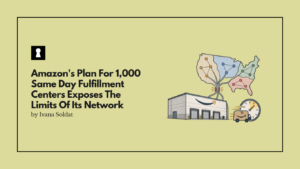

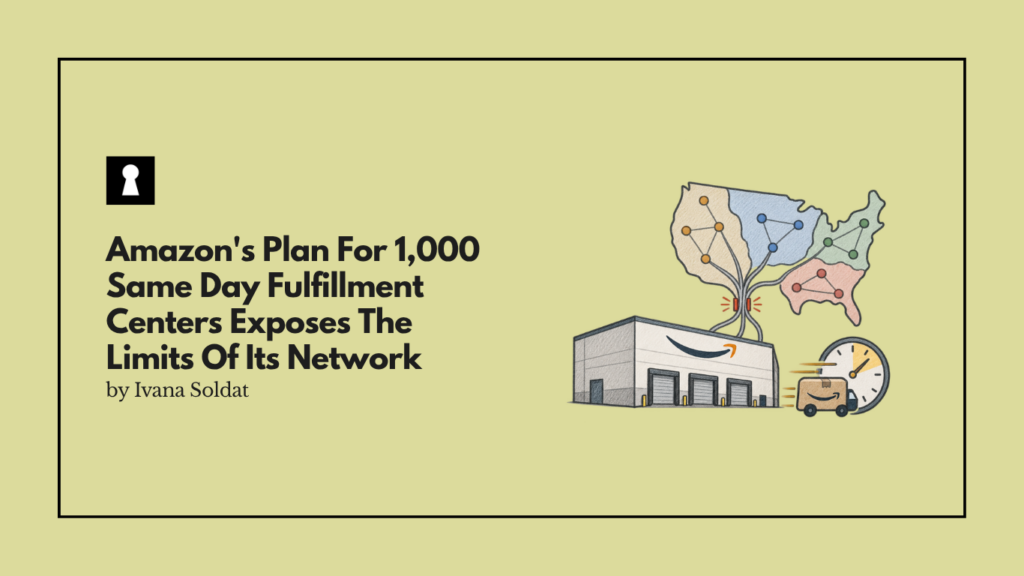
Amazon is preparing to radically alter its physical footprint by opening up to 1,000 new same-day delivery facilities across the United States. The ecommerce giant is shifting away from the massive regional fulfillment centers that defined its logistics strategy for the past decade.
Instead, it is pursuing a hyper-local network of smaller warehouses designed to put inventory within minutes of urban and suburban consumers. This move is a direct response to Walmart’s entrenched advantage in same-day delivery, but it also represents a massive capital expenditure that will test the limits of Amazon’s operational efficiency.
The Regionalization Strategy Failed To Deliver True Same Day Speed
Amazon spent the last few years regionalizing its fulfillment network to cut costs and speed up deliveries. The company divided the country into eight interconnected regions, aiming to keep inventory closer to customers.
While this strategy improved standard two-day and next-day delivery times, it fell short of the true same-day speed that modern consumers increasingly expect. The planned 1,000 new facilities will be significantly smaller than traditional fulfillment centers, likely ranging between 20,000 and 50,000 square feet.
By placing these micro-fulfillment nodes directly inside dense metropolitan areas, Amazon is acknowledging that regional hubs are still too far away to guarantee rapid delivery without incurring prohibitive last-mile transportation costs.
Walmart’s Store Network Remains The Ultimate Fulfillment Moat
The primary catalyst for this expansion is Walmart. The retailer operates over 4,600 stores in the United States, effectively giving it a massive, pre-existing network of localized fulfillment centers.
Walmart leverages these locations to fulfill online orders, offer same-day delivery, and provide curbside pickup without building new infrastructure from scratch. Amazon’s decision to build 1,000 new facilities highlights the sheer scale required to compete with a physical retail incumbent.
Even with this massive build-out, Amazon will still have fewer localized nodes than Walmart, forcing the ecommerce company to rely on superior inventory placement algorithms and automated sorting technology to bridge the physical gap.
The Real Estate And Labor Costs Will Crush Margins
Building a hyper-local logistics network is an incredibly capital-intensive endeavor. Securing real estate in or near major metropolitan areas commands a significant premium compared to the rural or exurban locations where Amazon traditionally built its massive distribution centers.
Furthermore, operating 1,000 additional facilities requires a massive expansion of the hourly workforce, increasing exposure to labor shortages and wage inflation. While Amazon hopes to offset these costs by reducing last-mile delivery expenses and increasing Prime membership retention, the near-term impact on its operating margins will be severe.
This strategy transforms Amazon from a highly scalable digital retailer into a heavy-asset logistics company, blurring the lines between its business model and the traditional brick-and-mortar retailers it sought to disrupt.
Automation Is The Only Way This Math Works
To make the economics of 1,000 small fulfillment centers viable, Amazon must rely heavily on automation. Traditional large fulfillment centers utilize massive robotic systems that require significant square footage to operate efficiently.
The new micro-fulfillment centers will require a new generation of compact, high-density automation technology to maximize storage and picking speed within a 20,000 square foot footprint. If Amazon cannot achieve a high level of automation in these smaller spaces, the labor costs associated with staffing 1,000 separate facilities will quickly erode any savings gained from shorter delivery routes.
The success of this entire initiative hinges on the deployment of next-generation robotics that can operate profitably at a micro scale.
Our Take
Building a Thousand Warehouses to Catch Up to a Retailer that Already has Four Thousand is a Desperate Strategy
Amazon’s plan to build 1,000 same-day fulfillment centers is a tacit admission that its digital-first logistics model cannot outpace physical retail in the race for instant gratification.
By trying to replicate Walmart’s store network through brute-force real estate acquisition, Amazon is taking on massive fixed costs that will inevitably pressure its profit margins. The company is betting that its technological superiority in inventory management and automation can overcome a structural physical disadvantage.
If the automation fails to deliver the required efficiency, Amazon will find itself trapped with an expensive, fragmented real estate portfolio that it cannot easily unwind.