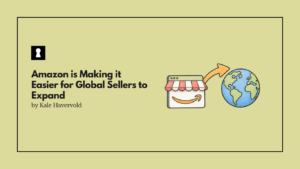

Despite Amazon sellers who are active in more than one country earning 70% more on average, only 30% of Amazon sellers list their items outside of their home country. This is often due to compliance issues and the complexity that’s traditionally involved in the process.
To make it easier for sellers to expand their reach globally, Amazon just announced a new set of connected capabilities that span compliance, logistics, and many other parts of the seller experience. Some of these capabilities are live already, others are coming soon, and even more are being planned for the future.
A Centralized and Unified View for Sellers
The first tool that Amazon has announced in an effort to make expansion simple is the first version of a unified view for sellers to easily see expansion opportunities in the U.S., Europe, and Japan, with more countries and regions coming by the end of 2026.
This shows sellers where there’s demand for what they sell, what the economics look like in each region, and what steps they need to take in order to start selling in those areas. Sellers no longer need to piece together this information through separate dashboards, as they can view everything in one place.
Amazon says that in the future, new features will let sellers manage their orders, listings, and inventory in one place, and be able to make changes globally, as opposed to repeating it for every country.
With cross-border commerce expected to explode in the coming years, there’s no doubt that these capabilities will make it easier and less time-consuming to list and sell products internationally.
Listing a Product Globally Becomes a One-Time Task
Thanks to these new capabilities, listing a product globally goes from an annoying process that you needed to repeat for every new country to a one-time task. Amazon is aiming to build an experience where, as soon as a seller creates a listing, its system will evaluate that item against everywhere at once.
This not only means translating product content, but also adjusting the currency and flagging any country-specific compliance requirements you should know. As these capabilities roll out, one listing will be able to do the same thing that used to take multiple listings and potentially hours of translating, adjusting currencies, and managing compliance.
Like many of these other new capabilities, this is aimed at removing the barriers around selling internationally and helping sellers see it as a straightforward option, and not one that requires a ton of time and energy.
End-to-End Supply Chain Visibility for Sellers
In the coming weeks, Amazon is also bringing end-to-end supply chain visibility to sellers for the first time. As soon as a seller creates a new shipment, a single interface will track it throughout its path, instead of sellers having to check separate systems to find out where inventory is.
Also, Amazon Seller Assistant is adding new supply chain capabilities, beginning with agents for inbound planning and aged inventory. However, it will expand over time to become a seller’s personal advisor, alerting them when actions need their attention, and explaining the reason and data behind every recommendation.
Having this end-to-end visibility gives sellers an entire overview of their products, helping them balance stock levels, plan inventory, offer reliable delivery and shipping estimates to customers, and properly manage inventory-related risks.
Simplifying Compliance
According to Amazon, compliance is the biggest reason sellers don’t expand internationally. This makes sense, as each country has its own rules and regulations for labeling, safety, packaging, and ingredient restrictions.
However, Amazon is aiming to remove this obstacle by giving sellers a clear view of the compliance requirements of every country they want to sell in. Also, instead of having to test compliance country by country and resubmit documents countless times, sellers just complete one test submission that satisfies the requirements of many countries at once.
This one-submission approach is being rolled out by category, beginning with toys, due to the complexity involved in safety testing in this space. By the end of 2026, this approach will also roll out to electronics and baby products.
Early sellers in Amazon’s pilot program for this approach have said that it has saved them up to 60% on compliance costs. As a result, it not only saves sellers time and effort, but potentially a significant amount of money as well.
Our Take
Go Global, But Be Aware of the Risks
Going global is a great way for companies to increase sales, build a stronger brand, deal with seasonal slumps at home, and access a new customer base, and Amazon is making it easier than ever to do it.
However, when expanding your operations to new countries and regions, you also need to be aware of the risks. If you don’t plan for things like regional preferences, market competition, preferred payment types, localization, and the cultural fit of your brand and/or products, the expansion could blow up in your face.
As a result, before expanding internationally, make sure to analyze the market you’re joining closely, assess the competition, and learn the cultural nuances so you can ensure your marketing and messaging are as natural as possible.