
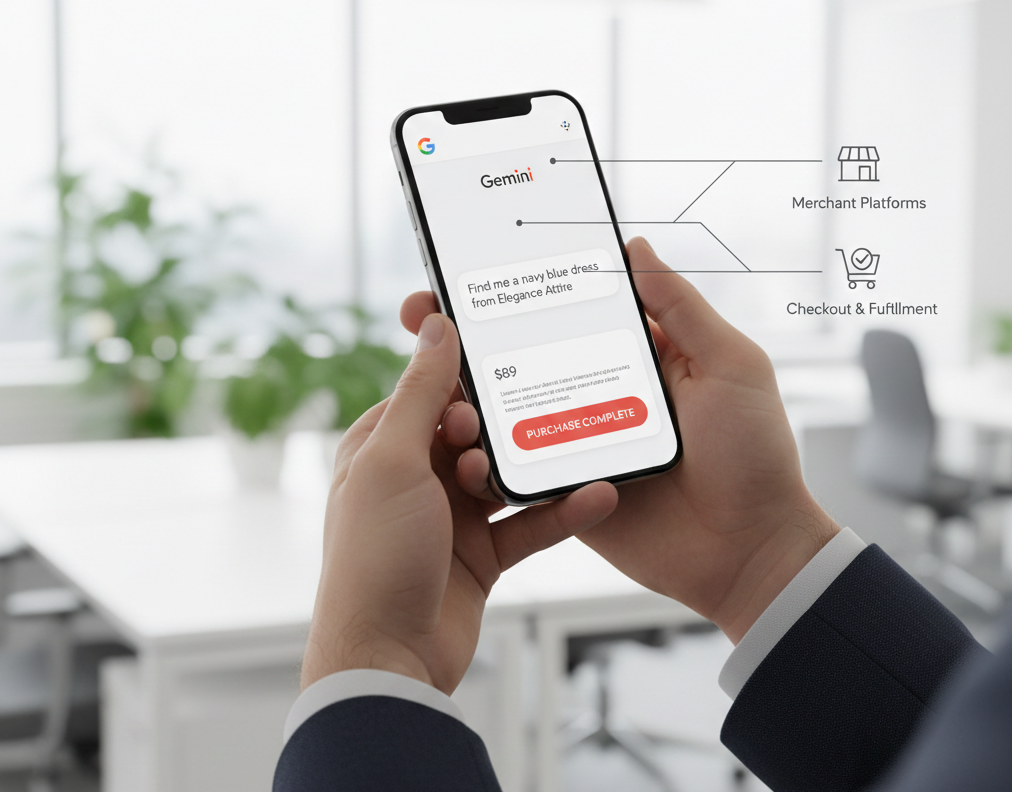
BigCommerce, in a high-stakes collaboration with Google, officially announced the launch of the Universal Commerce Protocol (UCP). The open-source standard is designed to allow artificial intelligence agents to interact directly with merchant storefronts.
Unveiled Sunday at the NRF 2026 conference, for the enterprise SaaS world, this is the formal beginning of Agentic Commerce. The protocol allows AI agents, led by Google Gemini, to browse products, answer customer questions, and complete transactions on behalf of shoppers without redirecting them to a traditional e-commerce website.
Why BigCommerce and Google Are Racing to Set the AI Commerce Standard
The timing of this announcement is a clear strategic counter-move. In late 2025, Stripe and OpenAI introduced an Agentic Commerce suite for brands, which focused heavily on the payment layer. Google has opted for an open-source, vendor-agnostic approach.
Co-developed with heavyweights like Shopify, Walmart, and Target, and endorsed by over 20 partners, including Visa, PayPal, and Mastercard, UCP is positioning itself as the industry’s universal standard.
For Commerce, the parent company of BigCommerce and Feedonomics, this represents a strategic move targeting the Enterprise and Mid-Market segments that prioritize data ownership. Unlike closed marketplaces where the platform owns the customer, the UCP is designed so that the seller remains the Merchant of Record (MoR).
This allows brands to maintain their direct-to-consumer (DTC) relationship where merchants reach customers across any AI surface (including Microsoft Copilot and others) using a single technical framework.
How the Universal Commerce Protocol Reshapes Online Shopping
For decades, the e-commerce funnel has relied on the click-through mode of operation. A user searches on Google, clicks a link, navigates a website, adds to a cart, and finally checks out. Each step is a point of potential friction and abandonment. Brands spend millions optimizing landing pages, reducing load times, and simplifying one-click checkouts.
However, the UCP suggests a future where the landing page itself is optional. Under the new protocol, the discovery-to-payment journey is compressed into a single conversational thread. A user interacting with Gemini can request a specific product, verify real-time inventory at a nearby BigCommerce-powered merchant, and authorize payment without visiting the website.
According to BigCommerce, the protocol allows merchants to expose their catalogs and transactional capabilities securely while maintaining control over pricing, inventory, and fulfillment logic.
“For agentic commerce to scale, it’s critical for the industry to align on a common set of standards,” said Ashish Gupta, vice president and general manager of merchant shopping at Google. “We are proud to have Commerce endorse the Universal Commerce Protocol as the foundation for that future.”
Google confirmed that Gemini will be among the first AI systems to support UCP, allowing consumers to discover products, compare options, and complete purchases directly within conversational search experiences. Additionally, the protocol is open-source, meaning other platforms, AI providers, and developers can adopt or extend it without licensing restrictions.
Feedonomics and Data Enrichment as a Technical Backbone
The success of AI-driven shopping depends entirely on the quality of the data. Large Language Models (LLMs) cannot accurately facilitate a sale if product data is messy, unstructured, or outdated. To solve this, the BigCommerce-Google partnership leans heavily on Feedonomics, the platform’s market-leading data enrichment engine.
UCP utilizes a specialized schema that translates raw product data into AI-legible signals. While standard Google Merchant Center feeds provide basic attributes, UCP-enriched feeds include specific shipping nuances, real-time localized inventory, and complex promotional logic. This ensures that when Gemini offers a buy button, the merchant’s back-end can actually fulfill the promise.
“AI is rapidly reshaping commerce. Merchants need to make it easy for shoppers to go from discovery to purchase, or they risk losing sales,” said Sharon Gee, senior vice president of product for AI at Commerce. “At the same time, keeping product data structured and enriched for AI can be resource-intensive. Our ongoing work with Google ensures merchants are not only present but competitive in AI-driven environments where consumers are searching and shopping.”
UCP Rollout: Timeline, Features, and Merchant Adoption
The UCP will begin powering a new native checkout feature on product listings in Google Search AI Mode and the standalone Gemini app in Q1 2026. Initially available to eligible U.S. retailers, the feature will allow shoppers to check out using payment and shipping information already saved in their Google Wallet. The integration will be opt-in, though the competitive pressure to adopt will likely be high.
Commerce has indicated that merchants using Feedonomics will have a fast-track to adoption, as the necessary data architecture is already in place. In the coming months, the protocol is expected to expand into more complex commerce actions, such as handling international duties, multi-item carts, and advanced loyalty program integrations.
Can Brands Survive When AI Becomes the Storefront?
The move toward UCP is not without its critics. Marketing executives have expressed concerns about brand erasure. If a customer buys a pair of boots through Gemini, does the brand identity of the merchant survive the transaction?
To mitigate this, BigCommerce has built Brand Identity Hooks into the UCP. These hooks ensure that merchant-specific loyalty programs, branding elements, and post-purchase follow-ups are integrated into the AI interface. However, the shift remains a challenge for brands that rely on high-touch digital experiences and visual storytelling to justify premium pricing.
What UCP Means for the Future of Ecommerce Platforms
With the Universal Commerce Protocol, BigCommerce and Google are betting that the future of shopping isn’t a destination, but an omnipresent service. The website is no longer the final stop but the infrastructure that supports a transaction happening anywhere.
For BigCommerce and Google, this partnership secures their position as the architects of the next great platform shift. For the rest of the industry, including Shopify and Salesforce, the pressure is now on to see if they can match the openness and scale of the UCP standard or develop a competitive standard.