
Every marketplace seller has a version of the same story. The email arrives with no warning. Account suspended. Funds held. Inventory stranded. The reason given is a policy violation, described in language vague enough to apply to almost anything. The appeal instructions point to a form that generates an automated response. The automated response says the decision is final. The funds sit frozen while the seller tries to figure out what happened and whether there is anything they can do about it.
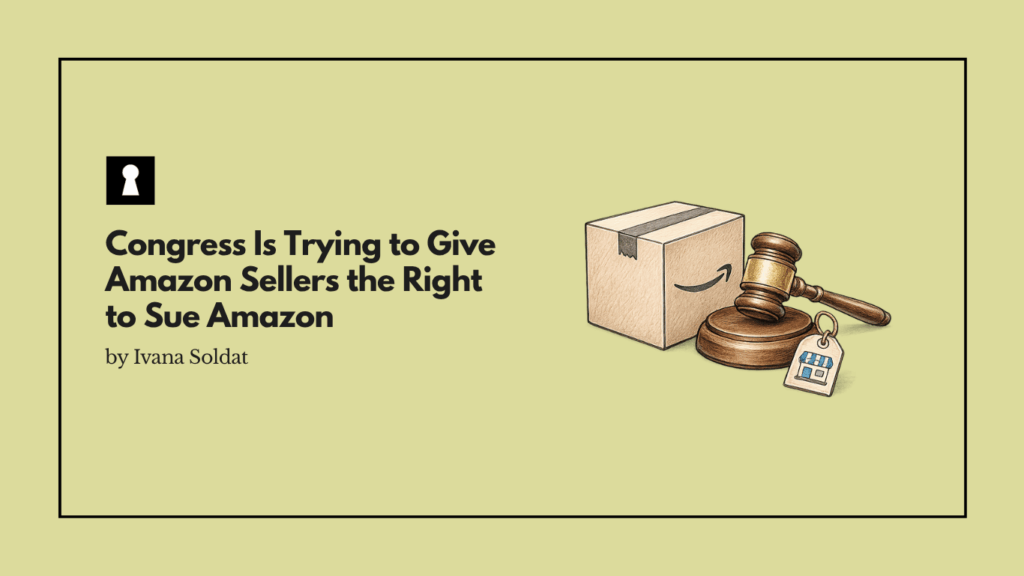
The “Online Sellers’ Bill of Rights Act of 2026,” introduced by Rep. Becca Balint (D-Vt.) and several co-sponsors, is a direct legislative response to that experience. H.R. 9799, now with the House Judiciary Committee, would not prevent Amazon or Walmart from suspending sellers, removing listings, or enforcing policies. It would instead establish federal standards for inventory holds, frozen payments, policy changes, investigations, and appeals.
What the Bill Would Actually Require
The provisions are specific enough to be worth walking through individually, because the specificity is where the significance lives.
Payment holds would be capped at 30 calendar days. To hold seller funds beyond that, a marketplace would have to demonstrate by evidence that the funds came from unlawful transactions. Suspicion alone would not be sufficient. This directly addresses one of the most common and damaging enforcement tools that large marketplaces currently use: holding seller funds indefinitely while investigations proceed at whatever pace the platform chooses, with no obligation to explain the basis or timeline.
Inventory holds would face the same 30-day limit. After 30 days, a marketplace would have to release stranded merchandise unless it could demonstrate clearly that the goods were counterfeit or otherwise unlawful. For sellers whose inventory is sitting in an Amazon fulfillment center during a suspension, this would represent a fundamental change from the current situation, where merchandise can remain stranded for months.
If a platform imposed a new restriction on a product or category, it would have to give the seller at least 30 days to sell the remaining inventory or return the merchandise at no cost to the seller. This addresses a specific and well-documented harm where sellers invest in inventory for a category, ship it to a platform warehouse, and then discover the category has been restricted without adequate notice or cost-free removal.
Policy changes affecting product eligibility, listing restrictions, compliance requirements, commissions, or fees would require at least 30 days’ written notice before taking effect.
The Due Process Provisions That Actually Have Teeth
When a marketplace investigates a seller, deactivates an account, or suspends a listing, it would be required to provide individualized information about the alleged violation. Not a templated response. Specifically: the policy involved, the relevant facts or documents, the proposed penalty, an explanation of how the seller could appeal, and an anticipated timeline for resolution.
Generic or templated responses would not satisfy the requirement. This is a direct response to the documented experience of sellers receiving form emails that cite policy sections without specifying what the seller actually did, preventing any meaningful response.
The Provision Every Marketplace Lawyer Is Reading Twice
The enforcement mechanism is the part of the bill that will generate the most resistance, and for good reason.
If H.R. 9799 becomes law, the FTC would have 180 days to issue implementing rules. Violations would be treated as unfair methods of competition under the FTC Act. State attorneys general could bring civil actions on behalf of residents. And sellers themselves would have a private right of action in federal court, even when a marketplace agreement requires arbitration.
That arbitration carve-out is significant. Mandatory arbitration clauses in marketplace seller agreements are precisely the mechanism that has historically prevented individual sellers from bringing federal court actions against platforms, forcing disputes into processes generally less favorable to smaller parties.
A successful plaintiff could recover three times the damages suffered, along with court costs and reasonable attorneys’ fees. Treble damages are not a standard consumer protection remedy. They are the kind of penalty that makes litigation economically rational for attorneys working on contingency, which makes the legal threat credible in a way a simple damages provision would not.
The Definition Problem That Could Undermine Everything
The bill has a structural weakness worth naming clearly. The protections apply to third-party sellers operating on a “dominant platform.” The legislation does not establish a revenue, transaction, user, or market-share threshold for determining dominance. Amazon and Walmart appear to be the primary targets. Whether the law would apply equally to eBay, Etsy, Poshmark, or smaller specialized marketplaces is genuinely unclear.
The FTC could address some of that ambiguity through rulemaking, but the absence of a measurable threshold means the definition of “dominant” would be contested in every enforcement action.
The Real Audience for This Bill Is Not Congress
H.R. 9799 was introduced in late July with a House Judiciary Committee referral and no Senate companion bill yet announced. The timeline for legislation of this specificity and commercial significance to clear committee, pass both chambers, and survive platform industry lobbying is long and uncertain.
But the bill’s significance for platform operators does not depend on its passage. The introduction of federal legislation with these specific provisions signals to Amazon, Walmart, and every other marketplace operator that the current enforcement-by-fiat model has attracted legislative attention. The specific provisions, the 30-day caps, the individualized explanation requirement, the arbitration carve-out, the treble damages, are a blueprint for what reform looks like. Platforms that begin voluntarily implementing some of these standards reduce their legislative exposure and their regulatory risk simultaneously.
The Amazon Canada FBA prep services piece we covered earlier this month, and the eBay performance fee restructuring, both illustrate the same dynamic: platforms making unilateral changes to seller relationships with inadequate notice and no meaningful appeal path. The Online Sellers’ Bill of Rights Act is the legislative response to years of that behavior accumulating into a political problem.
Our Take
Amazon Can Still Suspend You, but Now It Has to Tell You Why
The Online Sellers’ Bill of Rights Act is unlikely to become law in its current form. The platform industry will lobby aggressively against the treble damages and the arbitration carve-out.
The definition of “dominant platform” will be contested in ways that narrow the bill’s reach. What the bill represents is more important than whether it passes: a federal legislative articulation of the minimum process standards that marketplace sellers should be entitled to expect, introduced with bipartisan co-sponsors, and specific enough to serve as a policy blueprint whether it passes now or in a future Congress.
Every marketplace operator with significant seller relationships should be reading H.R. 9799 and asking whether their current enforcement practices would satisfy its requirements if they became law. The ones that would not might consider whether voluntary improvement is cheaper than the alternative.