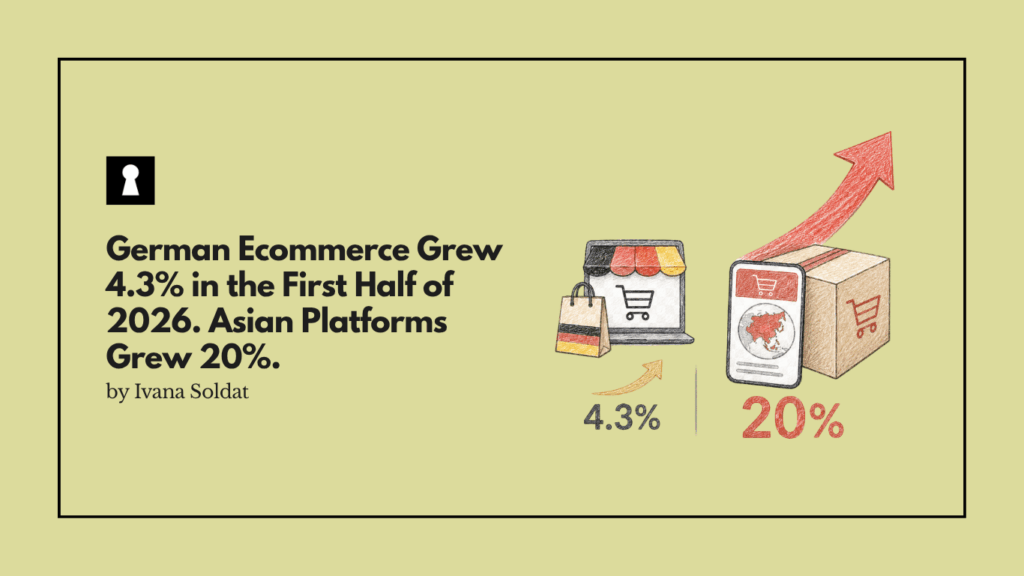
Germany’s ecommerce market had a good first half of 2026. Online retail turnover grew 4.3% compared to the first half of 2025, with Q2 coming in stronger at 5.1% growth.
The bevh association, which represents Germany’s online and mail-order retail sector, surveyed 40,000 consumers between April and June to produce the data. Martin Gross-Albenhausen, bevh’s deputy secretary general, described ecommerce as “the mainstay of the German retail sector in this extremely weak consumer environment.”
That framing is worth sitting with. Germany’s broader consumer environment is weak. Retail as a whole is struggling. Ecommerce is the thing holding it together. That is not a roaring growth story. It is a relative outperformance story in a market where the comparison is not strong.
The Categories Worth Paying Attention To
The growth is not evenly distributed, and the category breakdown tells a more interesting story than the headline number.
Mail-order pharmacies had the strongest sales growth of any category, up 13.9%, driven directly by the introduction of e-prescriptions in Germany. This is not a trend story. It is a structural shift: e-prescriptions have moved a category that was previously tightly controlled by physical pharmacy visits into the online channel, and the sales followed. Everyday goods grew 10.1%, with drugstore chains specifically up 11.7%. DIY and flowers grew 10.9%, hobby and leisure items 7.5%, and car and motorcycle accessories 7.6%.
At the other end, entertainment and home furnishing both grew at only 2.7%, lagging behind the market. Fashion grew 4.4% in Q2, up from 3.6% in Q1, suggesting some recovery in a category that has been under pressure across European markets.
By business model, online marketplaces generated 11.5 billion euros in turnover in the first half, growing 6.4%. Direct-to-consumer manufacturers grew 6.3%. Traditional online shops grew 3.8%, and multichannel retailers with brick-and-mortar roots grew 2.5%. The pattern is consistent with most mature ecommerce markets: platforms and DTC growing faster than legacy online shops, and legacy online shops growing faster than the broader retail sector.
One in Twenty Euros Goes to an Asian Platform
The number that will drive the most conversation from this report is the Asian platform share. Temu, Shein, AliExpress, and comparable platforms now account for 5.3% of online orders in Germany by mid-year, which translates to one in every 20 euros of online retail turnover. In fashion specifically, their share is 16% of all orders. And their revenues grew 20% in the first half of 2026, compared to the overall market’s 4.3%.
That gap, 20% growth for Asian platforms against 4.3% for the market, is not a new trend in Germany. But its persistence is notable given that the EU’s new parcel duty took effect on July 1, a week after this data was collected. The question the data raises is whether the July 1 charge will actually narrow that gap.
The Executive Who Said the Parcel Tax Will Not Work
Alien Mulyk, Chief Executive at bevh, addressed this question directly in the association’s commentary, and the answer is not encouraging for anyone hoping the parcel tax will change the competitive dynamic.
“The levy will have little impact on cheap imports from Asia. Suppliers have already begun to establish their own logistics structures within Europe. This means that goods no longer reach us in a haphazard manner in individual parcels that are almost impossible to monitor, but are instead shipped in containers and then distributed within Europe.”
This is the logistics evolution we flagged in both the France parcel tax piece and the Italy parcel tax piece earlier this month. The platforms and their logistics partners did not wait for the July 1 deadline to start building around it. They built European warehousing and container import infrastructure that routes around the small-parcel duty entirely. A container arriving at Rotterdam with 50,000 units of a product that will be distributed from a European warehouse is not a small parcel. It is not subject to the small-parcel duty. It is the same product, reaching the same German consumer, via a route that the new regulation was not designed to capture.
The bevh conclusion is not that the parcel tax is pointless. It is that it is already behind the curve.
Only 9% of Germans Will Let AI Buy for Them
The bevh data includes one finding that connects directly to EcomWatch’s AI coverage this week. In the first half of 2026, almost 6% of German online shoppers used AI when searching for product information before making a purchase. In Q2, 31.2% of the 2,500 online customers surveyed said they had asked a chatbot for a recommendation.
But only 12.7% said they would follow a recommendation from a bot without doing their own product search, and only 9% said they would be willing to let an AI agent buy products autonomously on their behalf.
Germany is joining the same pattern visible in every other market this week. Shoppers everywhere are willing to use AI as a research tool. They are not willing to hand over the purchase decision. The 9% figure is consistent with the resistance to autonomous purchasing that every market-level survey is now showing, and it has direct implications for anyone building fully agentic commerce infrastructure that assumes consumer adoption is ahead of where it actually is.
Our Take
Germany’s Online Pharmacy Business Just Changed Forever
The German H1 data is a useful market-level temperature check, but the three details that matter most for anyone watching European ecommerce are not the headline growth number.
They are the Asian platform surge at nearly five times the market rate, the bevh chief executive’s explicit statement that the parcel tax will not contain it because the logistics infrastructure has already adapted, and the e-prescription pharmacy boom that shows what happens when a regulatory change suddenly makes a previously friction-heavy category accessible online.
The third one is the most instructive for brands thinking about category opportunities: in Germany, a single regulatory shift moved 13.9% growth into a category that was previously limited by prescription requirements. Regulatory changes that expand online accessibility are some of the most powerful growth catalysts in ecommerce, and Germany’s e-prescription rollout is the clearest recent example of one working exactly as intended.