
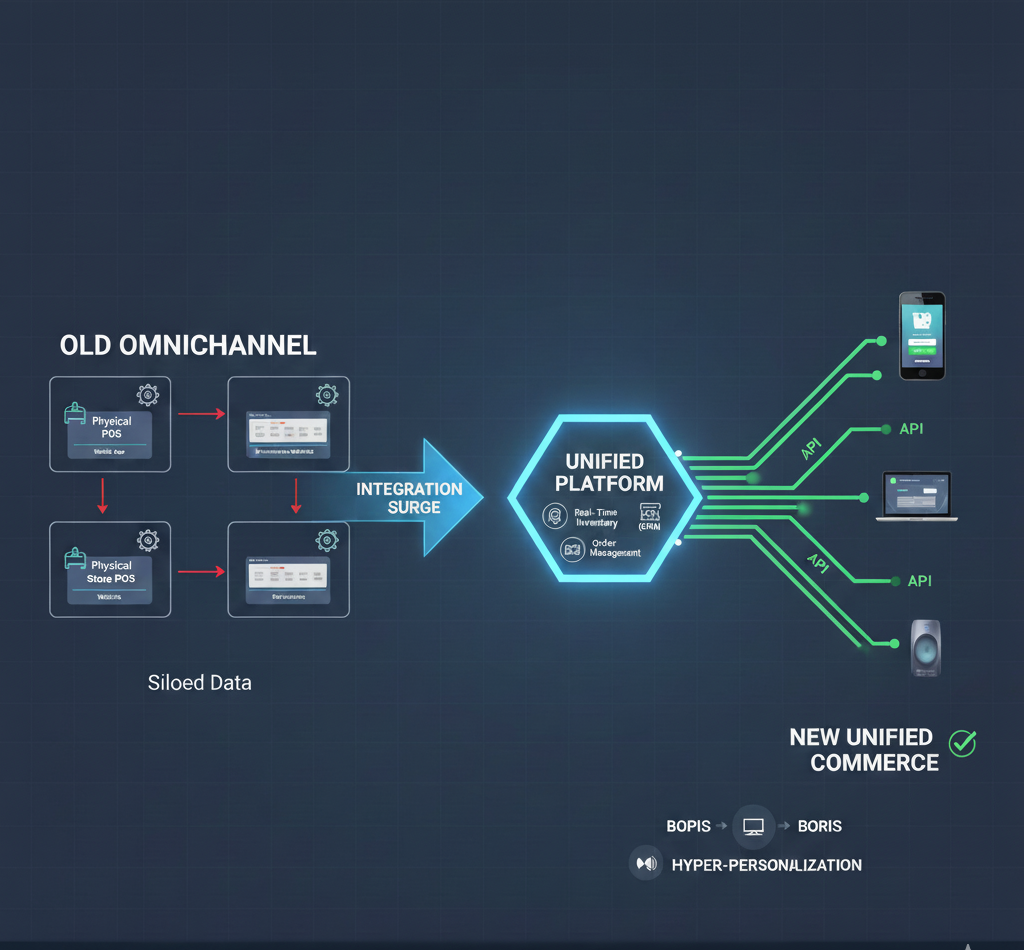
On December 1, 24Seven Commerce announced a major expansion of its integration capabilities, linking robust legacy POS systems, such as STORIS, with leading modern ecommerce platforms like Shopify and BigCommerce. This move signals the e-commerce industry’s response to a surge in the demand for unified retail systems and defines the new retail landscape for 2026. This announcement comes as platforms race to eliminate the friction caused by siloed systems.
The Flawed Foundation of Siloed Omnichannel
For a significant part of the past decade, merchants operated with an Omnichannel approach, focusing primarily on building brand consistency for consumers. The goal was to ensure messaging and pricing were uniform across the website, mobile app, and physical store. However, this outward consistency was often an illusion powered by siloed back-end systems.
The Point of Sale (POS), the website, and the inventory warehouse each operated on its own software, requiring complex and sometimes faulty integrations to pass data back and forth. This operational disconnect created persistent faults in the system. The most notorious issue was “ghost inventory,” where an item sold in-store might not be removed from the website’s stock count for minutes. This often resulted in cancelled online orders and breaking the consumer experience.
The siloed model meant retailers were effectively running two separate businesses ( physical and digital), and the resulting data friction dramatically increased operational cost and risk.
Transitioning from Omnichannel to Unified Commerce
Unified Commerce is the logical and essential next step in this evolution, which prioritizes operational efficiency over simple channel coordination. Instead of loosely connecting separate platforms, Unified Commerce centralizes the entire retail ecosystem, including POS, inventory, customer data, and order management, onto a single, real-time platform.
In effect, when an item is scanned at the physical register, it is immediately removed from the website’s stock, synchronizing the data. The shift effectively eliminates data discrepancies and enables e-commerce platforms to provide the frictionless experience customers will demand in 2026.
Meeting Customer Expectations
The e-commerce industry evolves rapidly, especially in response to consumer needs. The current and future customer demands call for a frictionless shopping experience and real-time inventory accuracy. The industry’s drive toward Unified Commerce is less about internal efficiency and more about meeting rapidly accelerating consumer expectations, such as:
- Buy Online, Pick Up In-Store (BOPIS): This is a service that grew from a pandemic perk to a standard logistical expectation for most customers. Without real-time sync, a customer might purchase an item online only to arrive at the store to find it was sold out minutes earlier. Such critical failures damage brand trust in both the merchants and the e-commerce platforms.
- Buy Online, Return In-Store (BORIS): Unified data refines the refund process, which is a logistical nightmare for omnichannel systems. With a unified retail system, a clerk can instantly access the customer’s online order history via the POS system, process the refund to the original payment method, and place the returned item back into inventory immediately, making it available for sale within seconds.
- Hyper-Personalization: A unified platform means that with a simple check, the clerk in the store knows what the customer browsed online, what items they abandoned in their digital cart, and what loyalty offers they qualify for. This creates a consistent and personalized shopping experience across all channels.
Integration as Risk Mitigation
As the recent Shopify outage on Cyber Monday demonstrated, over-reliance on a single system introduces critical single points of failure. The trend towards integration provides an operational lifeline.
Through the adoption of robust unified systems, e-commerce platforms are engineered for resilience. Should the storefront system encounter an issue, the inventory and customer data, centralized in the Unified Commerce hub, are still accessible to a redundant system or fulfillment method.
The strategy behind it is to decouple the sales channels from the core business logic, ensuring that a crash in one channel does not bring down the entire business. As the retail technology stack matures, investing in integration is a defensive move against inevitable technical failures.
What the Integration Race Means for Retail in 2026
The POS-ecommerce integration surge is both an offensive and defensive move. In 2026, a platform’s ability to offer reliable services will depend entirely on its backend integration. As experience has shown, if the POS and webstore don’t “speak” the same language, the customer experience suffers.
With 24Seven taking the lead, the race is on for merchants to audit their tech stack. The goal for merchants in 2026 is to run a Unified operation built for the demands of the modern consumer instead of the existing bloated, siloed omnichannels.