
For three years, the formula worked.
An Italian beauty brand was spending roughly €700 to €800 a day on Meta ads and getting back about €2.40 for every euro it spent. Then, earlier this year, the economics started to unravel.
The company cut its daily budget by more than half. It tried broad targeting, lookalike audiences, new creatives, old winners with new variations, consolidated campaigns and more fragmented ones.
Nothing really fixed it.
Even modest attempts to increase spending seemed to make performance worse. Eventually, the owner did what thousands of advertisers do when a once-reliable Meta account suddenly stops behaving as expected: he went to Reddit and asked whether something was broken.
“Since around February, performance has dropped significantly,” he wrote. “At this point, it feels less like a creative issue” and more like auction pressure, algorithm instability or an account problem he had failed to spot.
The replies were chaotic, contradictory and occasionally self-serving.
Some said Meta’s algorithm had deteriorated. Others blamed the website. One recommended moving from WooCommerce to Shopify. Another suggested more user-generated content. Someone proposed bid caps. Someone else pitched an AI media-buying tool. A few commenters insisted the problem was conversion-rate optimisation. One person simply suggested the product itself might be the problem.
Which is, in a way, what makes the thread useful.
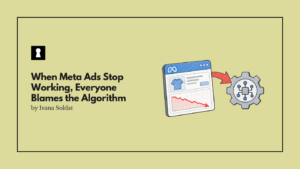
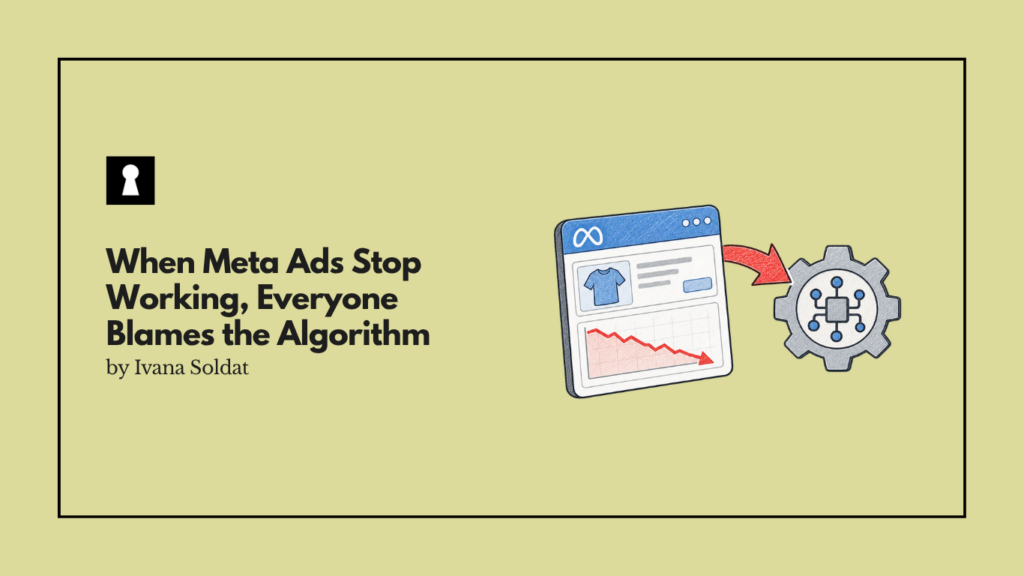
It captures the central difficulty of advertising on Meta in 2026: when performance falls, almost every part of the system can plausibly be blamed.
And Meta itself has made it harder to know exactly which part is responsible.
The seductive idea that “Meta is broken”
There is something psychologically convenient about blaming the algorithm.
It explains volatility without requiring the advertiser to reconsider the product, the offer, the website or the creative. It also fits the experience of anyone who has watched a campaign spend efficiently for days and then inexplicably deteriorate.
A few people in the thread reported seeing similar declines around the same period. One commenter said performance had fallen since February and concluded, simply, that the “algo is broken.” Another said advertisers began noticing weaker results around the middle of March.
That may be true at the level of individual accounts. It is not evidence of a platform-wide malfunction.
And that distinction matters.
Meta’s advertising system is largely opaque from the outside. Advertisers can observe outcomes but not the full process that produced them. When results deteriorate simultaneously across several accounts, it is tempting to convert correlation into explanation.
But “the algorithm changed” can quickly become less of a diagnosis than a place to stop looking.
The ad account may be where the problem appears, not where it starts
One of the more grounded replies in the thread suggested checking the site’s conversion rate, average order value and contribution margin before changing another campaign setting.
That sounds obvious. In practice, it is frequently ignored.
The advertiser sees Meta-reported ROAS falling and naturally starts working inside Meta Ads Manager. Audiences get rebuilt. Budgets move. Campaigns are duplicated. Creative is refreshed. Another attribution setting is tested.
Meanwhile, the underlying commercial equation may have shifted somewhere else.
A slightly lower conversion rate can make previously acceptable traffic suddenly unprofitable. So can a decline in average order value. So can a higher return rate, weaker repeat purchasing or a more aggressive discounting strategy.
One commenter who reviewed the brand’s site and ad library did not see an obviously broken campaign structure. Instead, he pointed to something more mundane: unclear messaging and a creative mix that appeared too dependent on similar types of advertising.
That is a less satisfying answer than “Meta broke something.”
It is also potentially more useful.
Meta wants advertisers to stop obsessing over targeting
There is a broader industry shift behind this.
Meta has spent the past few years pushing advertisers toward simpler campaign structures, automated delivery and broader audiences. Its current Performance 5 framework emphasises account simplification, automation, creative diversification, data quality and measurement.
The message is not subtle: give Meta more room to decide who sees an ad, and spend more of your energy deciding what those people should see.
That is convenient for Meta, of course.
A platform whose targeting and delivery mechanisms are becoming increasingly automated has every incentive to tell advertisers that the real competitive advantage now lies in creative. It moves responsibility away from the machinery advertisers cannot inspect and toward inputs they control.
But that does not mean the argument is wrong.
In the Reddit thread, one of the more interesting criticisms was that the brand may have been producing variation without producing much genuine diversity.
Creative fatigue is not always about seeing the same ad too many times
This is where the idea of “creative fatigue” becomes slippery.
Advertisers often treat fatigue as a frequency problem: the same people have seen an ad too often, so performance decays.
But a customer can also become fatigued with an argument.
A brand can change the actor, background, opening line and editing style while continuing to make essentially the same proposition.
One commenter claimed that most of the brand’s ads were aimed at people who were already relatively far down the buying journey—people who already believed cellulite was a problem worth treating. He suggested developing ads for different stages of awareness, using testimonials, expert explanations, proof, demonstrations and problem-led education rather than simply more variations of sales-focused creative.
Some of the numerical claims in that analysis cannot be independently verified from the thread. But the underlying observation is important.
Broad targeting does not eliminate targeting. It relocates part of it into the message.
An ad that says “reduce cellulite” and an ad that explains why someone’s existing routine may not be working can be shown to the same demographic audience while speaking to very different states of mind.
That is a more sophisticated way to think about advertising than endlessly searching for the right interest stack.
Then someone noticed the website
Several people in the thread reported another problem: the site was slow.
One said it timed out completely. Another said it was extremely slow to open. The advertiser himself acknowledged that the site could sometimes load quickly and at other times take several seconds.
A different commenter claimed that the site’s mobile Largest Contentful Paint was 5.7 seconds.
That specific test should be treated cautiously; the thread does not provide enough information to reproduce it. But the broader point is hard to dismiss.
Paid social traffic is unusually fragile.
Someone taps an Instagram ad while distracted, impatient and probably on a phone. The transition from feed to ecommerce site is the moment when a low-friction environment becomes a commercial one. If the landing page stalls, shifts around or takes too long to reveal the product, some portion of that paid traffic disappears.
The advertiser then sees a lower ROAS.
Meta looks worse.
But Meta may have delivered exactly the same person it delivered six months earlier.
The website simply converted that person less effectively.
This is why ROAS is such a dangerous metric on its own
ROAS feels definitive because it produces a clean number.
Spend €1. Get €2.40 back.
Then one day, get €1.70.
Problem identified.
Except it has not been identified at all.
ROAS tells the advertiser that the relationship between attributed revenue and ad spend has changed. It does not explain why.
- Was media more expensive?
- Did fewer people click?
- Did more people click but fewer buy?
- Did customers buy cheaper products?
- Did the landing page get slower?
- Did the business increase discounts?
- Did Meta attribute fewer purchases to itself?
- Did another channel contribute more heavily to the sale?
- Did the product simply become less compelling?
The Reddit discussion repeatedly drifted toward these questions. One contributor argued that improving conversion rate or average order value could matter more than squeezing a slightly cheaper CPM out of Meta.
That is probably the most important observation in the entire thread.
Advertising performance is not an isolated property of an advertising account.
It is a property of the business system surrounding it.
The uncomfortable possibility: the market moved
This is perhaps the least discussed explanation.
A campaign can stop working without anything being technically wrong.
Competitors improve. Advertising inventory becomes more expensive. Consumer tastes shift. The novelty of a product declines. Customers become familiar with the category. Discounts that once felt exceptional become expected.
One commenter argued that the audience had effectively been trained to respond to price-led offers. Another questioned whether the product had much repeat-purchase value at all.
Those comments are speculative. But they raise an important point that marketing discussions often avoid.
Not every performance problem is fixable with better media buying.
Sometimes the cost of acquiring the next customer has risen above what the business model can comfortably support.
So what actually happened?
The honest answer is that the Reddit thread does not tell us.
There is not enough data to prove that Meta changed its algorithm in a way that damaged this advertiser. There is not enough data to prove that creative fatigue caused the decline. The site-speed tests are anecdotal. The attribution theories are unverified. And several people offering advice were also, explicitly or implicitly, selling services.
But the absence of a neat conclusion is exactly what makes the case revealing.
The advertiser began with three suspected causes: auction pressure, algorithm instability or an account configuration problem.
By the end of the discussion, the list was much longer.
The algorithm is probably the wrong place to begin
One commenter accused the advertiser of “panic changing settings” when the more important problem might be the message. Instead of asking which campaign setting to change, he suggested asking what problem the customer actually struggles with, and how many genuinely different ways the brand can talk about it.
It is good advice, but it can be pushed further.
When Meta performance suddenly collapses, advertisers should resist two equally convenient stories.
The first is that the platform is broken.
The second is Meta’s preferred counterstory: that advertisers simply need better creative, broader targeting and more automation.
Either can be true, but neither should be accepted without evidence.
The more useful question is:
Where, exactly, did the economics change?
That requires looking at the ad auction, but also beyond it, at the site, the offer, the customer, the creative, the attribution model and the margin left after the sale.
The algorithm may be part of the story. It just should not be the whole story.