
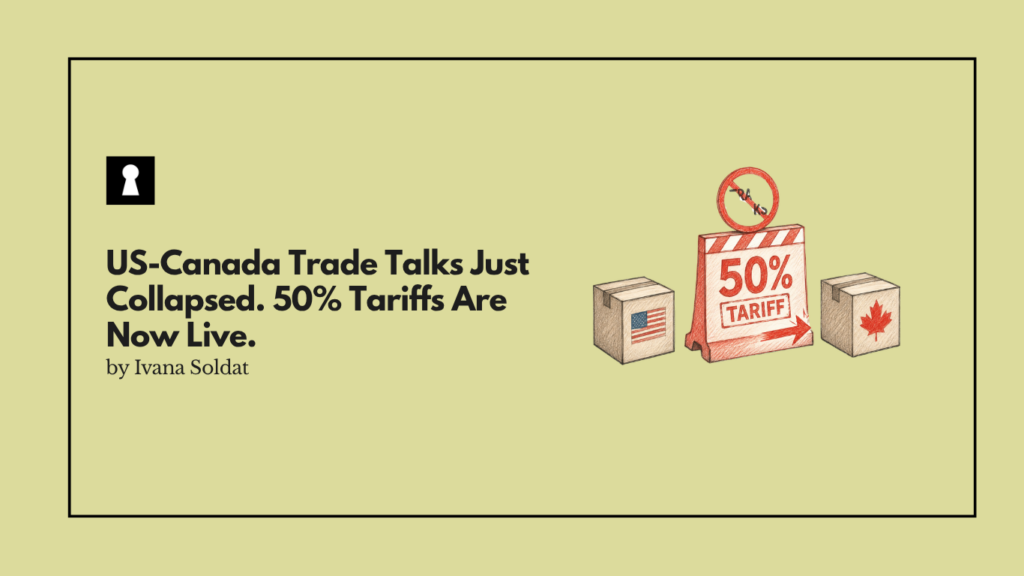
Trump had declared earlier in the week that “we’ve come to a deal with Canada,” adding it was “still subject to finalization of documents.” By Friday night, that finalization had failed. The US imposed 50% tariffs on $20 billion of Canadian products at midnight. Carney held a press conference Saturday and described the breakdown in terms that do not suggest a quick resolution:
“They asked too much and offered too little.”
US Trade Representative Jamieson Greer said that “Canada declined to finalize the trade deal under the terms agreed earlier this week,” adding that “despite the U.S. offer to Canada to receive the best treatment of any major exporter to our market, new demands and walk backs of other commitments by Canada have upended the careful balance reached in the past days.” Greer added on Fox News Saturday morning:
“We don’t have new talks planned with the Canadians. We’ve said enough.”
Canada will impose its own retaliatory tariffs “dollar for dollar” beginning on September 8, the Tuesday after Labour Day. Carney described the situation in terms that signal the dispute has escalated beyond trade negotiation: “You’re at war when you get attacked. We got attacked.”
What Is Actually Being Taxed
The 50% US tariffs apply to $20 billion in Canadian goods. The categories publicly confirmed include hockey sticks, building materials, liquors, and certain clothing. This is not a blanket tariff on all Canadian goods, USMCA-compliant goods retain their duty-free status, but it is a significant sectoral tariff applied at a rate that makes the affected categories commercially unviable to trade at current pricing.
Canada’s retaliatory measures have not yet been fully detailed. Carney said the Canadian government will release the details in the coming days, with the measures taking force September 8.
The USMCA Exemption That Is Not Saving Everything
The existence of USMCA is providing partial protection for ecommerce businesses that have structured their cross-border supply chains to comply with its rules of origin requirements. Goods that qualify as USMCA-compliant remain duty-free.
The problem is that USMCA compliance is not automatic and is not universal. The White House estimated earlier this year that approximately 38% of Canadian exports were not USMCA-compliant. For those goods, the 50% tariff now applies.
For ecommerce businesses specifically, the USMCA compliance question is most acute for brands that source components from outside North America and assemble or finish in Canada before selling to US customers, or vice versa. Brands whose supply chains include significant Asian or European component sourcing may find that their products do not qualify for USMCA protection regardless of where final assembly occurred.
The Shopify Context
EcomWatch covered the Shopify CEO controversy earlier this month, when Tobi Lütke’s comments about voting rights generated a boycott campaign targeting Shopify merchants. We noted at the time that Lütke had earlier expressed sympathy for the Trump tariff position on Canada.
That political context now has a commercial consequence. Shopify is a Canadian company with a predominantly US merchant base. A significant escalation in US-Canada trade tensions affects Shopify merchants in both directions: US merchants selling to Canadian customers face retaliatory tariffs on September 8, and Canadian merchants selling to US customers face the existing 50% duties on their product categories and the USMCA compliance question.
The September 8 Date That Every Cross-Border Brand Should Mark
September 8 is 16 days away. The Canadian government has not yet specified which US goods will face the dollar-for-dollar tariffs. For any ecommerce brand with meaningful cross-border volume between the US and Canada, September 8 is the planning horizon that matters most right now.
The question is not whether retaliatory tariffs will affect you, they will affect a broad range of US goods entering Canada, but which specific categories, at what rates, and whether any USMCA exemptions apply to your specific product and supply chain configuration.
Our Take
The Timing Is the Worst Part
The US-Canada trade talk collapse is the most significant trade development for North American ecommerce since the Section 301 tariffs on 60 countries took effect in late July. The 50% tariffs are live now on affected Canadian goods. Canadian retaliation takes effect September 8, 16 days before October, the month when eBay’s own shopper survey says 57% of holiday shoppers begin their purchasing.
A trade war between the two largest trading partners in North America, escalating into the peak season, with no talks planned and retaliatory measures not yet fully specified, is the kind of disruption that ecommerce brands cannot plan around because the parameters keep changing.
The immediate priorities are: confirm whether your cross-border products fall under USMCA exemptions, identify which Canadian categories face the 50% US tariff and whether your suppliers are affected, and watch the Canadian government’s September 8 announcement for the retaliatory category list. The answers to those three questions determine whether this is a manageable disruption or a fundamental change to your cross-border cost structure.