
You have probably read blogs comparing Shopify vs commercetools, but there’s hardly any competition between the two, as they largely serve different categories of brands.
One is an all-in-one, ready-made shop, which gives brands all the right tools to enter the market quickly. Another platform offers you complete control over how your front and back-end work, and enables enormous possibilities to scale your brand from Day 1.
Shopify is designed for most e-commerce businesses out there: small, mid-sized and large e-commerce brands that want to launch quickly. commercetools is suited for enterprise-grade brands that need custom solutions for headless architecture.
Before learning more about their differences, let’s understand in detail what each platform offers, and also, have a quick snapshot of what these two platforms offer.
What is Shopify?
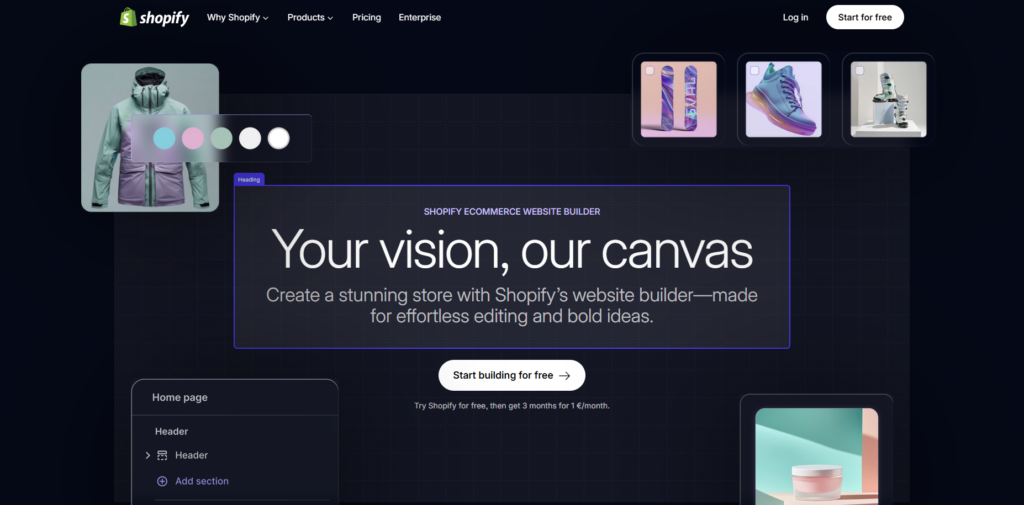
Shopify’s ecommerce platform caters to brands of all sizes: from small to mid-market companies. It handles your platform infrastructure by default, with limited customisation and limited scaling options with base packages.
The company’s B2B tools for accounts, pricing, payments, and purchase lists, and strong API access make it a solid option for all kinds of standard stacks a brand requires.
Shopify’s AI tools, like Sidekick and Shopify Flow, allow easy automation of basic functions. Some of the major Shopify customers are Gymshark, Heinz, Allbirds, and Red Bull.
What is commercetools?
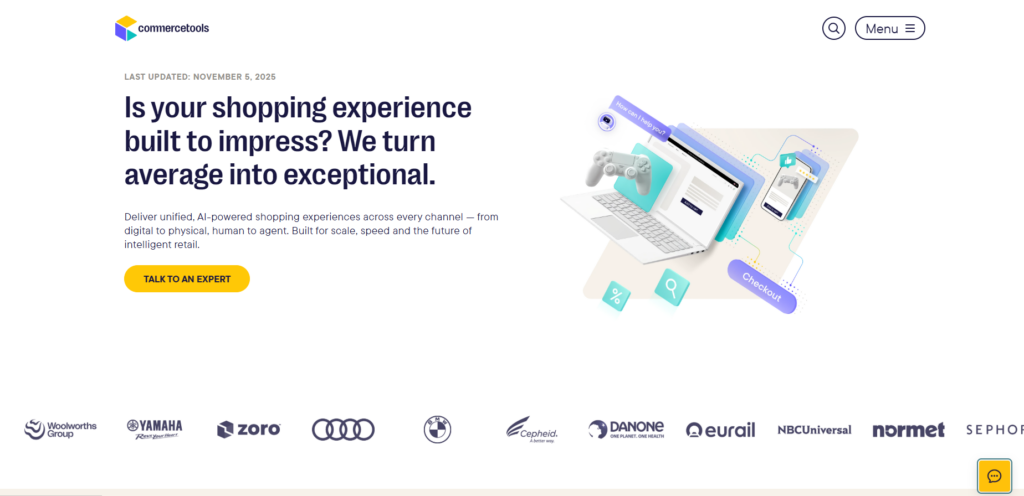
commercetools is a cloud-native platform with unlimited customisation facility via API services. Like Shopify’s unified in-built system, commercetools is headless and has a separate front-end and backend architecture. Built for large brands with no standardised needs, commercetools gives you complete control over how your site should look.
It’s designed for unpredictable scale, and can implement B2B solutions that actually make a difference: pricing hierarchies, RFQ management, punchout flows, without any limits.
With commercetools, businesses become market-ready in 6-18 months, depending on your requirements of frontend, middleware, and integration layers. It gives you all the right tools to build the structure you want. You also own the compliance structure, which means more control over security features than Shopify.
Some of the key customers of commercetools are Audi, LEGO, Volkswagen, Danone, Wild Fork Foods, and Purple.
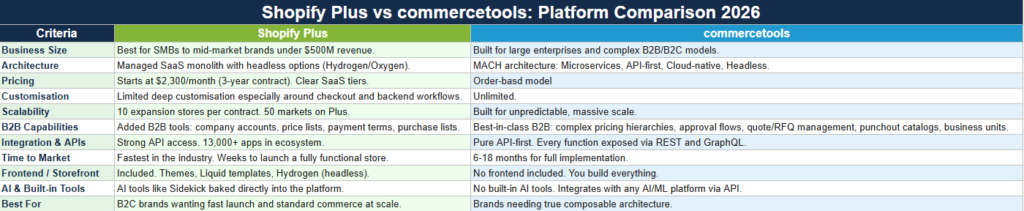
Now, here’s a comparison table that measures each platform on prime benchmarks such as business size, architecture, pricing, customisation, etc.
What Are The Advantages of Shopify

Shopify is an e-commerce behemoth, and controls around 23.4 to 27.6% of the world’s e-commerce market share, leading with 28.2% in the US.
The US-based e-commerce platform major offers a fast time-to-market for new brands, and has a strong app ecosystem of over 16,000, covering almost every business need.
It has all the right tools to increase ROI on ad spend, and puts a strong emphasis on custom experiences. In addition to a solid technical and security infrastructure, Shopify enables you to build custom storefronts.
Its tiered pricing structure, starting with a basic plan of $39 a month that goes up to $2,300/month for Plus plans, gives brands a predictable operational cost structure. The company offers 24/7 chat customer service across all plans, with call support for Shopify Plus users.
Its beginner-friendly interface, clean and organised setup, allows easy onboarding as soon as you sign up. Shopify’s built-in SEO and marketing tools are also easy for beginners to use, enabling the fastest time-to-market.
Where Shopify Breaks
Shopify is not scalable beyond a point. If you are a brand that’s already hitting $500 million in revenue and has complex business needs, you will eventually require a much more robust platform to grow your business.
The e-commerce platform offers limited flexibility. Its monolithic structure limits your ability to create custom changes in your website.
Shopify gives you a seamless omnichannel setup, but deeper, customised integrations are limited unless you are on a higher plan, i.e. Shopify Plus.
Though mostly secure, the company has been a frequent target for security threats due to its large ecosystem and app integrations. For example, in a 2020 insider breach incident, two rogue employees got access to customer data from at least 200 merchants. In 2024, Shopify saw another data leak linked to third-party Shopify apps, affecting 1.80 lakh customers.
Advanced features like custom product bundling and complex B2B pricing are not natively supported and are only covered via third-party apps, which adds to the overall cost.
What Are The Advantages of commercetools
commercetools is an enterprise-grade ecommerce platform that offers complex B2B/B2C solutions for marketplace models. Its API-driven structure allows you to connect different systems, frontends, payment providers, and a dedicated search tool, instead of relying on one platform.
commercetools’ pricing structure is based on an order-based approach, not the typical GMV-based model. This allows businesses to choose plans that fit their business size: core commerce edition for digitally mature companies, foundry edition for retailers and manufacturers, and premium for enterprises that scale. Prices for the plan vary as per the specifications.
The API-first MACH architecture means everything from the website to the mobile app is built to connect and work independently through APIs. The platform scores better on security, with no significant breaches reported so far.
Where commercetools Breaks
commercetools requires significant coding knowledge for customisation, so you must have a dedicated team of at least 8 developers. It does not offer ready-made templates, themes, or an all-in-one administrative experience like Shopify.
You have to map out every part of your platform journey from product pages to checkout flows, and hence, the time to market is slow.
The platform’s headless structure, where front-end and back-end are separated, is only suited for businesses with a clearer SEO strategy.
The company has limited direct customer support options, with no 24/7 assistance, but documentation is thorough.
There are certain costs attached to choosing commercetools. Extensive custom development and multiple microservices can increase your DevOps and infrastructure costs.
The pricing engine can also break at scale, showing difficulty in mapping bulk custom or contract pricing for customers.
Unlike Shopify, which promises an easy-to-navigate dashboard, commercetools’ merchant centre dashboard is slow and buggy. Sometimes, it makes the administrative experience difficult.
Shopify vs commercetools: Which One is Really for You?
Before you decide, ask yourself these 3 specific questions: what level of customisation you need, how fast you want to launch your business, and what your scalability vision is for the next two to three years.
Both are top-class e-commerce platforms, but they cater to different segments: Shopify is largely better suited for B2C brands, while commercetools works best with B2B platforms.
Shopify Plus’ in-built tools help you launch fast, allow operational simplicity with customer relationship services, quick checkouts with best-in-class conversion rates, and omnichannel sales facilities. Choose Shopify if you want to scale fast, and hit the $500 million revenue milestone quickly.
commercetools’ features like custom pricing, bulk ordering, and multi-level account management are clear differentiators, but they only work for enterprise-level brands needing true composable architecture.
You should definitely opt for commercetools if your brand is large enough to require complex workflows. Flexibility to incorporate any AI/ML platform via API is also a defining feature, but it requires a dedicated team to build and maintain.
Bottom line
By now, you have a clear idea of what each of these e-commerce platforms can offer you. If you want end-to-end built-in integration and a quick market foray, go with Shopify.
On the other hand, commercetools is the only viable option if you are looking for advanced customisation and enormous scalability options.
Nonetheless, figure out all your business requirements first: integrations, architecture, APIs, frontend, AI tools, compliance, and security.
From our point of view, headless platforms like commercetools give you more freedom to iterate, experiment, and scale. But if you are a new entrant in the large e-commerce space, you should start small and scale quickly. And Shopify gives the best-in-class built-in architecture for that kind of growth. As your brand moves from a small to mid-market DTC model to a high-traffic enterprise, you can choose commercetools.