
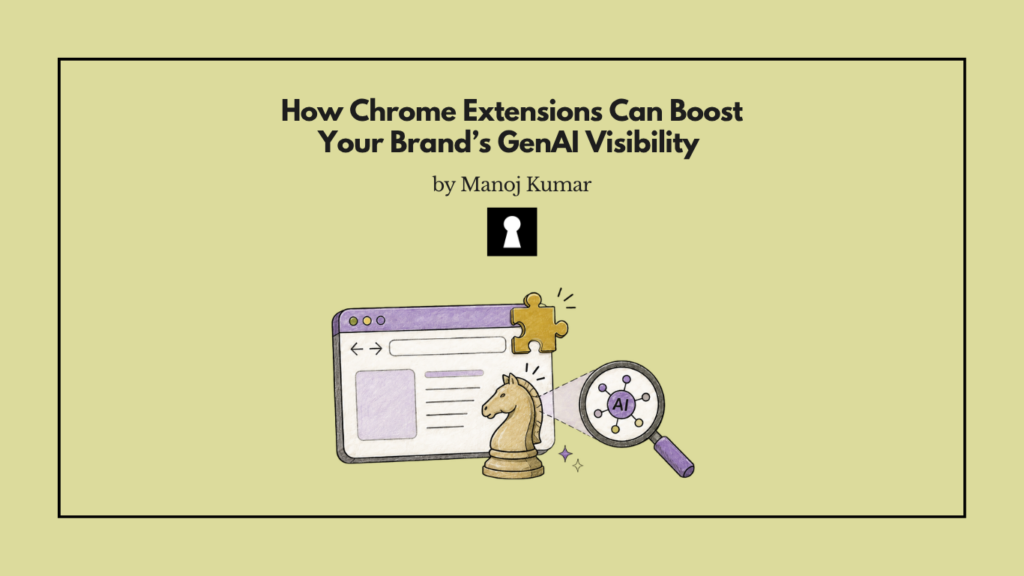
AI SEO or GenAI visibility has become an added layer on top of search engine SEO. For brands, it’s equally important to track whether your product pages are being cited on LLMs like ChatGPT, Gemini, Claude, and Grok, or you may be missing out on a whole lot of web traffic to your competitors. Chrome extensions are a good way to instantly view how your brand is being viewed via an AI lens.
These Chrome extensions help stimulate visibility ranking of your pages based on readability score and AI visibility. It’s always better to rely on more than one tool to ensure optimised visibility in AI models. However, there’s a clear caveat: most AI SEO tools are still in the development phase, much like general purpose AI models, so none of them can give you definitive answers to your AI visibility problem.
There are certainly some tools that can ensure you are not behind in the AI visibility race.
The Actual Problem With Most GenAI Visibility Tools
Most Chrome extensions in their current form are single-response snapshots. It’s always best to look at brands that are showing up consistently, not just one AI query output.
These AI results are also unstable. A brand appearing once may not appear the next time even though the input remains the same, which shows visibility cannot be measured from a single response on a GenAI model.
Types of Chrome Extensions for GenAI
There are three different types of Chrome extensions currently that give you surface-level visibility of your brand page. Visibility checkers, prompt testing tools, and SERP or citation observer tools show you brand mentions, let you run queries, and highlight sources used by AI.
Here are the examples of the top 5 free Google Chrome AI extensions, which can give your brand much-needed visibility:
1. AI Content Visibility Checker
This Chrome extension is a free diagnostic Chrome extension, which can check AI visibility for a single webpage. It shows citation and readability score to explain which specific text on your page is accessible to AI agents. It also compares a human user’s view of a page with machine readability.
As you open the page, the Chrome extension gives a citation readability score out of 100. A higher score means strong machine readability, which shows there’s a high chance your content will be shown in AI searches.
This is one of the most powerful AI visibility tools out there as it shows crawlability, readability, and citation patterns. Its enterprise version goes a step further and can help you track brands, compare your brand’s visibility with competitors, and deploy changes at the content delivery network level.
2. Audit GEO
Another popular free Chrome extension, Audit GEO, also analyses any web page and scores your brand content out of 100 for citation by GenAI tools.
It measures visibility on five key benchmarks: authority signal (30%), extractability (25%), answerability (20%), crawlability (15%), and semantic coverage (10%).
These parameters help you analyse page rank, backlinks, Reddit, and Wikipedia mentions. You also get suggestions on how to improve readability, FAQ presence, robot.txt accessibility, and semantic depth.
The extension claims to collect only minimum data to compute your GEO score, and doesn’t gather personal information, cookies, or browser history.
3. AI SEO Extension
This RadarKit extension checks pages for visibility score, reads your robots.txt, and discovers your top keywords with 1-word, 2-word, and 3-word phrase analysis. The extension checks readability scores and monitors page size against Google’s 2 MB crawl limit, beyond which your content is not indexed.
It also suggests if your page is failing schema validation, making your content suitable for AI understanding. The extension works on any website with one-click audit and is a good option to get insights into how AI sees your site.
4. AI Visibility Tool
This Google Chrome GenAI visibility extension offers a special focus on AI crawlability, technical clarity and semantics.
This tool is specifically helpful if you are struggling with low visibility in AI even when organic ranking looks fine. It reveals missing or broken schema and blocked AI bots, which may be limiting your brand’s visibility.
5. All in One SEO Analyzer
All in One SEO Analyzer can optimise heading tags, enhance site navigation, and analyse your website from top to bottom. It also gives you suggestions on meta descriptions, titles, keywords, and content structure.
The tool is helpful if you are looking to drive organic traffic to your site. So be it small business owners or SEO professionals, it can help you improve AI visibility.
Where Do These Chrome Extensions Fall Short
Despite their popularity, most Chrome extensions rely on single-run prompts and don’t offer time-based tracking. They give a one-time snapshot and lack the ability to capture how regularly a brand is being cited across LLM queries.
Like other productivity extensions, AI visibility tools are also prone to data risks, including the transmission of private information to external servers. They are also likely to have higher CVE (common vulnerabilities and exposures) compared to other extensions.
If you are not careful in your selection, malicious extensions can steal your personal data without permission. Some are not transparent in their data handling approach either. If a Chrome extension is malicious, you will find it hard to uninstall once it’s on your system.
Therefore, it’s always best to go for top-rated tools. Users should also check their data collection and security policies before installing them on their system.
What Can Brands Do to Increase LLM Citation
Much like Google search, LLMs also cite authoritative voices that are easily verifiable in their responses. If your brand is frequently appearing across reputed platforms, it’s likely that AI models will pick the website if it is being constantly updated.
If your brand is appearing in discussions across credible public forums like Reddit or LinkedIn, LLMs trust such content and it’s likely that it will be cited.
The content on your website should have a machine-readable structure, meaning the text should be easy for AI bots to ingest. Your platform is likely to be cited more if the text is structured and follows a semantic format, i.e. clear topic, subheadings, FAQs, QAPage, and HowTos.
Most of all, unlike Google Search that ranks pages based on authority, SEO practices, and a host of other factors, LLMs follow a pattern of trust. If you have a genuine brand, and it’s making useful products for society at large, LLMs are likely to recognise and reward it.