
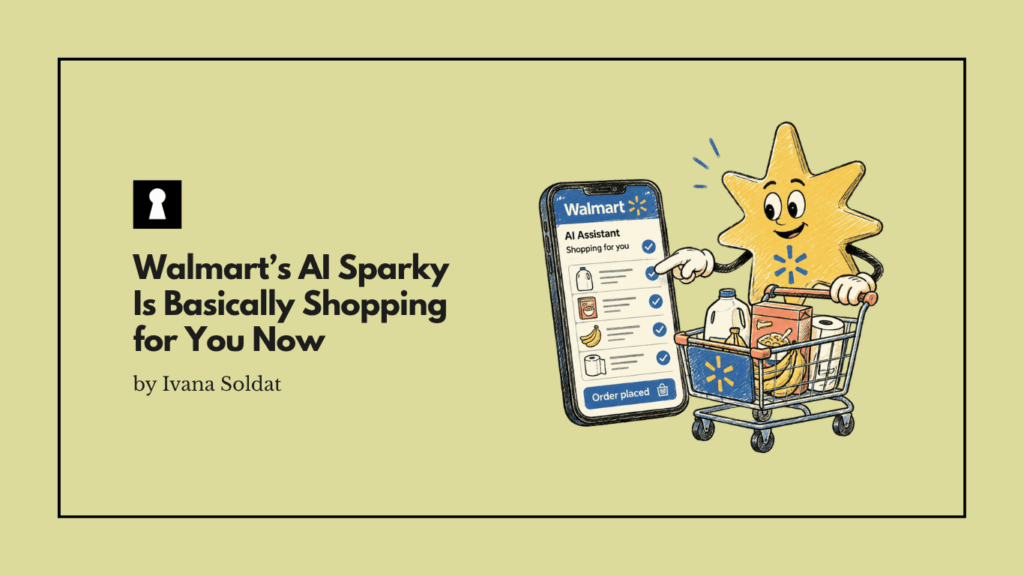
The retail giant’s AI agent is spending money faster than your impulsive cousin at a sample sale, and the numbers are hard to argue with.
Walmart has a robot doing your shopping, and apparently you love it. On the company’s first-quarter earnings call this week, CEO John Furner announced that Sparky, Walmart’s AI shopping agent, now has over double the weekly active users it had just three months ago. The company is officially calling itself “AI-native,” which is retailer-speak for “we are leaning into this very hard.”
Furner said Sparky’s intelligence and response quality improved by 40% this year alone. That is a remarkable number for something that essentially started as a glorified search bar with good manners.
The Numbers That Have Competitors Sweating
- 35% Higher average order value for Sparky users
- 4x Units purchased through Sparky vs last quarter
- 37% Global advertising revenue growth
The headline figure is this: customers who shop through Sparky spend 35% more per order than those who do not. Whether that is because Sparky is brilliantly persuasive or because it simply makes it too easy to say yes to things you do not need is a question Walmart is not rushing to answer.
David Guggina, CEO of Walmart U.S., said units purchased through Sparky quadrupled compared to the previous fiscal quarter. That is not a typo. He also noted Sparky has expanded into food and everyday consumables, not just general merchandise. So yes, the robot is now doing your grocery run too.
“Sparky is becoming more useful by the day.”John Furner, CEO, Walmart
What Sparky Can Actually Do Now
The agent is now live across Walmart’s website, mobile app, and physical stores. It can handle personalised product replenishment, suggest meal plans, and make recommendations based on Walmart’s real-time inventory and delivery speeds. Spanish speakers can use it too, which meaningfully widens its audience.
There is also an automatic reorder feature for household staples, which is either incredibly convenient or a fast lane to buying too much laundry detergent. For many households, probably both.
Context Worth Knowing
Sparky did not arrive out of nowhere. Walmart launched it in June 2025 as part of a broader AI push that included four “super agents” unveiled at its Retail Rewired event. Alongside Sparky for shoppers, the company also released Marty for sellers, an Associate Agent for staff, and a Developer Agent for internal tech teams. The retail giant was essentially building an AI workforce.
That original launch was framed as a direct response to Amazon’s Rufus assistant, which rolled out to all U.S. customers in 2024. Walmart’s counter-bet was to go further on agentic capability and, crucially, to open its platform to third-party AI tools rather than keeping everything locked in-house. ChatGPT, for instance, can complete purchases directly through Walmart’s checkout. Amazon, for comparison, is still not letting outside agents touch its marketplace. That open-vs-closed debate in retail AI is one to watch.
The Vizio Play Is Paying Off Too
The AI story does not stop at Sparky. Walmart’s advertising revenue grew 37% globally in fiscal Q1, and a big part of that story runs through Vizio. Walmart acquired the TV brand in December 2024 for around $2.3 billion, a deal that raised eyebrows at the time given Vizio’s modest market position in televisions.
The logic is clearer now. Chief Financial Officer John David Rainey confirmed Walmart is using Vizio’s connected TV platform to give advertisers new tools, including AI features that can adjust content and expand campaign reach across screens. Walmart calls this its “content to commerce” strategy, where a viewer watches something on their Vizio TV and, in theory, ends up buying it through Walmart before the credits roll.
That is a bold vision. Whether shoppers will feel seamlessly guided or mildly surveilled by it is a distinction retailers prefer not to dwell on.
The Bigger Picture
What Walmart is building is not just an AI shopping assistant. It is a closed loop where an agent spots what you need, recommends it, places the order, routes it through an AI-optimised supply chain, and gets it to your door while Vizio-powered ads remind you why you needed it in the first place.
Furner specifically mentioned that AI is now helping Walmart “make faster decisions and fulfill in the very best way possible,” which is a polished way of saying the supply chain has a brain now. Inventory positioning, fulfillment routing, last-mile decisions: all of it increasingly handled by machine.
Walmart’s online sales have now grown more than 20% for five consecutive quarters. At some point that is no longer a trend and becomes the company’s identity. The world’s largest retailer is quietly becoming one of its most ambitious AI operators, and Sparky is just the face of it.