
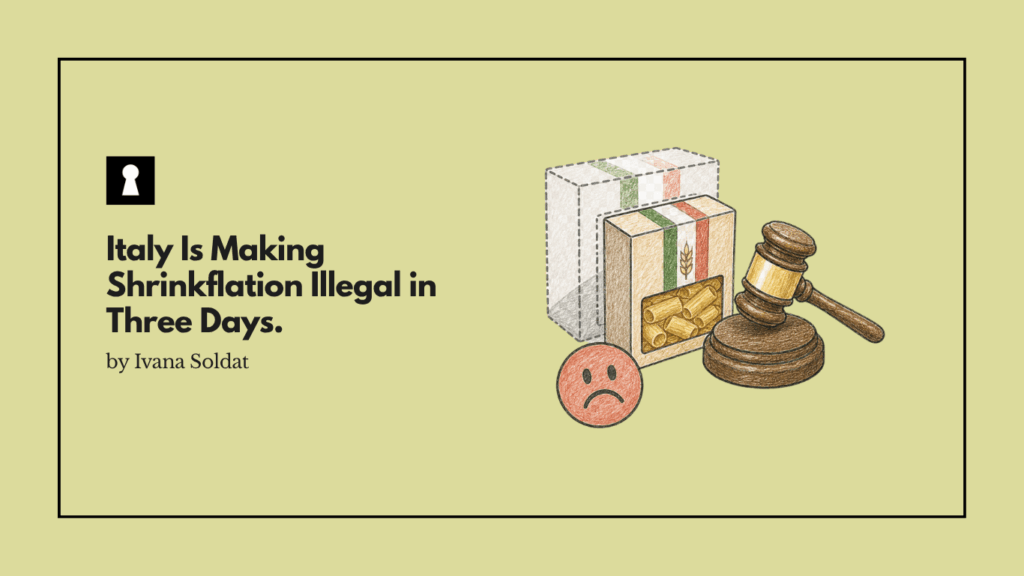
Shrinkflation is the practice of reducing the quantity in a package while keeping the price the same or raising it. The chocolate bar that was 200 grams and is now 180 grams at the same price. The bag of crisps that has had two more centimetres of air added at the top. The bottle of shampoo that used to be 400ml and is now 350ml. The price tag stays unchanged. The product does not.
Italy’s Ministry of Enterprise and Made in Italy formally notified the European Commission on April 15 of a legislative decree called “Measures to counter the commercial practice of re-portioning pre-packaged products.” Under EU notification procedures, the Commission has three months to raise objections. Those three months expire this week. In the absence of EU objections, the decree enters into force on July 15.
That sounds like a win for Italian consumers navigating a consumer goods market worth €120 billion where, according to Codacons, Italy’s main consumer rights association, shrinkflation has been producing hidden price increases averaging 10 to 18%, with peaks in some categories hitting 40%. Among the worst-affected: cereals, yogurt, ice cream, snacks, biscuits, soft drinks, detergents, toilet paper, shower gel, shampoo, and toothpaste. The everyday basket.
The problem, as Codacons is pointing out this week, is what the decree ended up looking like after its journey through the legislative process.
The Label That Disappeared
The original version of the decree included a straightforward and powerful obligation: when a manufacturer reduced the quantity of a product, they had to print a label on the packaging stating, in plain terms, “This package contains X less than the previous quantity.” A consumer picking up a box of cereal that had been quietly shrunk would see the disclosure on the box itself, at the moment of purchase, in the place where it could actually change their decision.
That obligation is gone from the final version. What replaced it is a supply chain communication system. When a producer reduces the quantity of a product, they must transmit a standardised communication to distributors and retailers containing the details of the variation and the percentage price increase attributable to the quantity reduction. The retailers, both physical and online, must then make that information available to consumers at the point of sale or on digital channels.
The information will exist somewhere. It will not be on the product. A consumer in a supermarket or on an ecommerce platform will need to actively seek out disclosure that, under the original proposal, would have been printed directly on what they were picking up.
Codacons called the final measures “watered down and not very incisive.” That is a polite way of saying the rule requires disclosure in a form that most consumers will never encounter.
Why is This Important for Ecommerce Specifically
The online retail dimension of the decree deserves specific attention. The requirement applies to “digital channels” alongside physical retail, which means ecommerce platforms selling packaged goods in Italy will need to surface quantity change information somewhere in the product listing when a supplier has reduced pack size.
What “somewhere” means in practice is not specified in detail. A product detail page that mentions in a footnote that the quantity was recently reduced is technically compliant. A prominent banner at the top of the listing that says “this product is now 10% smaller at the same price” is also compliant.
The implementation will almost certainly vary dramatically across platforms, and the gap between a compliant-but-invisible disclosure and a compliant-but-prominent one is the entire practical question for online shoppers.
For ecommerce operators, the new obligation creates a real data dependency: they will need to receive the standardised supplier communications about quantity reductions, process them, and integrate them into product listings in a way that can be audited. That is a non-trivial operational requirement for platforms carrying thousands of FMCG products across multiple suppliers.
Skimpflation: The Problem the Decree Does Not Touch
Codacons is also flagging a related and potentially more insidious practice that the new rules do not address at all: skimpflation. Where shrinkflation reduces quantity at the same price, skimpflation reduces quality at the same price. Same size package, same price, worse ingredients.
Butter or olive oil replaced with cheaper palm oil or margarine. Fresh eggs replaced with powdered yolks and whites. Premium ingredients quietly swapped for cheaper substitutes while the product name, packaging design, and price remain identical. The consumer has no visible signal that anything changed because the package size has not changed and the price has not changed. Only the formulation has.
Skimpflation is harder to regulate than shrinkflation because quantity is an objective, measurable fact while ingredient quality involves judgements that brands can argue are improvements rather than degradations. The decree does not attempt to tackle it, and Codacons is warning that as shrinkflation becomes harder to execute under the new rules, skimpflation may become the more attractive alternative for brands looking to protect margins in a cost-pressured environment.
Our Take
Same Price, Less Product, Buried Disclosure
Italy’s anti-shrinkflation decree is better than nothing and worse than what it was supposed to be. The original on-pack labelling requirement would have put the disclosure where it matters: in the consumer’s hand, at the moment of decision, in a format impossible to miss.
What was enacted instead is a disclosure that lives somewhere in the supply chain and surfaces somewhere on a shelf or a website at the discretion of the retailer. For online shopping specifically, where consumers are already scrolling through product listings without reading every detail, a disclosure that is required but not prominently placed is a disclosure that will be missed by most people most of the time.
The question worth asking is why the most visible and consumer-protective element, the on-pack label, was dropped, and whose interests that removal served.