
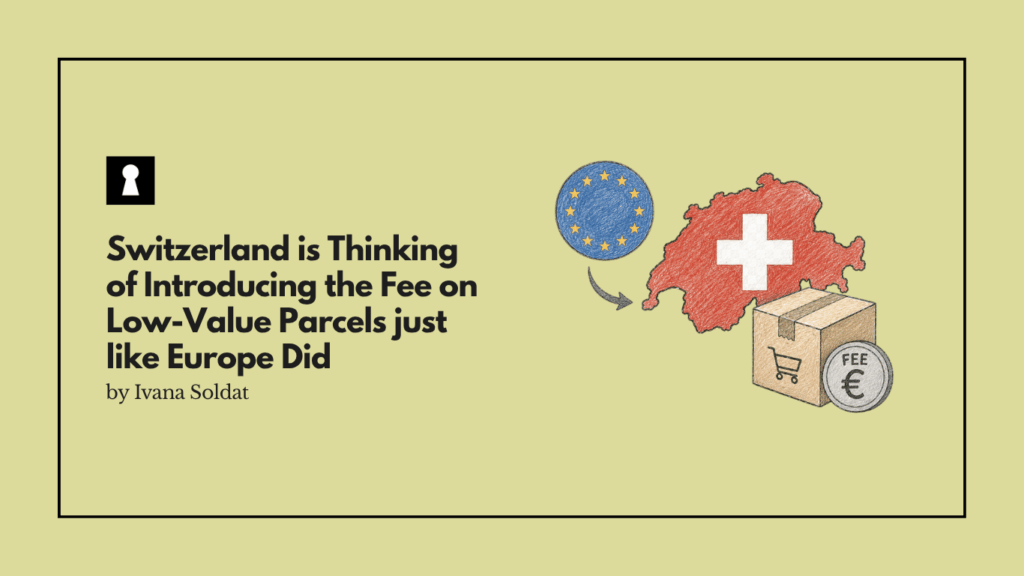
Switzerland is geographically surrounded by the European Union. It is connected to it through more than 100 bilateral agreements. It aligns with large swathes of EU regulation by default, by treaty, or by economic necessity. What it is not, and has never been, is a member.
Which means that on July 1, 2026, when the EU abolished its €150 de minimis customs exemption and replaced it with a €3 flat duty on low-value parcels from outside the bloc, Switzerland woke up as a notable exception in the middle of a regulatory map that had just changed around it.
In the EU, a Temu package under €150 now costs at least €3 more than it did on June 30. In Switzerland, that same package still arrives under the same rules it always did. For Swiss consumers, that looks like continued cheap shopping. For Swiss retailers and politicians watching the EU experiment unfold in real time, it is looking increasingly like a problem that needs its own answer.
The RSI, Switzerland’s Italian-language public broadcaster, has been tracking the domestic debate around what it is calling the “Temu Tax” question, and the debate is getting more structured. Swiss retail associations and parliamentary voices are pointing to the obvious competitive asymmetry: the EU is acting, Switzerland is not, and the platforms that built their European market share on duty-free small parcels now have a new incentive to route volume through Swiss consumers while the window remains open.
How Switzerland’s Parcel Rules Work Right Now
Switzerland is not a customs-free paradise for foreign ecommerce. It has its own import duty and VAT framework, and it is more complex than it might appear.
For standard goods subject to the full 8.1% VAT rate, the de minimis threshold in Switzerland effectively sits at around CHF 62, meaning orders under that value are not charged VAT because the tax owed falls below the CHF 5 minimum collection threshold. For goods on the reduced 2.6% VAT rate, that threshold rises to around CHF 193. Customs duties follow a similar minimum rule, with charges below CHF 5 waived regardless of the goods’ value.
Above those thresholds, things get more complicated. Swiss Post charges between CHF 11.50 and CHF 70 for customs clearance handling depending on the consignment. That processing fee is often more significant than the actual duty owed on lower-value parcels. A CHF 80 order from Temu that theoretically owes a small customs duty could end up with a CHF 11.50 handling charge that represents more than the duty itself.
The result is a system that is more restrictive than the EU’s pre-July 1 framework in some respects, but still leaves significant room for Chinese platforms to operate at a meaningful price advantage over Swiss domestic retailers.
Why the EU Experiment Matters So Much for Switzerland
The most useful data point Switzerland now has access to is France’s experience. France introduced a €2 national parcel surcharge on March 1, 2026. Within weeks, 90% of the parcel volume it was supposed to capture had rerouted to other European entry points. The tax collected roughly €2.3 million per month against a projected €400 million annual target: a 97% shortfall. France suspended the charge on June 30, the day before the EU-wide system kicked in.
That outcome is the cautionary tale Switzerland is watching. A national measure applied at a single country’s borders within a broader integrated trading area is extremely vulnerable to logistics rerouting. Switzerland’s position is different from France’s in one crucial respect: it is not inside the EU’s single market, so goods entering Switzerland from China do not automatically benefit from EU entry points the way they could reroute through Rotterdam to avoid a French charge. In theory, Switzerland’s standalone customs territory should make a national parcel measure more effective than France’s national attempt.
In practice, the question is whether Swiss customs infrastructure can actually capture the volume a new measure would target. The EU’s own customs authorities acknowledged that up to 65% of small parcels entering the bloc were undervalued before the new system took effect. Swiss customs faces the same declaration accuracy problem.
What Swiss Retailers Are Arguing
The Swiss retail sector’s argument for following the EU’s lead is structurally similar to the argument that drove the EU’s reform. Swiss retailers operate under Swiss VAT requirements, Swiss product safety regulations, Swiss employment law, and Swiss environmental standards. Their Chinese competitors on Temu and Shein do not.
With the EU now applying a €3 baseline charge, the relative price advantage of buying from Chinese platforms shifts modestly in EU markets but remains fully intact in Switzerland. For Swiss retailers, that creates a specific and newly worsened competitive dynamic: their EU counterparts now operate in a market where the price gap between domestic retail and Chinese platforms has narrowed slightly, while they continue operating in a market where that gap is unchanged.
Our Take
Switzerland Has Always Done This Slowly, Deliberately, and Eventually
Switzerland’s relationship with EU regulatory convergence follows a consistent pattern: watch, evaluate, negotiate, and eventually align, on its own timeline and terms, usually after enough domestic pressure has built that the cost of not aligning exceeds the cost of doing so.
The “Temu Tax” debate is early in that cycle. The retail associations are making the case, the political conversations are starting, and the EU is now running a live experiment whose results will inform whatever Switzerland ultimately decides to do. The most likely outcome is not a rapid Swiss imitation of the EU’s €3 charge but a gradual tightening of the existing de minimis framework, probably accompanied by more aggressive enforcement of declaration accuracy, as the political and commercial case for inaction gets harder to make.
The question is not whether Switzerland follows the EU on parcel taxation. It is how long it takes, and how many more Swiss retailers close in the meantime.