
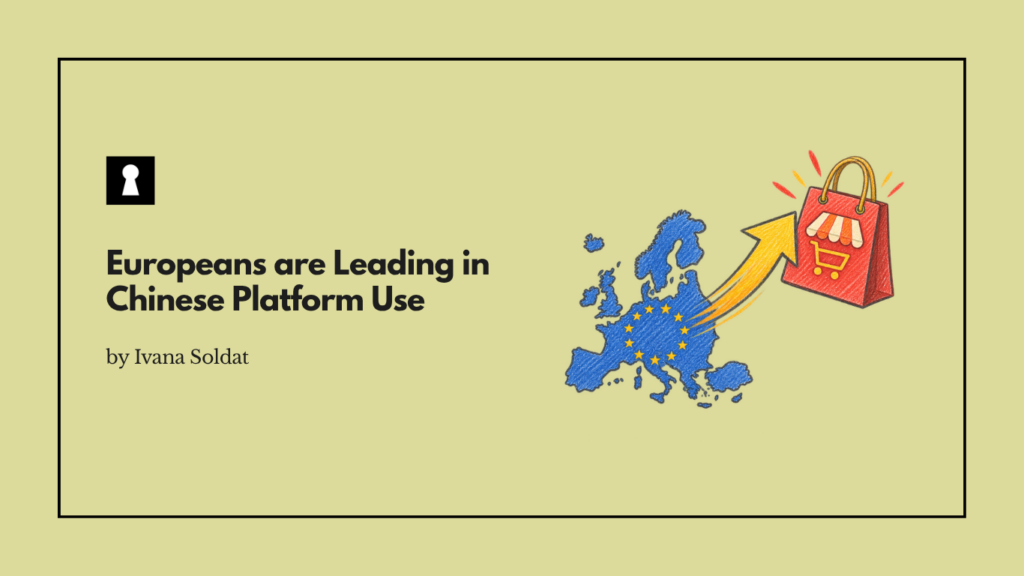
The ECB applied the same €3 per-category parcel duty to every member state on the same date, but the member states it affects are not equally dependent on Chinese platforms and do not have equally capable domestic retail alternatives.
The Numbers That Show the Dependency Gap
More than half of euro area consumers, 52%, have shopped on a Chinese platform at least once, but there are significant differences between regions. Usage is highest in Greece at 79%, Portugal at 77%, and Spain at 69%. In France at 43% and Germany at 40%, less than half of consumers have used Chinese shopping platforms.
The ECB’s own conclusion is precise: “The particularly deep market penetration in Southern Europe points to striking cross-country differences in consumer habits, platform awareness, delivery infrastructure, trust and local retail alternatives.”
That final clause matters most for the policy question. France and Germany have well-developed domestic ecommerce ecosystems. A French consumer who can no longer access Temu at the pre-duty price has multiple domestic alternatives at comparable quality. A Greek consumer in the same position has fewer alternatives. Greece’s domestic ecommerce market is smaller, less developed, and less competitive than its Northern European equivalents. The platforms that stepped into that gap were Chinese ones. The €3 per-category duty does not account for this. It applies uniformly across 27 member states regardless of the local retail landscape the consumer is navigating.
The Liège Airport Data That Confirms the Impact
The number of ecommerce shipments entering the customs zone at Liège Airport fell by 24% year-on-year in July and by as much as 41% compared with June. The airport attributes this directly to the European measure that came into effect on July 1. Meanwhile, the number of B2C shipments from China valued above €150 increased by 10%.
Liège Airport is one of Europe’s primary gateways for Chinese ecommerce shipments. A 41% drop compared to June is a dramatic contraction in a single month, and the 10% increase in higher-value shipments above €150 is the threshold effect in action: platforms and their logistics partners are shifting some volume toward higher-value shipments that avoid the duty, while the duty is suppressing the ultra-low-value shipments it was designed to target.
This is consistent with what we reported from the Chinese logistics industry data showing a 20% overall decline in EU-bound Chinese parcel volumes, and consistent with the order consolidation strategy that platforms have been implementing.
Why Affordability Is Not the Whole Answer
The ECB survey found that affordability plays a central role in the popularity of Chinese platforms. Product variety is a second major driver: “In sum, low prices combined with extensive product choice appear to be the core competitive advantage of these platforms.”
The product variety dimension goes beyond the standard narrative. Chinese platforms offer product ranges that European domestic retailers do not match. The long tail of niche products, specific spare parts, hobby equipment, specialist tools, unusual sizes, is where Chinese platforms have a structural advantage that no amount of parcel duty reduces, because the domestic alternative does not exist.
The consumer who was buying cheap fast fashion from Shein faces a meaningful duty impact. The consumer who was buying a specific spare part for an appliance that no domestic retailer stocks faces the duty but has nowhere else to go.
Geopolitics Are Not Deterring Consumers. Price Is.
The ECB concluded: “Geopolitics do not seem to deter many consumers. Price, however, does.”
That sentence distills the entire policy question into one observation. The political debate around Chinese platform dominance in European ecommerce has involved concerns about data sovereignty, unfair competition, unsafe products, and geopolitical dependency. The consumer survey data suggests that none of those concerns are meaningfully influencing purchasing behaviour.
What influences purchasing behaviour is price. The duty works on price. The question is whether working on price is sufficient to achieve the policy goals that motivated the duty.
The Southern European Consumer Is the One Who Feels This Most
The geographic data means the burden of the EU parcel duty is not evenly distributed across the bloc. A Greek consumer who uses Chinese platforms at a 79% rate is more affected by the duty than a German consumer at 40%. That Greek consumer also has fewer domestic retail alternatives and is more likely to be in the income bracket where the price difference between Chinese platforms and domestic alternatives is commercially significant.
The EU applied a single policy instrument uniformly across a bloc with non-uniform market conditions. The countries with the most developed domestic alternatives are the least affected by the duty in practical terms. The countries with the least developed domestic alternatives are the most affected, and also the ones where the Chinese platforms had the most legitimate consumer utility.
Our Take
The €3 Duty Applied the Same Way to Greece at 79% and Germany at 40%
The ECB survey data and the Liège Airport figures together tell the most complete story yet of what the EU parcel duty has done in its first seven weeks: it has sharply reduced Chinese parcel volumes at major European logistics hubs, it has shifted some volume to higher-value shipments above the duty threshold, and it has landed most heavily on the member states where Chinese platform dependency was highest and domestic alternatives are fewest.
Whether that is the intended outcome depends on what the policy was trying to achieve. If the goal was reducing low-value Chinese parcel volumes entering the EU, it is working.
If the goal was creating competitive conditions that help European domestic retailers across all member states, the geographic distribution of impact suggests the retailers being helped most are in the markets where they needed help least.