
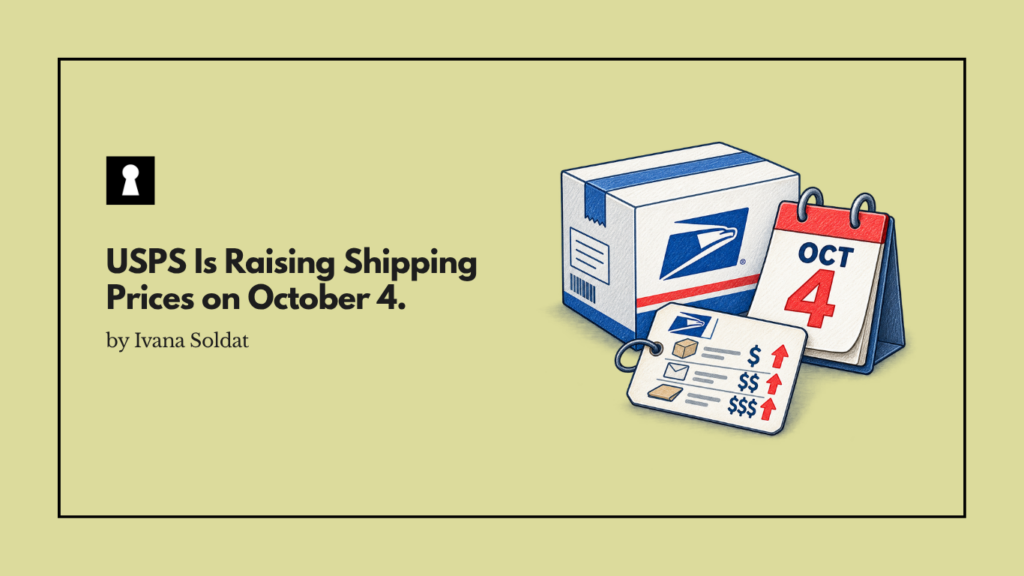
USPS filed notice today announcing temporary price increases on its competitive parcel products, Priority Mail Express, Priority Mail, USPS Ground Advantage, and Parcel Select, effective at 12:01 a.m. CT on October 4, 2026, pending PRC approval. The increases remain in place until 12:01 a.m. CT on January 17, 2027.
The Full Rate Table
The increases are zone-dependent and weight-dependent. Here are the commercial rates that apply to sellers using USPS commercial accounts and shipping software:
- Priority Mail and USPS Ground Advantage, Zones 1-4: $0.40 increase for 0-3 lbs., $0.65 increase for 4-10 lbs., $1.05 increase for 11-25 lbs., $3.15 increase for 26-70 lbs. and Oversized.
- Priority Mail, Zones 5-9: $0.85 increase for 0-3 lbs., $1.75 increase for 4-10 lbs., $3.85 increase for 11-25 lbs., $9.10 increase for 26-70 lbs.
- Priority Mail Flat Rate: $1.75 increase for Large Flat Rate Boxes, $0.85 increase for all other Flat Rate products.
- USPS Ground Advantage, Zones 5-9: $0.55 increase for 0-3 lbs., $1.05 increase for 4-10 lbs., $1.75 increase for 11-25 lbs., $7.70 increase for 26-70 lbs. and Oversized.
- Priority Mail Express, all zones: $1.40 increase for Zones 1-4, 0-3 lbs. $2.35 increase for Zones 5-9, 0-3 lbs. $2.10 increase for Zones 1-4, 4-10 lbs. $5.55 increase for Zones 5-9, 4-10 lbs. $4.90 increase for Zones 1-4, 11-25 lbs. $10.50 increase for Zones 5-9, 11-25 lbs. $12.55 increase for Zones 1-4, 26-70 lbs. $18.20 increase for Zones 5-9, 26-70 lbs.
- Priority Mail Express Flat Rate: $2.35 increase for Flat Rate Envelopes.
- Parcel Select, all entries: $0.40 increase for 0-3 lbs., $0.50 increase for 4-10 lbs., $0.80 increase for 11-25 lbs., $2.35 increase for 26-70 lbs. and Oversized.
Who Gets Hit the Hardest
Sellers shipping small, lightweight products such as jewellery, cosmetics, accessories, books, small electronics, mostly within regional zones 1-4 will see increases in the $0.40 to $0.65 range per package. Meaningful but manageable.
Sellers shipping heavier products across long distances in zones 5-9 will see increases in the $1.75 to $9.10 range on Ground Advantage and Priority Mail. For sellers using USPS Ground Advantage as their primary long-distance method, a $9.10 increase on a 30-lb package is a significant per-unit cost change.
Sellers using Priority Mail Express will see the steepest increases: up to $18.20 on heavy packages shipped across zones 5-9. PME is typically used for high-value, time-sensitive shipments where the speed premium is already accepted. The additional peak surcharge on top of an already-premium product is the largest single increase in this filing.
The Flat Rate Calculation That Changes
Flat Rate products have historically been one of USPS’s most competitive offerings for heavy items. The Large Flat Rate Box increase of $1.75 is the most significant change to that calculus. For sellers who have built their pricing model around Flat Rate box economics, the peak season surcharge needs to be factored into holiday shipping cost projections now, before October 4.
How This Fits the Broader Peak Season Cost Picture
EcomWatch covered the peak season fulfillment cost crunch this month, showing freight shippers are paying 30% more to move 3% less freight, warehouse vacancy is at its lowest point since 2022, and the overall logistics cost environment heading into Q4 is the most expensive in recent memory.
The USPS surcharge adds the postal carrier layer to that picture. Every carrier, including UPS, FedEx, and now formally USPS, will be running peak season pricing from October. USPS framed this filing explicitly as bringing its pricing “in line with competitive practices”, a direct acknowledgment that UPS and FedEx have been running peak season surcharges for years while USPS absorbed equivalent costs. For ecommerce sellers who chose USPS precisely because it historically did not run peak surcharges, this is a meaningful policy change.
Our Take
USPS Peak Rates Start October 4. Your Holiday Shipping Budget Needs to Reflect That.
The USPS peak season surcharge completes a Q4 logistics cost picture that is uniformly more expensive than last year. Every carrier is surcharging. Warehouse space is tight and expensive. Freight rates are elevated. The tariff-driven inventory front-loading has filled the network.
And now USPS is formally joining UPS and FedEx in running holiday-period rate increases. Sellers who set their holiday shipping thresholds, free shipping offers, and product pricing before October 4 without accounting for these rate changes will find their margin assumptions wrong within 40 days of finalising them. Run the rate table above against your actual shipping mix before finalising any Q4 pricing decisions.